What are the characteristics of wild crucian carp, and how do you distinguish wild from farmed crucian carp?
Summary: What are the characteristics of wild crucian carp, and how do you distinguish farmed from wild crucian carp?
When I was a child, there were many fish in the river next to the village, and the most numerous were crucian carp. At that time there was almost no farmed crucian carp, so there was a distinction between wild crucian carp and farmed crucian carp. Crucian carp is a fairly active fish and can be seen in all four seasons. It is also high in protein and rich in phospholipids, making it an excellent food for nourishing the body in daily life, especially for women who are weak after childbirth and need to promote lactation; drinking plenty of crucian carp soup has a very noticeable effect. It is precisely because the market prospects for crucian carp are good that many farmed crucian carp now appear, and the prices of the two kinds differ greatly, so how do you tell whether a crucian carp is wild?
Growth characteristics of wild crucian carp.
The wild crucian carp can be said to be one of the more active fish among fish, coming out to feed in all four seasons, with almost no so-called dormant behavior. It is precisely this active growth trait of the crucian carp, combined with the fact that food for fish in the natural environment is not so abundant, that gives the wild crucian carp an essential difference from the farmed crucian carp that never worries about food and drink.
A captured crucian carp
How do you identify wild crucian carp?
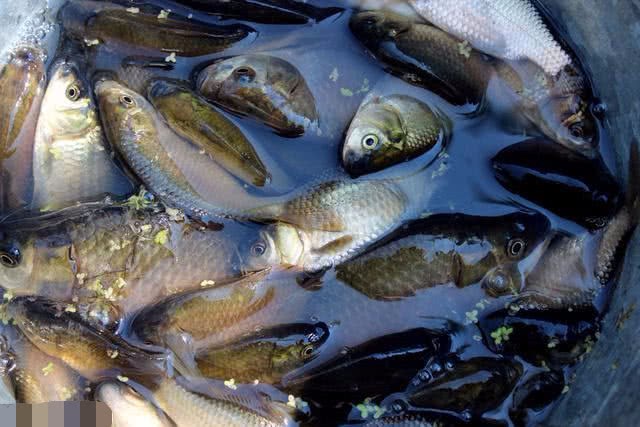
Because of differences in their living environment, wild crucian carp and farmed crucian carp show fairly obvious differences in body shape, appearance, internal parts, flesh quality and other aspects. In terms of body shape, in size the wild crucian carp tends to be small, and generally there will not be very large ones, while farmed crucian carp have abundant fish food and are generally larger. Because the wild crucian carp swims constantly searching for food, the fin on its back is also higher than that of the farmed crucian carp, and its tail is also fairly wide, so the whole back looks high and protruding. Farmed crucian carp have relatively abundant food, so their body shape is more plump, and there is more fat inside the belly, while the wild crucian carp has a relatively slender body shape with almost no fat inside.
Crucian carp
Identifying by appearance
There are differences in color between wild crucian carp and farmed crucian carp. The body of the wild crucian carp is yellowish and glossy in color. The farmed crucian carp is black all over, with a heavier color. The gills of the two are also different: the gills of the wild crucian carp are relatively clean, while the gills of the farmed crucian carp will have mud stuck to them or be darker in color, especially since there are more fish intestines and filth inside the belly.
Identifying by flesh quality
The wild crucian carp both searches for food and avoids natural enemies, so its activity level is very high. In terms of feel, the flesh of the wild crucian carp seems firmer, while the farmed crucian carp has a lower activity level and does not need to search for food, and what it eats is some artificially processed fish feed, so its flesh is relatively softer and lacks the firmness of the wild kind.
Home cooking, mother's skill.
In fact, the most practical way to identify wild crucian carp is still from relatively intuitive aspects such as appearance and body shape, identifying from the fish's color, body shape and the feel of the flesh. If you buy it and cut it open before identifying it, then it seems there is not much point. There must be other relatively intuitive methods for identifying wild crucian carp as well; you are welcome to leave a message and exchange ideas.
This is Science Promoting Agriculture; you are welcome to follow, and I will take you along to grow your knowledge.