The wild grass by the roadside looks unremarkable, but its roots can sell for 20 yuan per jin, and it is often pulled up as a weed.
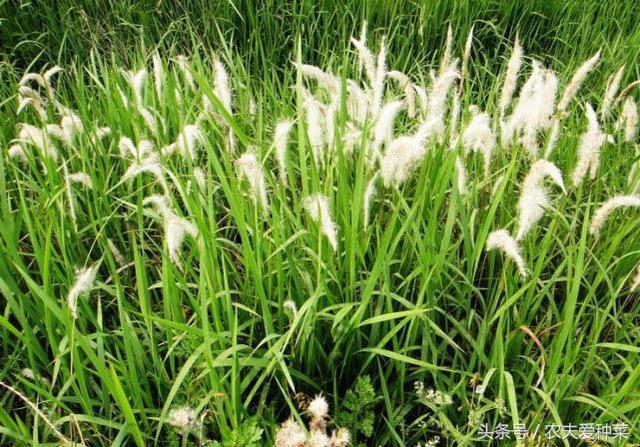
In our hometown, there is a kind of weed whose flowers look like dog's tails. We call it silk thatch grass. It is one of the weeds farmers hate, because it grows fast and often spreads over a large area, harming crops, so as long as it grows by the field edge or in the field, it will be removed.
But the silk thatch grass growing on the hillsides is a little snack and toy for rural children. When the tender young flower spikes of the silk thatch grass have not yet opened, we call them maozhen, and they can be eaten as a snack. When its inflorescence grows old and opens, from a distance patch after patch looks like snow, very beautiful, and it can also be pulled out to weave hats for fun.
It is this rather unappealing wild weed whose root is actually a Chinese medicinal herb called baimaogen (cogon grass root). It has good effects on acute nephritis, vomiting, cough and so on. This cogon grass root is roughly dug up in autumn and winter. Fresh, it looks a bit like fish mint root, and after being dried in the sun it can sell for about 20 yuan per jin.
The prospects for cultivated baimaogen are still very good. It has strong adaptability and is not picky about soil. As long as the soil is not too clayey or too sandy, it can be planted. It is very tolerant of poor soil. It can be planted in places like ordinary roadsides, parks, lakesides or lawns, and it grows quickly.
Baimaogen is a plant that very much likes moisture but is also very tolerant of drought. You can see that in rural areas a lot of baimaogen loves to grow in moist places, and it loves to grow along riverbanks and field ridges, often spreading over a large area at once.
Planting baimaogen is relatively easy. The soil should mainly be kept moist, but at the same time too much water and moisture that rots the roots should be avoided. Sometimes a period of drought is no problem for it either. In addition, it is also very shade-tolerant, so appropriate light is enough.