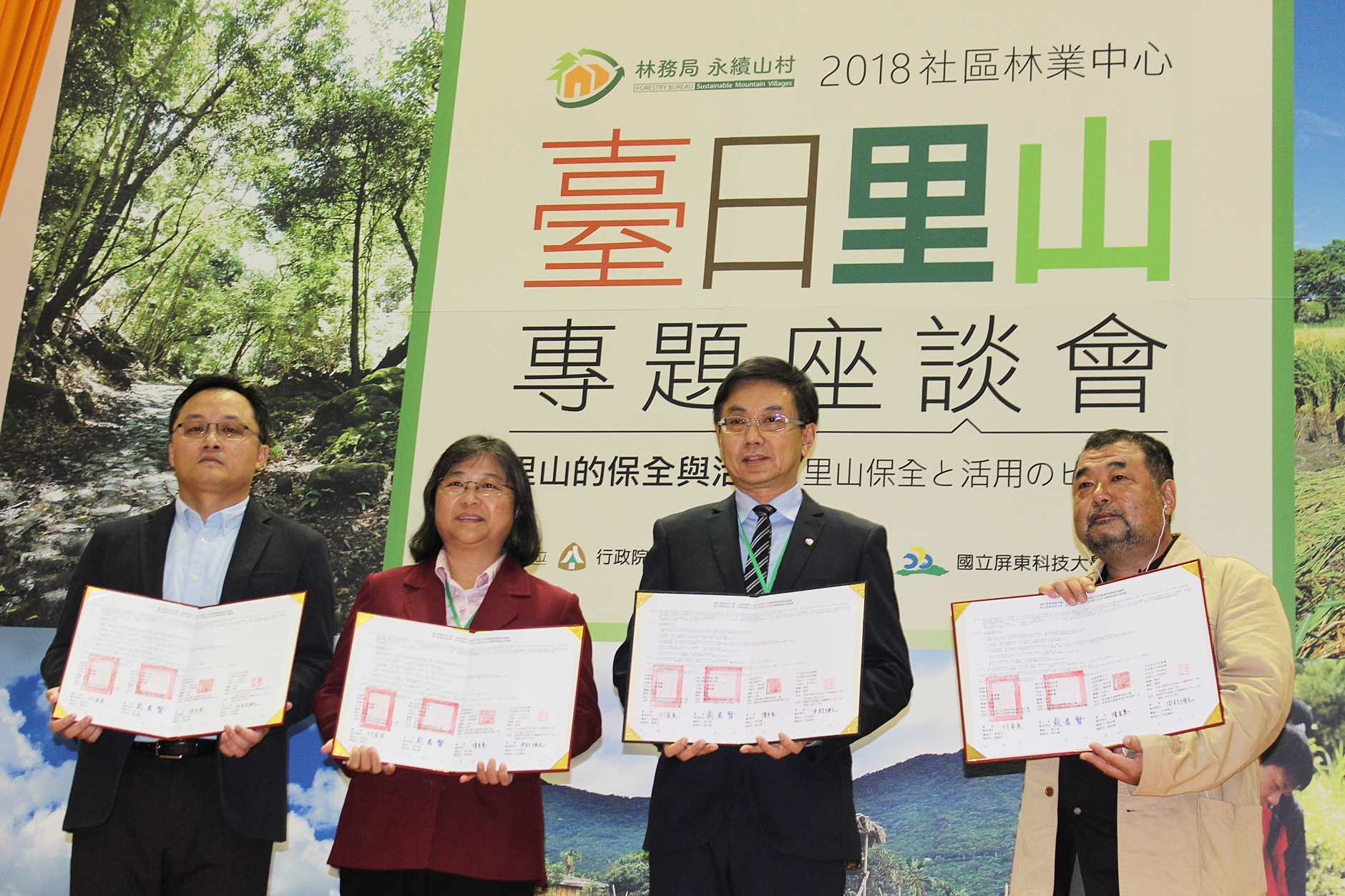
Taiwan and Japan sign a Satoyama strategy alliance agreement, inviting craftspeople, youth and residents to participate
To promote cross-national approaches to preserving and making use of satoyama, the Forestry Bureau and the Department of Forestry at NPUST co-hosted the "Taiwan-Japan Satoyama Symposium" on the 18th, inviting eight Japanese business operators, practitioners and returning youth who have long been involved in satoyama issues to come to Taiwan and share Japan's experience in promoting satoyama. The cases included using botanical gardens for ecotourism and environmental education, exploring how forests and deer can coexist, revitalizing mountain village economies by organizing craftspeople, and creating creative shared spaces to attract young people to return, among other fascinating examples.
At the meeting, the two sides also signed a strategy alliance agreement, hoping to increase opportunities for future exchanges. Nakamura Nobuyuki, representative of the Japanese delegation, said that he saw how Taiwan's community forestry makes use of satoyama resources to build an economic environment of shared prosperity between satoyama and surrounding settlements, attracting urban people to take part in satoyama activities and then purchase satoyama products. This not only lets outsiders experience local culture but can also create community income. These are all extremely valuable achievements, and he looks forward to the two sides continuing to discuss concrete ways to promote satoyama.
Did you know: "Satoyama" in Japanese refers to a mixed landscape located between high mountains and plains, encompassing communities, forests and agriculture. It is also a complex ecosystem combining human survival, economic production and the natural environment. The Satoyama Initiative aims to improve existing mixed landscapes that have been overdeveloped or left desolate, creating a sustainable management model that balances life, production and ecology, and realizing the ideal of harmonious coexistence between society and nature.