Sharing the complete production process of the award-winning aquascaping contest work "Spring"
Reposted from Baijiahao: Fishing Old Zhang
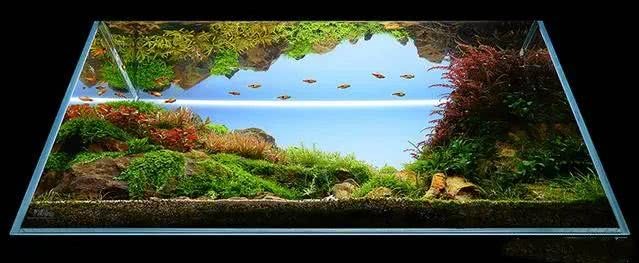
IIAC Aquatic Plant Aquascaping Contest, ranked 21st, work 'Spring'.
Equipment introduction:
Aquarium: Yi Ding 90x45x45 ultra-clear tank
Lighting: Zhonglan multi-spectrum LED lights x2 (lights on 12H daily)
Filtration equipment: Yi Er MK800 canister filter, CAL Efflux F3 glass outlet pipe, VIV glass surface skimmer
CO2 equipment: ISTA high-pressure aluminum cylinder, ISTA single-gauge solenoid valve, ISTA turbo high-efficiency CO2 diffuser (CO2 on/off with lights)
Temperature control equipment: ISTA 300W external heater
Materials introduction:
Silica sand substrate (with buried root fertilizer), stone is shale.
Aquatic plants introduction: New Large Pearl Grass (Hemianthus micranthemoides), African Red Willow (Ludwigia inclinata), Red Ludwigia (Ludwigia palustris), Java Moss, Petite Anubias (Anubias barteri var. nana 'Petite'), Pearl Grass (Hemianthus micranthemoides), Green Rotala (Rotala rotundifolia 'Green'), Scarab (Bucephalandra), Needle-leaf Crown (Pogostemon helferi).
Fish introduction: Golden Triangle Tetra (Trigonnectes heteromorpha), Three-color Mickey Mouse Platy.
Algae-eating organisms: Amano shrimp, Long-nosed shrimp (Caridina gracilirostris), Black shell shrimp (Neocaridina davidi), Siamese Algae Eater, Otocinclus.
Fertilizer: ISTA Red Enhancing aquatic plant liquid fertilizer, TBS root fertilizer tablets
The initial composition inspiration for this work came from a photo of the East Rift Valley online. I hoped to strengthen the sense of depth in the entire scene, so I deliberately arranged a foreground effect on the right side first, and then used the arrangement of materials and aquatic plants on the left side to gradually extend the scene toward the middle and back, enhancing the visual depth.
At the beginning, there was a small problem with the stone arrangement. The right side needed taller stones to express the foreground, preferably with the stone height close to the water surface, to strengthen the feeling of 'closeness.' But at that moment I found I didn't have stones of sufficient size on hand. What to do?
No problem, just stack stones, stack them to sufficient height, and then use appropriate aquatic plant arrangements to cover up the traces of 'stacking.'
Look at the Green Rotala and Needle-leaf Crown just purchased at this time - they are all emersed leaves, but the forum moderator never cares about this, because they will quickly convert to submersed leaves on their own.
The Scarab (Bucephalandra) in the right foreground was glued on using ISTA gel instant adhesive.
Although no sketch was drawn at the beginning of this work, after referencing the photo I already had a clear idea in mind about the future aquatic plant layout and development direction. So I used PS to first draw a reference image, using this image to check whether the aquatic plants and stones were coordinated, and whether adjustments were needed.
Actually, from this image you can see that I really hoped the aquatic plants could display vivid colors - red, yellow, green, and even coffee brown - to make the entire aquascape more colorful. So initially I used three Zhonglan multi-spectrum LED lights to create a strong light environment.
One month after setting up the tank, the aquatic plants all grew smoothly as expected, and I didn't encounter any algae problems. Because this is a contest work, in order to avoid an algae outbreak affecting the entire progress, I still adopted a conservative fertilization strategy. During the initial period when the root fertilizer was still effective, I temporarily didn't add liquid fertilizer. Only about one month after setting up the tank did I gradually begin adding liquid fertilizer.
(The above image is a demonstration aquascape from the IIAC Aquatic Plant Aquascaping Special Training Practical Lecture)
During this period I attended an aquascaping practical lecture, where the expression of naturalness was mentioned. At this point I began to hesitate about whether this work should continue to maintain the vivid color style. Should the Red Ludwigia display bright red? Or would a more natural orange-red be better? Should the Needle-leaf Crown be red or green?
The struggle~~
Two months after setup.... Huh? Why does it look about the same as one month ago? Actually, the aquatic plant layout of this scene could only develop toward 'density,' not toward 'height.' Even stem plants couldn't be allowed to grow too tall, otherwise they would excessively block the background stones and lose the sense of layering.
So stem plants must be trimmed more diligently, and you absolutely must not wait until they reach the water surface before trimming.
Additionally, to make the Needle-leaf Crown in the foreground appear lower, I cut off all the leaves and let them all regrow. This way the newly grown leaves would also be lower in height, better fitting the needs of this scene.
But the key point to look at here is actually not that - it's the Pearl Grass in the left background! These Pearl Grass plants were just glued on....
For Pearl Grass, I think most hobbyists would choose to plant it into the substrate, but it can actually also be glued onto hardscape using instant adhesive. Even if the roots are not planted in the substrate, as long as there is an appropriate supply of liquid fertilizer for nutrients, it can still maintain good plant condition. (This work used ISTA Red Enhancing aquatic plant liquid fertilizer entirely after one month of setup.)
The reason Pearl Grass was only glued on now is because it grows very quickly. If it were planted right when the tank was set up, its progress would far outpace the other aquatic plants, making it difficult to reach the ideal state at the same time for photographing the final image. So I decided to plant it one month before the final photo.
This is a predicted final image drawn using PS software. At this point I began arranging small details - for example, the Pearl Grass in the background was planned to be trimmed into the slope shown in the image, and smaller triangular stones were arranged within the Pearl Grass to make the background scenery appear more 'distant.'
Coincidentally, the Red Ludwigia in the left scene of this PS image was from a previous photo, and at that time these Red Ludwigia couldn't appear bright red because they were shaded. But using them in this image felt more natural, and seemed more suitable for this work. So I immediately decided to remove one of the Zhonglan multi-spectrum LED lights, keeping only two lights to reduce light intensity, hoping the Red Ludwigia would subsequently turn to a less red orange-red.
But man proposes and heaven disposes. I originally expected to photograph the final image in three months, but unfortunately at that time I happened to go abroad for a trip.... No, I went abroad to watch a transvestite show, and actually missed a great opportunity to photograph the final image. I had no choice but to trim the stem plants again and wait for the next opportunity.
Although the final photo was delayed, it wasn't entirely a bad thing. The extra trimming of the stem plants actually increased their density once more, and the aquatic plants would look more lush.
Only a few days before photographing the final image did I begin arranging the central river channel. Although slightly last-minute, it saved quite a bit of maintenance trouble.
Although the schedule was slightly delayed, fortunately the final result was quite satisfying, and the final image photography went very smoothly. The main credit for this goes to the Golden Triangle Tetras that are superb at schooling.
I wonder if readers noticed the corner in the left background? Generally, aquarium corners have a white (or black) silicone reflection, but the Yi Ding 45-degree bonded surface completely shows no silicone. It photographs like a transparent piece of glass, unexpectedly beautiful.
Fortunately this work gained the favor of the IIAC judges, ranking 21st among 803 entries.
Off-topic: Actually, naming aquatic plant aquascaping works is an annoying task. I'm very lazy in this regard, and always just randomly find names to fill in - like WISH and FOCUS have both been used. The most commonly used one is this character 'Spring.'
No matter what style the work is, I can call it Spring. This name has no sense of incongruity in aquatic plant works, so every year there's a Spring once - no, I mean every year there's one work called Spring. This year is no exception. Maybe next year I'll still continue to call it Spring.....
There's also a surprise here