Black spots on orchids are mostly anthracnose, and there are two main underlying causes
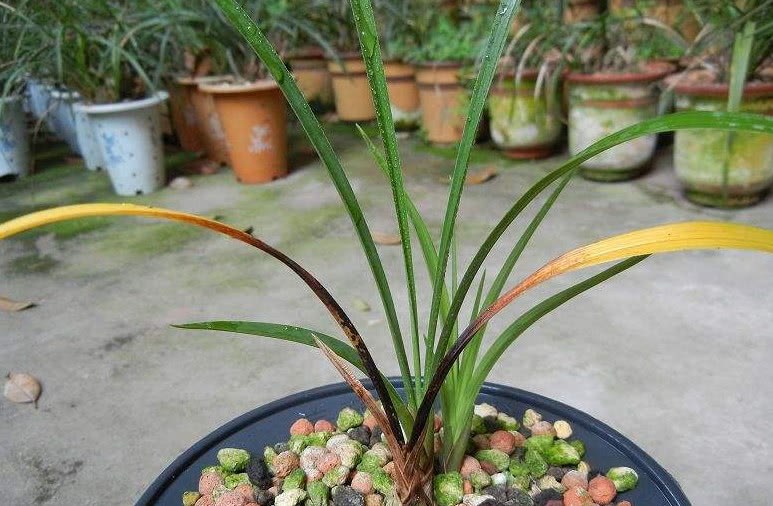
Recently, quite a few orchid growers have been asking about orchid black spot disease. Black spots on orchid leaves are a sign that the orchid has been infected by a virus, meaning the virus has invaded the orchid's interior. If growers do not take the spread seriously and control it, it will harm the orchid's growth. Black spots mostly appear in summer and autumn, in the hot, rainy, stuffy and windy-free season.
There are many causes of black spots. For example, long-term insufficient watering and air that is too dry will cause the roots to shrink and wrinkle, weakening their ability to absorb water and nutrients, resulting in an insufficient supply of nutrients, which in turn causes the leaf surface to turn yellow or the leaf tips to scorch. Also, orchid pots should be placed with proper spacing so that air can circulate. If the air does not circulate, orchids are also prone to developing black spots.
Secondly, orchids should be given light fertilizer, not heavy fertilizer or raw fertilizer. If fertilizer is applied too heavily in one go, especially excessive application of chemical fertilizer, it often damages the roots and then causes black spots.
When orchids develop black spots, it is mostly anthracnose, and there are two main underlying causes:
(1) The orchid seedlings are not growing vigorously enough, and the seedlings' resistance is relatively weak. The root cause is still that the growing medium is not ideal, so the orchid roots do not grow well; you still need to work on the growing medium. Poor roots lead to black spots on the leaves.
(2) The orchid is exposed to strong sunlight at relatively high temperatures, or the environment is relatively stuffy and hot. After the temperature exceeds 28°C, orchids should be shaded;
At the same time, during hot weather, the environment should be ventilated; never let a stuffy, hot condition occur. The key is still to improve the cultivation conditions.
When necessary, you can spray an 800-fold dilution of Shibaogong (mepanipyrim) or Shigao.
Thank you for reading the article. If you find it helpful, you are welcome to follow and share it. This article comes from an original submission by Yumi Orchids; for reprints, please contact the Yumi Orchids official account!