Reasons why orchid lovers get cheated when buying orchids at the orchid wholesale market: 3 things they failed to check
Nowadays, more and more flower enthusiasts have fallen in love with growing orchids. As the saying goes, growing flowers is not as good as growing orchids - the benefits of growing orchids! Orchids can calm the mind. In fact, growing flowers is all about mood. If you have a hot temper, growing orchids will make you much more peaceful!
In the past, we all bought orchids at the orchid wholesale market, and quite a few orchid lovers cried foul. Not only were the prices high, but many orchids were hard to keep alive after being brought home. The orchid market is a mixed bag, especially when it comes to some rare and precious orchids - many vendors pass off inferior goods as the real thing, making it hard for most orchid growers to tell them apart.
Today, the author will teach you how to buy good orchids. Generally, orchids are bought at flower shops or on online platforms, and few people go directly to the orchid wholesale market to buy them. So how should you choose good orchids? You should choose based on the following aspects.
1. If it is the flowering season for orchids, this is generally the peak sales season, and orchid prices will be somewhat on the high side. As an amateur enthusiast, just pursue something clear and elegant - a good-looking flower shape and a faint fragrance are enough. There is no need to chase after famous varieties, because the more precious the orchid, the harder it is to grow. To be honest, a precious orchid is not necessarily better looking than an ordinary one; it is expensive only because it is rare.
2. There is a famous saying about buying orchids: better to have one strong seedling than two weak ones. Look at the total number of leaves, leaf width and leaf length. Orchid leaves grow once and last a lifetime. After an orchid sprouts and the whole plant's leaves have opened, no new leaves will grow from the center of the plant. These few leaves are the orchid's lifelong leaves, so the more leaves, the better. A healthy orchid will grow stronger with each generation. Once it reaches a certain level of strength, it stays that way permanently.
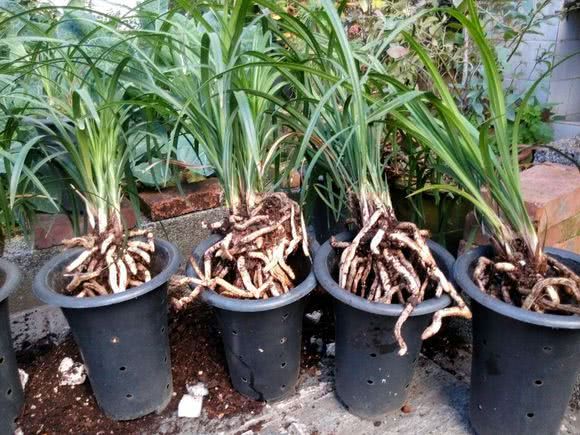
3. Look at the roots, look at the roots, look at the roots - important things must be said three times - you must look at the orchid roots. Naturally grown orchid roots are thick and sturdy, spread out, with thick root skin and obvious crystal tips. This kind of root has strong resistance, and after transplanting, the seedling recovers quickly. Greenhouse-grown orchid roots clump together, hold a lot of water, have thin root skin, basically no crystal tips, and slender root tips. This kind of root takes a relatively long time to recover and does not adapt to the pot easily.
Tissue-cultured orchid roots are delicate and short. Because this kind of root is cultivated under constant temperature and sterile conditions, it has poor resistance and needs technical hardening before it can adapt to the environment. Hormone-treated orchid roots show, first, severe branching; second, uneven thickness; and third, an oversized root system. Once the environment changes, this kind of root has a high chance of developing disease, and most will show symptoms such as shrinking and drying up, or root rot in the orchid seedlings.
Thank you for reading the article. If you find it helpful, you are welcome to follow and share it. This article comes from an original submission by Yumi Orchids. For reprints, please contact the Yumi Orchids official account!