A Detailed Guide to the Quick Landscape Method for the Lazy Aquarium Plant Tank
Times change rapidly, and the influence of aquascaping grows ever greater. More and more aquatic plant enthusiasts are entering the aquascaping field, and home fish tanks have gone from casual, improvised keeping to proper aquascaping.
The materials for aquascaping are diverse, and among them the most popular with lazy hobbyists is the plant ball.
Plant balls simplify the tedious planting process. There is no need to plant them one by one or clump by clump; you simply place the whole ball in, positioning it according to the height of the aquatic plants and the aquascaping layout, achieving the effect of an instant landscape as soon as it enters the tank.
Therefore, if you want an instant landscape, submerged-leaf plant balls are undoubtedly a very good choice.
The Advantages of Plant Balls
Why using plant balls for aquascaping is adopted by so many fish keepers comes down fundamentally to one word: "efficiency."
Because plant balls are grown semi-emersed, they grow fast and have well-developed root systems, propagating faster than ordinary emersed leaves and transitioning to underwater growth more quickly too. Usually, a traditionally planted medium-to-large plant tank needs 3-5 months to achieve a landscape, but plant balls take only 1 month or a little over a month (of course, the specific time to achieve the landscape varies from person to person, such as different tank sizes, different water quality, different maintenance levels and so on, but in any case it is much faster). Small tanks can even be completely covered and grow a first layer of carpet within 3 weeks.
In addition, because the aquatic plants' root systems are well developed and have already burrowed into the substrate, during the propagation process they avoid the disturbance of creatures turning them over or even the trouble of needing to replant.
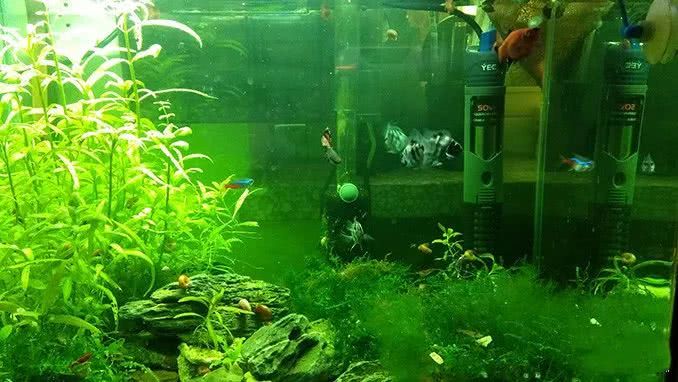
First, let me post a few before-and-after comparison photos of my fish tank with plant balls. The improvement in the aquascaping effect is very obvious, and the fish swimming among the plants look very pleasing to the eye. In the latter half of the article, I will discuss the names and characteristics of various plant balls for everyone's reference. The plant balls I bought include: green varieties such as creeping dwarf pearlweed, green Newton, and red varieties such as large red leaf and red wave. I got more green ones, then paired them with some red aquatic plants, which can produce a finishing touch effect in the aquascape.
Before adding the plant balls, it looked monotonous and messy
Then the plant balls I bought include: green varieties such as creeping dwarf pearlweed, green Newton, and red varieties such as large red leaf and red wave. I got more green ones, then paired them with some red aquatic plants, which can produce a finishing touch effect in the aquascape.
Now look at the next few photos after the plant balls were added:
After adding the plant balls, isn't it very pleasing to the eye? :)
Tips for Placing Plant Balls
Creeping types, plant balls that can spread horizontally, can be placed in high spots, so that they trail downward as they grow, creating a distinctive scenery.
Pair the same or similar types front and back, high and low, to create a sense of layering. And red plant balls placed at the golden ratio point of the fish tank have a better effect.
Two Planting Methods for Plant Balls
The first is to simply place the plant ball on the substrate, rocks or driftwood. The advantage is that it is flexible enough, and you can see creeping-type plant balls spreading downward along the slope as they grow.
The second is to bury the substrate into the bottom bed, with the plants exposed above the bottom bed (mud). The two planting methods have no connection at all with the quality of the substrate or the quality of the aquatic plants; it is entirely a matter of aquascaping habit.
The first is more time-saving and faster, but usually requires a greater number of plant balls, and after being laid on the bottom bed and achieving the landscape it will look slightly bumpy; the second produces a smooth, more refined carpet landscape, and creeping-type plant balls creep, propagate and achieve the landscape faster.
There is also a surprise here