The root-as-trunk style of bonsai has a uniquely striking artistic form
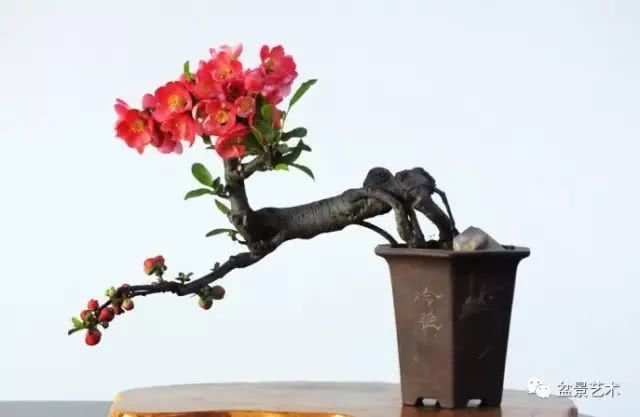
Although plants such as Chinese wolfberry (Lycium chinense) and winter jasmine (Jasminum nudiflorum) have many branches, the branches are slender rather than thick and sturdy, and there is no obvious main trunk, yet their roots are twisted and full of variety, quaint and unusual. In addition, the roots of some miscellaneous tree stumps such as Vitex negundo and water willow are simple and unusual, but the trunks are straight and lack grace. When making bonsai from these plants, you can use the "root-as-trunk" method, lifting their roots out of the soil to replace the trunk.
The difference between root-as-trunk style bonsai and exposed-root style bonsai is: exposed-root style bonsai lifts the roots while retaining the original trunk, making the roots hang and the claws show, without changing the form of the roots, which serve only as a part of the viewing subject; whereas in root-as-trunk style bonsai, the trunk is completely replaced by the tree roots, and the ornamental form of the roots no longer exists, appearing instead in the form of a trunk.
For root-as-trunk style bonsai, the stump material used should be chosen from those tree stumps whose roots have the form of a trunk; the requirements for the branches are not very strict. The planting time can vary according to the tree species, generally mostly in winter and spring, with the highest survival rate especially before bud break in spring. Before planting, the stump material must be pruned and shaped: cut off unwanted branches, appropriately shorten overly long branches, but retain relatively thick branches for future shaping needs, and prune the tree roots, then plant into a clay pot to grow the rough material.
Because the roots of Chinese wolfberry are thick at the top and thin at the bottom, lifting the roots would violate the natural rule of trees being thick at the bottom and thin at the top, so it can be planted upside down, and it also survives easily, but its growth is weaker. The tree stump should be planted deep, preferably with the entire root system buried in the soil; if the flower pot is not deep enough, you can roll felt into a tube and fit it into the flower pot, then fill with soil, to increase the height of the potting soil. When planting, the soil must be pressed firm and watered thoroughly.
When the weather is cold, cover with a transparent plastic bag for cold protection and warmth retention; place the newly planted specimen in a wind-sheltered, sunny spot for care, keeping the potting soil moist but not waterlogged, and remove the plastic bag once it is well established. When the plant is growing vigorously, apply some decomposed dilute liquid fertilizer; the branches can be allowed to grow freely, so that through leaf photosynthesis more nutrients are produced, making the tree stump grow vigorously with a well-developed root system.
After leaf fall in winter, cut off the excess branches of tree stumps such as winter jasmine and Vitex negundo, and shorten overly long branches. Chinese wolfberry, however, should be pruned only when spring is about to bring bud break, otherwise it will cause branch dieback (that is, the pruned branches wither and die). During care, part of the potting soil should be gradually removed to prepare for later root lifting.
Root lifting for root-as-trunk style bonsai should be carried out gradually and in stages; do not rush, lest too many fine roots be exposed and the plant die. Its shaping can be made into various different forms of bonsai according to the specific form of the tree roots. In the first year after the finished bonsai is moved into a fine pot, it should be planted in not very fertile soil, so that it adapts to the new environment and survival is ensured. Then when repotting in the second spring, plant it in relatively fertile soil. After that, normal management can be carried out according to the different habits of the tree species.