Detailed Guide to the Making of Malus halliana Bonsai: Methods and Steps
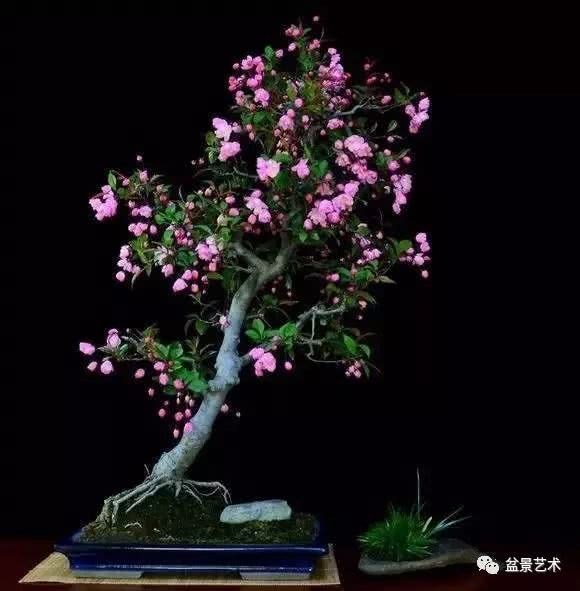
(1) Botanical Knowledge
Belongs to the Rosaceae family, genus Malus. A deciduous small tree with a graceful, spreading form and purple young branches. Leaves ovate or elliptical, with fine blunt serrations along the margins. Flowers bloom between March and April, clustered in groups of 4-7, with purple pedicels that are slender and drooping; the flowers are bright red, as gorgeous as rosy clouds, and charmingly graceful. The fruit is small, spherical, 6-8 mm in diameter, turning purplish-red when ripe.
Main Varieties
1. Double-flowered Malus halliana: flowers red or pink, double-petaled.
2. White-flowered Malus halliana: flowers smaller, pale pink or nearly white, with shorter pedicels.
Related species: Malus micromalus, also known as small-fruited crabapple. A small tree with an upright form and purplish-brown branchlets. Leaves long-elliptical, with fine pointed serrations, rather firm in texture and glossy on the surface. Flowers pale red, double-petaled, with pedicels that do not droop and bear soft hairs. The form with deeper color and more petals is called "Zimian" and is a precious ornamental variety.
Malus halliana is produced in Jiangsu, Zhejiang, Anhui, Hubei, Shaanxi, Sichuan, Yunnan and other provinces and regions. Lines such as "The skies of Shu are warm and genial, a land suited to rare blossoms" and "A thousand li of Min and Shu land, yet the crabapple alone blooms in beauty" all praise the abundance of crabapple in Sichuan. Malus micromalus is relatively cold-hardy and can be distributed as far as the North China region.
It prefers light and does not tolerate shade; it likes a warm, humid climate. A deep, fertile neutral loam is ideal, though it can also adapt to calcareous soil, slightly acidic or slightly alkaline soil. It is drought-tolerant but not waterlogging-tolerant; even slightly prolonged waterlogging easily causes root rot. It has strong suckering ability.
(2) Material Collection and Propagation Measures
Artificial propagation: Mainly by sowing and grafting, though root cuttings, division or layering can also be used. Seedling plants grown from seed flower relatively late, generally requiring seven or eight years to bloom, and they cannot retain the fine characteristics of the original variety, so grafting is usually adopted for propagation. Grafting mostly uses seedlings of wild crabapple (Malus hupehensis) or Malus baccata as rootstock, with cut grafting performed in March. For bonsai grafting, it is best to graft as low as possible. Select excellent varieties for the scion, taking the middle section of a vigorous, well-developed one-year-old branch with 2 plump buds; if the scion collected beforehand is not used immediately, it can be stored buried in moist sand. For cut grafting, cut off the rootstock 3-5 cm above ground level, make a gentle upward slanting cut from one side of the cut surface, then from the cambium at the slanting cut near the shoulder, cut downward about 1.5 cm with a little wood attached, keeping it vertical and not skewed; then on one side of the lower part of the scion make a vertical cut about 2 cm deep with a little wood attached, and on the opposite side make a steep slanting cut. Insert this scion into the cut of the rootstock so that the cambium of the rootstock and scion are tightly joined. Bind the joint firmly with plastic film strips, water thoroughly at the roots, and provide shade. This grafting method has a high survival rate, and the joint heals easily. After successful grafting, new branches emerge, and with proper management they can reach 80-100 cm in height the same year. In winter, cut off the tip and keep 3-5 main branches to encourage branching. In the second winter, cut off the tips of the main branches again to develop the scaffold branches, thus forming a neat tree shape conducive to flowering. Bud grafting is carried out in June-July and also has a relatively high survival rate. Root cutting propagation is done in spring from February to March; select tender roots within 1 cm in diameter and 6-7 cm long, insert them to a depth of more than 2-3, with the tip allowed to protrude above the ground; a loose, fertile, well-drained sandy loam is ideal, and survival is relatively easy. Division planting using crabapple root suckers is also possible and can advance flowering.
(3) Potting Process
Pot selection: For Malus halliana, use a medium-deep round, rectangular or square pot, preferably made of purple clay pottery or glazed pottery. The color and form of the pot must harmonize with the tree shape and flower color of the crabapple.
Soil: Crabapple rather likes fertilizer, so fertile, loose leaf mold or garden soil mixed with an appropriate amount of sand and rice husk ash is suitable. It can grow in slightly acidic or slightly alkaline soil.
Planting: It is best done in early spring, though late autumn is also acceptable. When planting in a pot, place decomposed soybean cake and bone meal at the bottom of the pot as base fertilizer.
(4) Shaping Techniques
Processing: For Malus halliana, palm fiber is suitable for bending and binding, combined with pruning for styling. However, care must be taken to remove the palm fiber in time, otherwise it easily causes "wire bite" and affects both appearance and tree growth. Processing is best done during the dormant period, or after flowering.
Tree forms: Malus halliana bonsai is suitable for slanting-trunk, curved-trunk and cascade styles, etc. The branches and trunk should be upright, elegant and well-extended, with attention to appropriate sparseness and density so as to promote abundant flowering branches, delicate and colorful flowers, and enhanced ornamental effect.