How to Pair Bonsai with Stands? A Full Analysis of the Spatial Relationship
People who love flowers, trees and bonsai are people of refined taste!
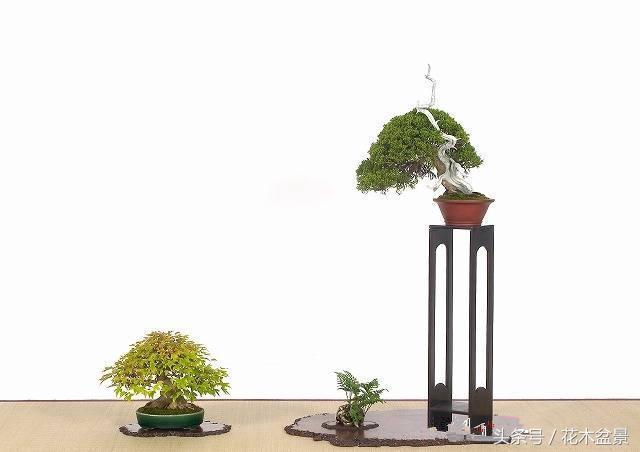
Traditional Chinese bonsai follows the aesthetic formula of "first the scene, second the pot, third the stand." The stand plays an indispensable role in the appreciation of bonsai, and its modeling form and spatial dimensions are very important for enhancing the appreciation effect of bonsai. Traditional Chinese painting is generally mounted, and mounting is a highly skilled craft, while the stand is also a kind of traditional arts and crafts with independent aesthetic value. However, in the display and appreciation of bonsai, the stand must match the bonsai, otherwise it will not only fail to set it off but may even have the opposite effect.
The stand is a product of interior decoration, usually displayed together with furniture. Its styles fall into two major categories: "Ming style" and "Qing style." "Ming style" refers to Ming dynasty furniture, which occupies an important position in Chinese arts and crafts, with a concise and lively form, smooth lines and elegant colors, possessing extremely high aesthetic value. "Qing style" refers to Qing dynasty furniture, known for its complex and elaborate carved decoration, with winding and varied lines, and colors dominated by bright gold and rice-red, possessing a royal air. In modern times, stands used for displaying bonsai are the result of the "green revolution" and a fashion of beautifying modern urban homes.
The Spatial Composition of the Stand
"Stand" is the general term for "ji" and "jia." Ji includes tea tables, long tables, scroll tables, square tables, round tables, corner tables, etc.; jia includes tall-legged stands, nested stands (high-low connected stands), floor stands, window stands, bookshelves, tree-root stands, curio shelves (many-treasure shelves), etc. The various stands produced by factories are mostly designed for displaying all kinds of antiques, curious stones, vases, artworks and so on indoors and in halls. To be used for bonsai display, they need to be specially designed according to the volume and formal characteristics of the bonsai. Large bonsai are generally displayed outdoors, mostly on stands made of stone or cement. Small and medium-sized bonsai generally follow the principle of "square with square," "round with round," emphasizing unity in appearance. The size of the flat surface space of the stand should be determined by the size of the pot's base feet; generally the stand should extend several centimeters beyond the pot bottom on all sides, leaving space like the design of newspapers and books, and it must not be filled completely. This is a rule of formal beauty and also a habit of people's aesthetic appreciation.
The Peripheral Composition of the Stand
As arts and crafts, stands have both practical and aesthetic functions, three functions in two aspects. A stand used for displaying bonsai should be mainly practical, so the peripheral design of the ji should preferably use concise, smooth lines and crisp flat surfaces, avoiding border carvings as much as possible, especially complicated openwork floral patterns. If the patterns around the stand are too complex and too ornate, it will affect the appreciation effect of the bonsai.
The Leg Composition of the Stand
As a craft, the design of a stand's legs is often rather complicated, such as dragon-claw and tiger-foot types; this is a common traditional form. When a stand is used to display bonsai, the leg design is best done with straight lines or inward-curving lines, generally not using outward-splayed forms, and all superfluous decoration can be dispensed with entirely.
The Frame-Openings Composition of the Curio Shelf
The curio shelf is used to display miniature bonsai, and the design of its frame openings emphasizes variety within unity. They are generally mostly square and rectangular, not using round, triangular, fan-shaped or prismatic forms. These forms are beautiful when viewed alone, but once bonsai are displayed, it becomes very difficult to handle the spatial relationships, because each frame opening is a three-dimensional painting. If a "?"-shaped frame opening is used, the space after the bonsai is displayed within it will not be visually comfortable, and it is not easy to make the bonsai stable. The outer frame design of the curio shelf is also best done with smooth lines, without other decorations.
The Color Composition of the Stand
Traditional stands mostly use redwood, nanmu and rosewood, and their colors are all the natural color of the wood. The added colors are also mostly quiet, deep and heavy dark red, and dazzling golden splendor and bright colors must not be used. Bonsai differs from painting; its colors are purely natural. Therefore, whether pot or stand, it is best to also use natural colors. If artificial color needs to be added, it is best to unify it with the bonsai as much as possible.
Pairing Bonsai with Stands
Pairing bonsai with stands. The pairing of bonsai and stands should be considered from the following aspects. First is the shape of the stand. In principle, a perfectly round pot should be paired with a perfectly round stand, a rectangular pot with a rectangular stand, and an irregular pot with an irregular stand. Of course, a perfectly round pot can also be paired with a square stand, and an oval pot can be paired with a rectangular stand. But the decorative effect is far from as good as the former pairing of the same shape.
Second is the height and size of the bonsai stand. From the perspective of decorative aesthetics, in principle the height of the stand should be slightly higher than the bonsai by 10% to 15%. The height and size of the stand should most avoid being equal to the bonsai pot. For small and medium-sized bonsai, the stand should be higher than 2/3 of the pot or be 2/3 of the pot. For large bonsai, the stand is usually lower than 2/3 of the bonsai pot.
Finally is the decorative color and manufacturing craft of the stand. The stand paired with a bonsai should be both steady and dignified, and also beautiful. Generally speaking, the color of the stand should be deeper than the bonsai pot. Usually, to highlight the colors of the bonsai, colors, styles, textures and crafts with greater contrast can also be used. Ultimately, the choice of the stand should depend on the overall appreciation effect of the bonsai, and at the same time one should fully consider one's personal economic conditions. For larger bonsai that are difficult to match and also inconvenient to transport, a stand is usually not provided.
For more information on bonsai, flowers and plants, and orchids, please follow the WeChat public accounts: Huamu Penjing, Yanghua Renjia, Zhilan!