Never keep these 11 toxic plants at home, or they may affect your health
Growing plants at home brings a great many benefits. They are not only excellent decorative plants, but can also improve the environment, absorb common indoor harmful pollutants, and increase indoor oxygen levels, all of which are very good for people's health.
But some plants are toxic. Their branches, leaves, flowers, fruits or sap can be poisonous, so extra care is needed when caring for them. This is especially true for households with children or pets, who must be kept from touching them carelessly. The following toxic plants are best avoided.
1. Oleander
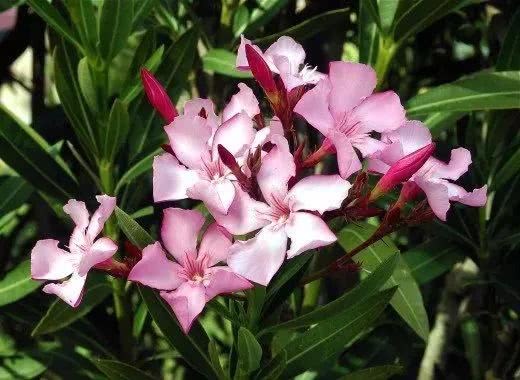
Oleander is the most common toxic plant. It is a very charming landscape flowering plant that will keep blooming year-round when grown in a sunny spot. It has very bright, attractive flowers, with the most common varieties being pink, white and yellow.
The leaves, branches and sap of oleander are all toxic, so children must be kept from touching it, and above all from accidentally eating it.
2. Caladium
Caladium has very gorgeous leaves with variegated patterns, and it is well suited to being planted in shady spots. It has very low light requirements and prefers a warm, humid environment year-round.
It is very suitable as a landscape plant and has a good air-purifying effect, but it should be kept from being grown indoors. Its sap is toxic, and accidental ingestion can easily lead to poisoning.
3. Dieffenbachia
Dieffenbachia is also called the dumb cane, meaning that after accidental ingestion it easily causes swelling and pain in the throat, and in severe cases can lead to becoming mute. Its sap is the most toxic, easily irritating a person's lips, mouth, tongue and digestive tract, and causing inflammation and other conditions.
Dieffenbachia is a very bright indoor foliage plant. It prefers a warm, humid environment year-round, and the growing spot should be kept ventilated. During the spring and summer growing season the soil should be kept moist, while in autumn and winter watering should be appropriately controlled.
4. Fritillaria
Fritillaria has a great many varieties. It has very gorgeous flowers with a uniquely charming ornamental appeal. It is generally grown in yards as a medicinal plant, and it is not suitable for growing indoors. The most common flower colors are green, yellow, pink, red and brown.
Fritillaria can be grown as a potted plant on a balcony. Its leaves are very bright and quite large. Although fritillaria can be used as medicine, it is toxic, so accidental ingestion should be avoided.
5. Monstera
Few people know that monstera is actually toxic too. Although it has a good air-purifying effect, you must be careful and avoid accidental ingestion. If people with sensitive skin come into contact with its sap, it can easily cause skin sensitivity.
It prefers a warm, humid environment year-round, with a minimum care temperature kept above 5°C, and relatively high air humidity.
6. Poinsettia
Poinsettia is a very common indoor potted plant, and it is very popular in winter and spring. The most popular varieties are those with red bracts at the top. It grows well both indoors and outdoors, and in winter attention must be paid to protecting it from the cold.
In fact, poinsettia is also a toxic plant. It can be placed on a balcony or porch, and it is best kept from being grown indoors. Accidental ingestion should be avoided.
7. Calla lily
Calla lily is a tuberous plant, with swollen tubers at the base of its rhizome. It belongs to the Araceae family and can produce very beautiful flowers. In fact, the bright petals we see are its bracts, and the true flowers are hidden inside the bracts.
Calla lily contains a substance called calcium oxalate, which is toxic. Gloves should also be worn when repotting, and accidental ingestion should be avoided.
8. Daffodil
Daffodil is a very charming bulb plant that blooms in winter and spring. In fact, it is also a toxic plant, and its toxicity is concentrated in the bulb.
The bulb of the daffodil contains calcium oxalate crystals, a toxic alkaloid. Accidental ingestion can easily cause discomfort in the mouth and throat, and can easily lead to nausea, vomiting and diarrhea. Some people with sensitive skin are also prone to dermatitis, with the skin easily turning red and itchy.
Some people even mistake daffodil bulbs for edible onions. They look very similar, so be sure to be careful and avoid accidental ingestion.
9. Hyacinth
Like the daffodil, hyacinth is also a plant with a toxic bulb. Its bulb contains calcium oxalate, and accidental ingestion must be avoided. Some people with sensitive skin are also prone to skin sensitivity.
10. Tulip
The bulb of the tulip also contains a harmful toxin. Accidental contact can easily cause dermatitis and other conditions. Gloves should be worn when repotting and handling the bulbs, and above all accidental ingestion should be avoided.