Digital agriculture is a major opportunity in the next 10 years, and 6 major trends in China's agriculture
I. The agricultural industry system will continue to improve
Land transfer is accelerating, and the degree of land scaling and intensification will further increase
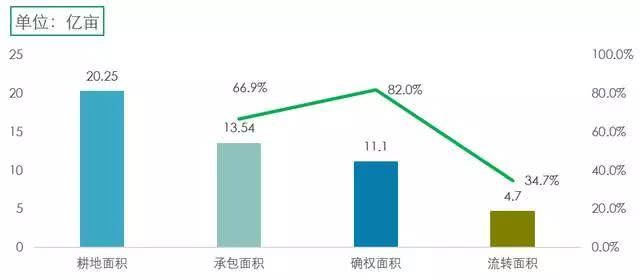
As of November 2017, China had 1.36 billion mu of contracted arable land, 1.11 billion mu of confirmed rights area, and 470 million mu of transferred arable land, with a transfer ratio reaching 34.7%. With the full implementation of the work of confirming, registering, and certifying rural land rights, future rural land transfer will also advance in an orderly manner. Some experts estimate that in the future the scale of typical farms (bases) will be around 50 mu-200 mu, and in Northeast China it will be larger, reaching 1,000-2,000 mu.
Data as of November 2017
There is no doubt that appropriately scaled land management will be conducive to the standardized, mechanized, modernized, and industrialized development of agriculture. However, the currently high land transfer prices have affected the overall transfer process and results. How to effectively balance the interests of all parties in the process of land transfer and achieve sustainable development is the key to determining the pace of transfer in the next 10 years.
The level of agricultural socialized services will continue to improve
At present, many socialized service organizations have emerged in the agricultural field, such as the Jinfeng Commune launched by Kingenta, the MAP (Modern Agriculture Platform) proposed by Sinochem Group, Henan's Jiajiayou, the land trusteeship organization Meilai Zhonglian founded by Liu Shi, and various small and medium-sized institutions in different places.
Providing agricultural socialized services is the only way for agriculture to achieve transformation and upgrading. But the premise is that socialized service organizations must not hang out a sheep's head while selling dog meat, using the name of "socialized services" to actually "sell agricultural inputs and earn the price difference." They must truly help agricultural producers make up for shortcomings and effectively solve their needs and pain points. Socialized services, humble as they are, have nothing particularly lofty about them. Any company that claims its model is so impressive and so innovative is either ignorant and fearless, or a master of deception.
Socialized services have broadly similar models; the key is how you do it and how you implement it step by step.
II. Major changes will take place in production and operation entities
The absolute majority will still be farmers
The meaning of "farmer" will undergo major changes in the future; they will become moreprofessional, occupational, younger, highly educated, and knowledgeable about agricultural machinery,and receptive to new things。
The entire "farmer" group will gradually differentiate: more and more college graduates with agricultural professional backgrounds will engage in field management; in the future there will be increasing demand for labor that can operate and repair agricultural machinery; future farmers will understand the market better, and new farmers with internet thinking will engage in agricultural marketing and distribution-related work; the older generation will gradually be phased out or take on basic work.
At the same time, there will be more and more specialized large households, cooperatives, and companies, and they will play a more important and practical role. In northern regions, especially Northeast China, production and operation entities will be mainly specialized large households. Cooperatives will become more standardized and substantive, emulating the Japan Agricultural Cooperatives. The downward expansion of companies (industrial and commercial capital) into the countryside will no longer be eager for quick success and instant benefits (and being eager for quick success and instant benefits will not yield good results anyway).
III. Agricultural technology (Agtech) will become the true "primary productive force"
As China's demographic dividend gradually disappears, and extensive development under the pressure of resource and environmental constraints becomes unsustainable, agricultural technology will become the main driving force and main engine for development in the agricultural field.
Genetic engineering technology will be applied on a large scale in the future; opening up is only a matter of time
Products using genetic engineering technology are superior to traditional crops in disease resistance, insect resistance, drought resistance, stress resistance, and other aspects. The use of genetic engineering technology can both greatly increase crop yields and improve product quality. If the Chinese public can view this technology more scientifically and rationally, the government's pace in allowing the cultivation of genetically modified crops will be faster.
The penetration rate of drones in the next 10 years will reach at least 30%, and optimistically even 100%
In July and August of this year, I conducted research in Inner Mongolia, Hebei, Hunan, Shandong, and other places, and was startled to find that drone plant protection in rural areas has already become a prairie fire. Although it was a quick look at flowers on horseback and seeing only a glimpse of the leopard through a tube, seeing one leaf tells you autumn has arrived, and seeing one spot tells you the whole leopard. Especially in my hometown Hunan, because it is a hilly area and the fields are scattered, in the past farmers used knapsack sprayers to apply pesticides, which was time-consuming, laborious, and dangerous. Now with drone plant protection technology, the help is truly enormous.
Although drone plant protection still has problems such as pesticide drift, strong winds changing operation trajectories, and poor battery endurance, we have reason to expect that in the future field of agricultural plant protection, drones will play a major role. Some experts even optimistically estimate that 100% drone plant protection can be achieved within 10 years.
Grain and agricultural product storage facilities and technologies will be developed
According to Wang Tao, general manager of JD Agriculture Cloud, in the future more platform companies and technology companies will upgrade and transform storage and logistics facilities, such as JD's cloud warehouse and joint warehouse models.
Water-saving technologies such as sprinkler irrigation and drip irrigation will be vigorously applied
The government advocates saving water and fertilizer. After facility agriculture is vigorously developed in the future, water-saving technologies will be applied more, such as integrated water and fertilizer. The future application of water-saving technology will mainly depend on the region and crop. Northeast China will apply more of it.
Digital agriculture (precision agriculture, smart agriculture, agricultural big data) will become an important direction for future agricultural development
First, it should be explained that digital agriculture is a collective category that includes concepts such as precision agriculture, precise agriculture, smart agriculture, agricultural big data, and the Internet of Things (IoT).
Liu Shi, chairman of Meilai Zhonglian and former president of Pioneer Seed China, believes thatdigital agriculture will be an important opportunity in the next 10 years and will become the final solution for the entire industry.Digital agriculture solutions can combine planting models and data models, plus the solidification and refinement of traditional experience, thereby making the entire process more efficient and precise.
I believe thatterminal devices such as mobile phones will become important future farming tools,big data will become the most important means of agricultural production in the future,digital agriculture solutions will also become the most important productive force,and the relations of production that can nurture and promote the development of digital agriculture,are the advanced relations of agricultural production!
A duck knows first when the river warms in spring. Abroad, the agrochemical giant Monsanto is already making the transition to digital agriculture. Monsanto acquired Precision Planting in 2012 and Climate Corporation in 2013, and through the Fieldview platform provides services such as planting planning and fertilization recommendations to growers in the United States, Brazil, Europe, and other regions. As of 2017, the Fieldview platform had served 720 million mu of land area, with paid service area covering 200 million mu.
Climate Corporation's main digital partners
IV. The agricultural input and machinery system will be restructured and optimized
The agricultural input circulation system will become flatter, but the role of agricultural input e-commerce will be limited
Changes in agricultural production methods and operation entities are also forcing the agricultural input circulation system to continuously evolve and upgrade. Traditional agricultural input manufacturers and distributors are also seeking transformation, changing from single transaction dealers to service providers. For example: Kingenta has successively launched Nongshang No. 1 and Jinfeng Commune. Noposion has also launched Tiantianquan and provides financial services to agricultural input distributors through Nongfadai and Nongtai Finance.
In the agricultural input circulation system, reducing levels is inevitable, but should it concentrate toward provincial-level agents (or manufacturers) or toward town (village)-level distributors? This varies by location, by product category, and by the comprehensive strength of the agent (distributor). As operators continue to increase in scale, town (village)-level distributors can completely bypass intermediate links and directly connect with provincial-level agents or even manufacturers, and town (village)-level agents serve the front line of planting, deeply understand growers' needs, and provide service solutions that are more to the point and more implementable.
But for some agricultural inputs with a relatively high degree of standardization (such as chemical fertilizers), as operators grow in scale, operators can completely order directly from provincial-level agents or even manufacturers, and the role of town (village) distributors will be weakened.
As foragricultural input e-commerce, this circulation form will become an effective supplement, but it is absolutely impossible for it to replace offline channels. The e-commerce model is a transaction model and cannot, or finds it difficult to, provide precise and systematic agricultural input service solutions, and the platform matchmaking model of agricultural input e-commerce cannot solve the trust relationship problem between supply and demand sides. Agricultural inputs are different from daily consumer goods. The key to determining a transaction is still: trust and service!
Therefore, those who hype the agricultural input e-commerce model either do not understand it, or are pretending to be foolish!Agricultural input e-commerce can only be a supplement and cannot become the mainstream.
The modernization of agricultural machinery will continue to improve, and high-end agricultural machinery and equipment will be applied more and more widely
As rural aging intensifies and labor shifts, in the future agricultural machinery will be needed to improve productivity and reduce labor input; without mechanization, it would be impossible to find enough people to engage in agriculture.
In 2016, China's comprehensive mechanization rate for plowing, sowing, and harvesting had reached 65.2%, and it is expected to exceed 70% by 2020. Judging from this number alone, China's level of agricultural mechanization is acceptable, but the application of high-end agricultural machinery and equipment is still insufficient, such as the application of agricultural robots in orchards and tea gardens.
V. Agricultural product quality will improve, and the degree of branding will increase
Shifting from pursuing quantitative change to pursuing qualitative change
The state has already made an important judgment that current agricultural products are characterized by both periodic undersupply and oversupply, and advancingagricultural supply-side reform to meet the people's growing demand for high-quality agricultural products is an urgent task.
Future agricultural production (especially cash crops, specialty agricultural products, and the like) willtake marketability as the principle,pursue safety, health, nutrition, and high quality,and take contract farming as an important carrier, providing the general public and urban residents with agricultural and sideline products that are rich in variety, reliable in quality, and trustworthy in brand.
Improvement of agricultural product quality
With the application of genetic engineering technology and the growing popularity of the concept of sustainable development, future agricultural production will reduce the use of chemical fertilizers and pesticides, thereby reducing or eliminating related residues and improving the quality of agricultural products.
Consumers' growing demand for high-quality and safe agricultural products will also prompt the agricultural production side to pay more and more attention to product quality.
At the same time, with the application of emerging technologies such as blockchain, a fully transparent and traceable system "from field to table" is expected to be truly established.
Upgrading of agricultural product brands
In the future, there will be more regional public brands and corporate agricultural product brands. As agricultural sub-industries continue to cluster, building regional brands and obtaining economies of scale will become more possible and easier. Companies will also pay more attention to achieving product premiums through brand cultivation.
The agricultural product circulation system will become more intelligent
New retail is gaining momentum. The three giants Alibaba, Tencent, and JD.com are forming alliances and maneuvering vertically and horizontally, and through self-building, cooperation, investment, and mergers and acquisitions, they are drawing up the map of new retail. Agricultural and sideline products are an important piece on that chessboard.
Whether it is the gradually fading "O2O" or the rebranded "OMO" (online-merge-offline), agricultural product circulation cannot avoid online and offline. As for how offline channels and online traffic can be effectively combined to produce the greatest synergy, only practice can verify it.
VI. The agricultural financial system will be gradually improved
Because agriculture has relatively low comparative returns and relatively high natural and market risks, traditional financial institutions lack the motivation to serve the agricultural field. China's primary industry added value accounts for about 9% of GDP, but the balance of agricultural loans accounts for only about 4% of the balance of various loans.
In the next 10 years, the agricultural financial system will be gradually improved, and farmers' access to loans will be increased. At present, the Ministry of Finance has initiated the establishment of the National Agricultural Credit Guarantee Alliance and is promoting the establishment and improvement of credit guarantee systems at the provincial, municipal, and county levels, while models such as "credit + insurance" and "insurance + futures" are also being piloted in various places. New internet institutions such as Ant Financial, Zhonghe Rural Credit, and JD Digits are also contributing to the development of agricultural finance.
Summary: In the next 10 years,the agricultural industry system, production and operation system, agricultural technology, agricultural input and machinery system, agricultural product supply side, and agricultural financemajor changes will take place in 6 aspects, anddigital agricultureis undoubtedly the biggest variable in development. People of insight who want to make great achievements in the agricultural field must clearly recognize this!
This article comes from the internet. If there is any infringement, please contact us for deletion.