What rare and bizarre temperate marine fish species are suitable for aquarium keeping?
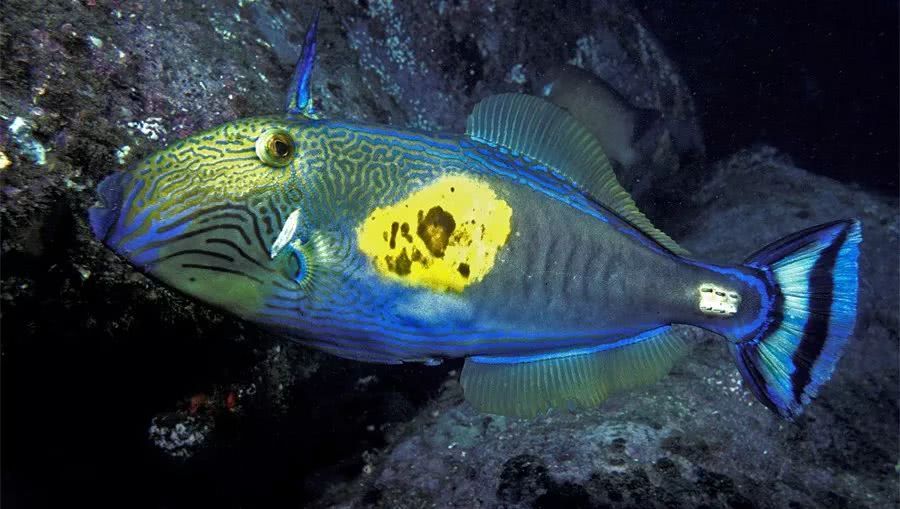
In most people's understanding, most of the brightly coloured, multicoloured marine fish are tropical fish, while those cold-water fish living in temperate and subtropical zones are all grey or brown and look rather plain, but in fact some fish living in certain temperate marine regions possess elegant shapes and gorgeous body colours no less impressive than those of tropical fish. The waters of southern Australia are one such place, where various cold-water beautiful fish live, including these temperate Tetraodontiformes that inhabit only southern Australia. Among them some have elegant body shapes, and others have adorable looks. Let us now take a look at these amazing little creatures.....
Family Monacanthidae
Genus Meuschenia
This genus contains a total of 8 species, all distributed in the waters of southern Australia and New Zealand, mainly inhabiting coastal or estuarine rocky reef areas covered with seaweed and sponges, feeding on organisms attached to the rocks, and can be used as food fish. The fish of this genus have a variety of stripes and markings mainly in blue, and are very beautiful.
Meuschenia freycineti
Photographed at Jervis Bay Marine Park, New South Wales
Meuschenia hippocrepis
Photographed on Flinders Island, Tasmania
Meuschenia galii
Photographed at Rapid Bay, South Australia
Genus Acanthaluteres
This genus contains a total of 3 species. They are a type of small leatherjacket with brilliant colours, distributed in temperate/subtropical waters from Sydney to Perth, mainly inhabiting shallow-sea seagrass beds and kelp forests, liking to hide among the seaweed to avoid predators, and feeding on small molluscs and arthropods
Acanthaluteres spilomelanurus
Photographed at Port Phillip, Melbourne, Victoria
Acanthaluteres vittiger
Photographed on the Freycinet Peninsula, Tasmania
Genus Brachaluteres
This genus contains a total of 4 species. Australia has 2 species, namely Brachaluteres taylori and Brachaluteres jacksonianus. The latter is distributed in the tropical waters of Queensland and northern New South Wales, while the former is distributed in the temperate waters from southeastern to southwestern Australia. The other two species are respectively found in the tropical region of the Red Sea and in Japanese waters, and are an extremely small type of leatherjacket, inhabiting relatively calm bays and shallow seas, generally active near seaweed. This fish has a relatively round body shape, similar to a boxfish, and looks very adorable
Brachaluteres jacksonianus
Photographed at Port Phillip, Melbourne, Victoria
Juvenile Brachaluteres jacksonianus
Photographed at Port Phillip, Melbourne, Victoria
Genus Eubalichthys
This genus contains a total of 6 species and is a genus endemic to Australia. They are a widely distributed temperate/subtropical fish. Some species inhabit coastal waters and estuaries, while others inhabit the rocky reef areas of the deeper continental shelf, feeding on small organisms
Eubalichthys mosaicus
Photographed at Botany Bay, Sydney, New South Wales
Eubalichthys gunnii
Photographed at Port Phillip, Melbourne, Victoria
Genus Thamnaconus
The fish of this genus are widely distributed in the Pacific region, among which there are 6 species in the Australian region, but only Thamnaconus degeni is a temperate/subtropical marine fish. This fish inhabits southern Australia, and its traces can be found from Tasmania to southern Western Australia. This fish is light brownish-grey to pale greenish-grey accompanied by bright blue spots, and generally inhabits the continental shelf.
Thamnaconus degeni
Photographed at Gulf St Vincent, South Australia
Family Aracanidae
Genus Anoplocapros
This genus contains a total of 3 species and is a genus endemic to Australia, a temperate/subtropical marine fish distributed from New South Wales to Western Australia. Its body is oval and its texture is very hard. It inhabits deep coastal waters and often appears near rocks covered with sponges. It looks very adorable and possesses boxfish toxin
Anoplocapros amygdaloides
Photographed at Busselton, Western Australia
Anoplocapros inermis
Photographed at Botany Bay, Sydney, New South Wales
Anoplocapros lenticularis
Photographed on Rottnest Island, Western Australia
Genus Aracana
This genus contains a total of 2 species and is a genus endemic to Australia, distributed in the temperate waters of Victoria, Tasmania to Western Australia. Its body shape is round, its texture is hard, and its body colour is extremely gorgeous. It was once introduced into China as an aquarium fish, commonly known as dragon-pattern papaya, but due to its brilliant body colour this fish is regarded as a tropical fish in China. Almost all aquarium websites that introduce this fish say that the water temperature it lives in is 24-27 degrees, but in fact the highest water temperature of this fish's native habitat throughout the year does not even reach 20 degrees, which leads to no one in China being able to keep this fish alive and it being very niche...
Aracana aurita
Photographed at Port Phillip, Melbourne, Victoria
Aracana ornata
Photographed on the Mornington Peninsula, Victoria
Family Tetraodontidae
Genus Canthigaster
Most species of the genus Canthigaster are tropical organisms, but in Oceania there is one species called Canthigaster callisterna that is distributed in the somewhat temperate subtropical waters of New South Wales, Australia, and the New Zealand region. Its notable features are the parallel dark stripes extending along the sides of its body and the white gaps between them. This fish mainly inhabits rocky reef areas
Canthigaster callisterna, photographed at Halifax Park, Port Stephens, New South Wales
Having grown accustomed to the tropical scenery of the Great Barrier Reef, at the same time the relatively lesser-known kelp forests of southern Australia and the rocky reef waters covered with sponges, together with these graceful little creatures, have also successfully created an underwater world no less splendid than the coral reefs and tropical fish of tropical regions.