Rural areas lack comprehensive planning; local revitalization should align with national spatial planning
Series preface: Taiwan is expected to promote a "local revitalization" policy. As the main implementation areas of "local revitalization," "rural areas" need comprehensive planning to come first, and only after problem analysis and strategy formulation should spatial planning and resource investment be carried out, so as to avoid resources being wasted because investment does not match needs. In addition, Taiwan has drawn on Japan's local revitalization policy; what are the actual resource investments and local effects of Japan's governments at all levels? These all require deeper understanding.
In order to deeply grasp rural development and local revitalization under Taiwan's real context, "Upstream and Downstream" has cooperated with the "Rural Development Foundation" on a "Rural Development Special Topic," using a series of articles to explore Taiwan's current situation and Japanese policy trends. This article is the beginning of the series.
Local revitalization: comprehensive planning for rural areas must come first
Text / Hsieh Chih-cheng (Chairman, Rural Development Foundation), Wu Chin-yi (Chairman, Taiwan Association for Urban and Rural Development)
Only regulation, no planning
In the past, the laws on which rural construction or development was based were mostly general land use and building management regulations, and laws regulating comprehensive construction in rural areas were still lacking. Rural construction involves agricultural land use, building management, public facilities, cultural landscapes and the rural ecological environment. Without special legal regulation, difficulties in implementation are bound to increase.
In view of the importance of agricultural and fishing village construction or rural development, the Council of Agriculture of the Executive Yuan drafted the "Rural Planning Act" in 1994. Because its content involved issues of authority over land use regulation and building management, the then Ministry of the Interior stated that the ministry was drafting the "Urban and Rural Planning Act," and therefore suggested that the Council of Agriculture suspend its drafting. However, after many years, the Ministry of the Interior has still not drafted the "Urban and Rural Planning Act."
In view of the importance of special legislation for rural construction, the Council of Agriculture again drafted the "Rural Regeneration Ordinance" in 2009, and it was passed by the Legislative Yuan in July 2010. At that time, the Council of Agriculture explicitly provided in the "Rural Regeneration Ordinance" for the establishment of a "Rural Planning and Development Administration" to carry out the work exclusively. The relevant provisions were all deleted because of concerns about land enclosure, and the expectation of comprehensive rural planning was fleeting. Rural areas and urban and rural areas returned to a state lacking comprehensive planning.
Local revitalizationshould align with national spatial planning and promote comprehensive planning for rural areas
At present, there are more than 4,000 "non-urban rural districts" across the country (Note 1). Because spatial planning and resource investment have not been carried out with consideration of the characteristics and development needs of rural areas, rural areas have fallen into development difficulties including poor environments, dilapidated buildings, declining industries and population loss.
It is gratifying to see that in order to solve problems such as Taiwan's total population decline, aging, excessive concentration of population in metropolitan areas and stagnant rural development, Premier Lai Ching-te, after hearing a briefing on the National Development Council's "Preliminary Concept of Our Country's National Strategy for Local Revitalization" at the first "Local Revitalization Meeting" held on May 21, 2018, stated that he would fully cooperate in promoting "local revitalization" to encourage migration within the island and relieve pressure on cities, and designated 2019 as "Taiwan's first year of local revitalization."
To cooperate with the promotion and implementation of "local revitalization," rural areas, as the main implementation areas of "local revitalization," need comprehensive planning to come first, and only after problem analysis and strategy formulation should spatial planning and resource investment be carried out, so as to avoid resources being wasted because investment does not match needs.
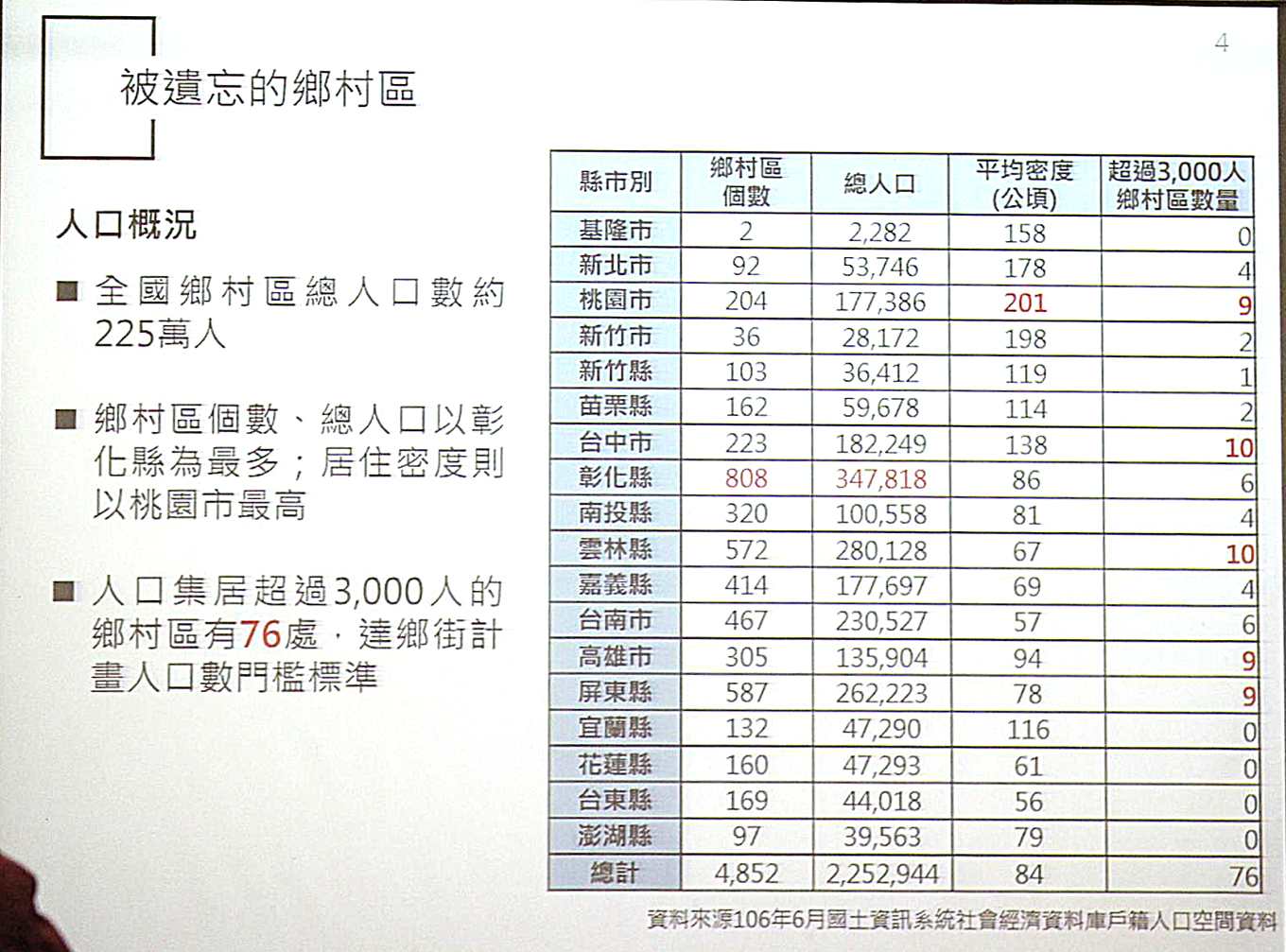
Note 1: A "rural district" is a type of use district in non-urban land. It is designated jointly with relevant agencies in accordance with Article 11 of the Enforcement Rules of the Regional Planning Act and Point 5 of the operational guidelines, in order to harmonize and improve rural living and production environments and to meet the needs of the government's policy of building residential communities.
(This article is part of the "Rural Development" special series cooperatively produced by "Upstream and Downstream" and the "Rural Development Foundation")