Do radishes need their leaves removed promptly to grow vigorously?
Summary: When radish leaves grow vigorously, how should they be managed?
As the saying goes, "Eat radishes in winter, ginger in summer." Radishes are indeed a vegetable that many people like, and both white radishes and carrots are very suitable for growing and eating. However, friends who have grown radishes have probably all experienced the situation where the radish looks like it has very large leaves, but when you pull it up, the radish underground is not large. Here, Science Agriculture addresses this question.
Should radish leaves be removed?
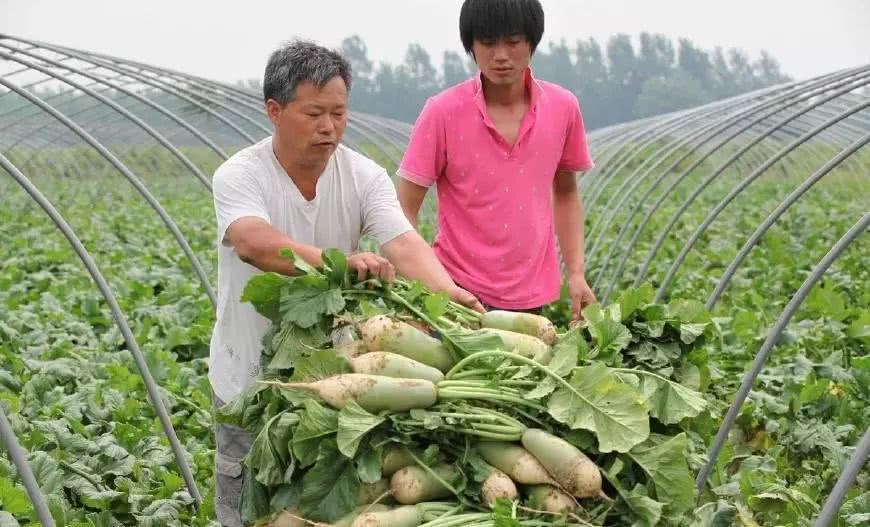
In fact, radishes grow very quickly, and most radishes grow very vigorously. Radish leaves are often very dense as well. We used to grow radishes at home too, and my mother would often pick some leaves to take home and stir-fry, and they tasted pretty good, though she did not pick very many. In fact, radish leaves are where the radish performs photosynthesis; this is where the radish manufactures nutrients and then supplies them to the radish's root. Because the weather in autumn and winter is relatively cold, only when the radish leaves manufacture nutrients can the radish's root expand and grow smoothly.
Therefore, it is not recommended to remove radish leaves excessively. If there really are too many leaves and the growing space between the radishes has already been affected, then a moderate, small amount can be removed. If it is not especially serious, there is no need to deliberately remove them. In addition, when planting radishes, maintaining appropriate row spacing and plant spacing is also very beneficial for later radish growth.
How can radishes be grown better?
To grow radishes well, three main aspects need to be considered: first, the issue of site selection; second, the issue of fertilisation; and third, the issue of watering. Here we will mainly discuss these three aspects.
First, the issue of site selection
Radishes are not very demanding about soil, but a good soil environment is more conducive to radish growth, and the quality of the radishes grown will also be better. The most suitable soil for radish growth is deep, fertile sandy soil with good drainage. Soil that is too clayey or has too shallow a soil layer is not suitable for radish growth. Soil that is too clayey will cause radishes to grow slowly and their roots to rot. Too shallow a soil layer will cause the radish's taproot to branch. None of these are good for radish quality.
The issue of fertilisation,
Fertilisation is also a major issue in the radish growing process. Not only must the base fertiliser be applied in sufficient quantity, but later topdressing must also keep up so that the radishes can grow better. For the base fertiliser, organic fertiliser is generally chosen as the main component, combined with an appropriate amount of chemical fertiliser. Organic fertiliser is generally applied at about 4000 kg per mu, and the chemical fertiliser can be used together with about 10 kg per mu of diammonium phosphate and about 3 kg of potassium sulphate.
Topdressing should be determined according to the radish variety and the growing environment. If the radish variety is relatively small and the growing time is relatively fast, then this kind of radish can have its topdressing reduced; otherwise, topdressing should be carried out moderately. Topdressing is generally divided into three times. The first is at the seedling stage, when about 5 kg per mu of urea can be applied together with cultivating and watering. The second is when the radish grows to the rosette stage, at which time about 8 kg per mu of urea can be applied as topdressing. The last time is when the radish enters the expansion stage, when the fertiliser requirement is relatively large, and about 5 kg of urea, 10 kg of diammonium and 10 kg of potassium sulphate per mu can be applied as topdressing.
Finally, there is the issue of watering. Watering is a very important part of the radish growing process, and watering well has a very big impact on radish quality. After sowing, the soil should be kept moist so that the germination rate can be ensured. After entering the seedling stage, watering should not be too frequent; at this time small amounts of water are needed, which is beneficial to the growth of the radish's taproot. In the middle stage of radish growth, the leaves grow vigorously, and at this time the soil needs to be kept moist with moderate moisture; there must not be uneven drought and waterlogging in the soil, as this easily causes the radishes to become spongy in the centre. It is best to stop watering one week before harvest, as this is more conducive to improving radish quality.
This is Science Agriculture. You are welcome to follow us and learn together.