Creeping thyme tolerates foot traffic and blooms like a carpet beside stone paths
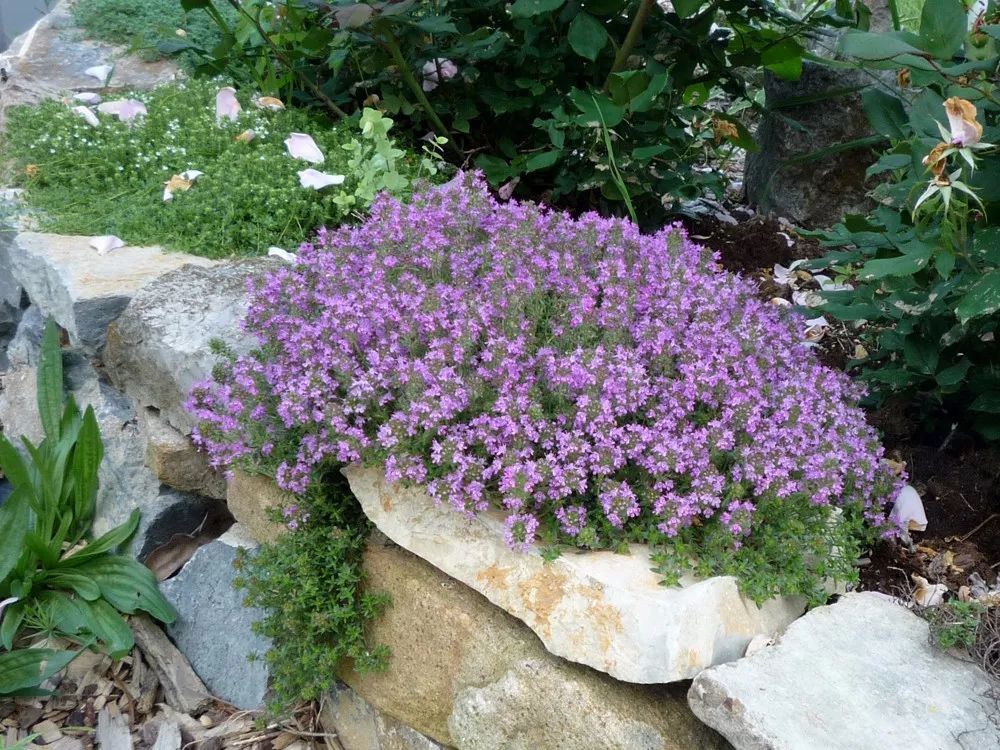
If you want to plant some bright and charming creeping plants beside stones, creeping thyme is a great choice. It blooms very abundantly and is especially easy to grow. Planted in the yard, it will not die even if stepped on freely. It is an excellent lawn substitute.
Planted in the yard, creeping thyme grows very quickly, has very low maintenance costs, and can withstand foot traffic. It has a great many varieties. My favorite is red creeping thyme, which produces purplish-red flowers, grows very low, and has very small leaves and delicate flowers.
Creeping thyme is very suitable for filling the gaps between stone paths. It does not need frequent pruning, and when it blooms it can also become a beautiful sight in the yard.
The environment for planting creeping thyme is very simple. It has a relatively high demand for light and likes well-drained soil. During care, be sure to keep the soil well drained and avoid waterlogging. You can add some river sand or perlite to the yard to maintain good drainage and air permeability.
Compared with other ornamental grasses, creeping thyme grows very quickly and can tolerate a good amount of foot traffic. Its leaves are very attractive, and it also produces delicate flowers. Moreover, it is a perennial plant, so once planted, it can grow on its own afterward.
Planting thyme has another benefit: its flowers carry a charming fresh fragrance, and its branches and leaves are edible and can also be used to make tea or prepare herbal medicine.
Another very good thing about planting creeping thyme is that it rarely suffers from pests and diseases and has strong adaptability to the environment.
The spot where creeping thyme is planted should receive more than four hours of direct sunlight each day, and the growing soil should be a loose, airy, sandy soil with good drainage.
During planting, avoid overly moist soil. It has good cold tolerance and drought tolerance, but in the first year after planting it should be protected from freezing, and the minimum care temperature should be kept above 5°C.
Creeping thyme is very drought tolerant. Once it is planted in the soil and well established, it does not need frequent care. Keep the soil moist during the first two weeks after planting, and after two weeks of care it should not be watered often.
Creeping thyme does not need frequent pruning. It will keep producing branches, and during growth, spent flowers should be removed promptly, which helps it produce more flowers. During care, weeds should be cleared regularly to avoid consuming too many nutrients.
Creeping thyme does not need frequent fertilizing. It is relatively tolerant of poor soil. You can add some decomposed organic fertilizer when it is first planted, and it will grow well.
When the temperature is too low in winter, you can cover the soil surface with some peat soil, decomposed wood chips, or other mulch to keep the roots and stems from being damaged by freezing.
Propagating creeping thyme is also very simple. You can do cuttings in spring and autumn. You can directly cut a section of branch about 7-9 cm long, remove the lower leaves, dip the base in a little rooting powder, and insert it into slightly moist sandy soil. You can first grow it in a small flower pot, and after it is well established, transplant it into the soil.