How profitable is Millettia speciosa cultivation? This medicinal herb can bring in 200,000 yuan per mu
The entrepreneurial fortune-building story of Weng Yijie, a young man from Huazhou, Guangdong: growing Millettia speciosa made him a "cow guy"
2018-10-08 Source: Zhanjiang Daily
For days, at the Millettia speciosa planting base of Wuchuan Huancheng Agricultural Development Co., Ltd. in Bashicun, Wangcungang Town, Wuchuan City, Guangdong Province, people and vehicles came and went, machines roared, and the scene was bustling, with a busy harvest scene everywhere.
"Because I got rich by growing Millettia speciosa, the folks all call me 'cow guy.' The name sounds energetic, and I like it." On September 12, facing a reporter's interview, Weng Yijie, vice president of the Urban and Rural Entrepreneurial Youth Association of the Wuchuan City Working Committee for the Care of the Next Generation and head of the base, put down the work in his hands and talked endlessly about his own entrepreneurial fortune-building story.
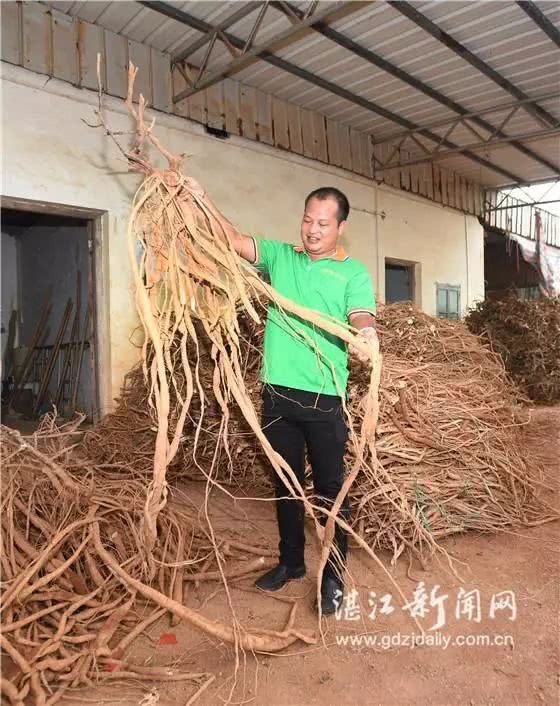
Weng Yijie holds the thick "Millettia speciosa" just dug up.
A pharmaceutical distributor contracts land to grow Millettia speciosa
Weng Yijie is from Huazhou, Maoming. More than 10 years ago, he went to Guangzhou to work in traditional Chinese medicine sales for a pharmaceutical company. Dealing with medicines every day, he found that northern medicines had been passed down and developed very well, while southern medicines had never gained much momentum. In particular, medicinal herbs such as Morinda officinalis, agarwood, and Millettia speciosa had great market potential, so he developed the idea of going home to grow southern medicines.
As it happened, in 2004, when he went to Beijing to attend a pharmaceutical conference and chatted with a top-tier figure in the pharmaceutical field, he mentioned the matter of growing southern medicines. That pharmaceutical expert was very affirmative and gave him guidance.
The pharmaceutical expert pointed out that for growing southern medicines, one should look for varieties unique to the south, and at that time ones that nobody or few people were growing, that were easy to manage, had high added value, and were popular. As long as these conditions were met, one could boldly give it a try. But as for exactly what to grow, the expert only smiled without answering and let him find the answer himself.
Having worked in the industry for many years, Weng Yijie had already accumulated a certain amount of industry experience and felt that growing Millettia speciosa was the most feasible. This is because Millettia speciosa has long been known as "southern ginseng" and is used to treat lumbar muscle strain, rheumatoid arthritis, chronic pharyngitis, bronchitis, as well as spermatorrhea and cardiovascular and cerebrovascular diseases. At the same time, it is a top-grade ingredient for making healthful soups. It had already been widely used among the Chinese people, and consumption was increasing day by day.
He acted as soon as he thought of it. To be safe, he continued to visit some veteran traditional Chinese medicine doctors. After receiving full recognition, he resolutely took out his savings from many years and raised several million yuan more, renting more than 1,000 mu of land in Heyuan to grow Millettia speciosa. However, the ideal was very full, but reality was cruel. Through wind and rain, the business still showed no improvement. Although he had previously studied traditional Chinese medicinal herb cultivation techniques and experience on site, his first batch of Millettia speciosa grown on his contracted land ended in failure. Because the variety was backward and management was not in place, the survival rate of Millettia speciosa was less than 60%, and the yield per mu was also very low, resulting in a loss of several million yuan. In his words, "the money earned through many years of hard work was all thrown away."
Good seeds and good methods help upgrade the industry
"Entrepreneurship not only requires relying on a streak of tenacity to keep solving problems, but also requires accurately grasping information and daring to think and act." After being dealt a heavy blow and experiencing wind and rain, Weng Yijie did not give up, but faced the difficulties head-on. In his view, only persistence is the best way out. Besides, in this industry he had more advantages than others; if others could do it, so could he.
In 2008, he invited experts from the Guangdong Provincial Institute of Traditional Chinese Medicine to conduct an on-site inspection, and asked that research and development team to carry out special scientific research to improve the seedlings and cultivation methods of Millettia speciosa. In 2010, the first generation of Millettia speciosa seedlings was born, and the survival rate was greatly improved. After continued improvement, the third-generation seedlings had become nearly perfect. Coupled with scientific management, the yield per mu jumped from the previous 2,000 to 3,000 jin to 10,000 jin. After ten years of polishing a sword, having gone through the hardships of selling a house to repay debt, raising funds everywhere, and living on steamed buns, in 2014 his team's net income reached several million yuan, earning the "first bucket of gold" of entrepreneurship.
Millettia speciosa flower.
After initial success, Weng Yijie began to expand the planting scale. Through loans, financing, and various other methods, he raised more than 10 million yuan and established Wuchuan Huancheng Agricultural Development Co., Ltd. in 2014, and rented more than 1,350 mu of land in Wuchuan to grow Millettia speciosa, becoming Wuchuan's first enterprise to grow the traditional Chinese medicinal herb Millettia speciosa.
On the day of the reporter's interview, it was seen that after a long growth period of 4 years, Millettia speciosa had now matured and was on the market. Multiple excavators were lined up in a row digging and harvesting the traditional Chinese medicinal herb Millettia speciosa, known as "southern ginseng," with a busy harvest scene everywhere.
Weng Yijie calculated an account for the reporter: one mu of land can plant 1,000 Millettia speciosa plants, with an average weight of 10 jin per plant. Calculated at the current market price of 20 yuan per jin, one mu of land can bring in 200,000 yuan. After deducting costs such as land rent, fertilizer, and labor, the net income per mu reaches more than 100,000 yuan, and the benefit is very considerable. "It is just that Millettia speciosa has a long growth cycle, and at least more than 4 years are needed to ensure medicinal efficacy. In addition, the pressure from risks in all aspects and capital investment is also very great," Weng Yijie said.
Along the way, Weng Yijie also transformed from an "outsider" into an expert, mastering a complete set of cultivation techniques and management methods from seedling raising, plowing, watering, to pest and disease control and later processing. His company's bases are spread across Heyuan, Maoming, Zhanjiang, and other places in Guangdong, with more than 10,000 mu planted with Millettia speciosa, making him a "cow guy" praised by the villagers.
Committed to building a southern medicine comprehensive industrial park
After leaping over the "dragon gate" but returning to the "farm gate," at the beginning of his entrepreneurship, Weng Yijie's approach puzzled the villagers a great deal, and he was often talked about. "I am very optimistic about the world of rural areas. Today's agricultural production is no longer the traditional concept of facing the yellow earth with one's back to the sky. As long as you create distinctive features, you can make a name for yourself." Facing the villagers' discussions, Weng Yijie had secretly encouraged himself in his heart.
In fact, Weng Yijie's plan was not just to get rich by himself. After he earned his first bucket of gold from Millettia speciosa, he mobilized the villagers of Huazhou and Wuchuan to grow it with him. To meet the planting needs of more farmers, he adopted the "company + base + farmers" model, signed agreements with growers, provided planting technology and sales services free of charge, and drove more villagers to grow their way to wealth. The development of the base not only revitalized idle hilly land, but also solved the employment problem of surplus rural labor, promoting the revitalization of the rural economy.
Weng Yijie also introduced that every part of Millettia speciosa is a treasure. In the past, only the tuberous root was used, but now research has found that its rhizome can be used to make wine, its extract can be made into chewable tablets, its leaves can be made into herbal tea, and its flowers can be made into flower tea, and all are top-grade health products. In the words of the villagers, every part of Millettia speciosa can be sold for money.
At present, the company is connecting with some high-tech enterprises in the Pearl River Delta and preparing to develop products such as Millettia speciosa beverages, Millettia speciosa biscuits, and Millettia speciosa wine. Next, Weng Yijie will apply to plan and build a Millettia speciosa industrial park, realize integrated operations such as planting, sales, and processing in the park, continuously make the Millettia speciosa industry chain bigger and stronger, and increase the added value of products. In addition, the company is also cooperating with well-known agricultural product e-commerce platforms, letting Zhanjiang Millettia speciosa products ride the fast train of the internet, sell around the world, and continuously make the brand of southern medicines resound.
This article comes from the internet. If there is any infringement, please contact us for deletion.