The steps for making a landscape bonsai are briefly described below.
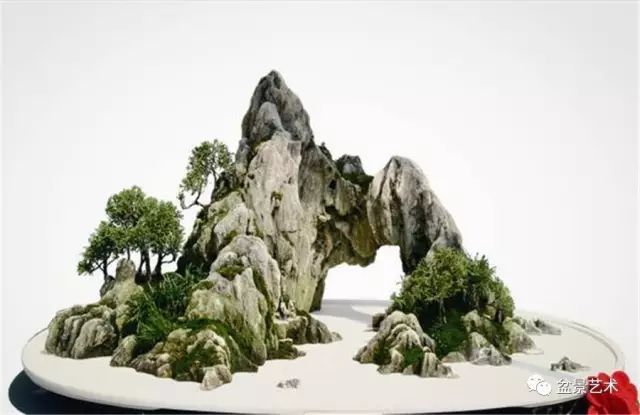
A landscape bonsai is a type of bonsai that focuses on the appreciation of rocks. To make a landscape bonsai, one must first carry out an artistic conception, determine the theme, and then, according to the natural character of the mountain stones, take all or part of the stone material suitable for shaping, and use plants and necessary accessories to carry out artificial carving, configuring it into a rockery. Natural scenes such as strange peaks and exotic ridges, high gorges with flying mist, a hundred barriers and a thousand peaks, and secluded caves with wondrous sights are condensed into a shallow pot and placed on a table, looking just like a three-dimensional landscape painting, making people feel as if they are before blue waves and green waters, among famous mountains and great rivers, full of delightful interest.
1. Selection and processing of mountain stones
I. Selection of mountain stones:A landscape bonsai is a landscape formed by the arrangement and combination of mountains, stones, grass, and trees in a pot. Mountain stone material is the main material for the creation of landscape bonsai. There are many kinds of mountain stones, most of which are mined from nature, and their texture, color, and texture lines all have a natural essence. When selecting materials, first note that the natural characteristics of the stone material should be used to determine what kind of natural landscape shape it is suitable for. If what is selected is a set of sandy limestone with upright and concise texture lines, a long strip shape, and natural contours as the material for a bonsai, it can definitely be said that these materials are most suitable for a shaped landscape of sharp sword peaks and towering uprightness. When selecting materials, note that the texture, type, and texture lines of the materials must be unified. For one bonsai, it is best to use only one category of material, and the colors should not differ too greatly.
II. Chipping and cutting of the mountain body outline:When we are making a landscape bonsai and selecting materials, we must first observe the outline line at the top of the stone material, triggering conception and repeatedly weighing it. Whether hard stone or soft stone, when the arrangement of the outline line is not obviously undulating, it must be chipped and cut to make it clearly undulating and full of rhythm.
III. Cutting and gluing:Most of the time, one piece of stone material cannot form the complete picture of a landscape bonsai, so multiple pieces of stone material must be combined to form the landscape. Stone materials are generally natural and unprocessed, so according to the landscape requirements, the stone materials must be sawed, cut, connected, and glued. Sawing and cutting stone materials is done with a cutting machine or a hacksaw, and can also be done by breaking them with a hammer and smoothing them. Then cement, or cement mixed with color, or other adhesives are used to bond them into shape.
IV. Texture adjustment and staggered arrangement:Generally speaking, a landscape bonsai requires the texture lines on the stone body to be roughly consistent, so that the landscape picture appears more unified. However, due to differences in the stone materials themselves, on the premise of choosing as consistent natural texture lines as possible, sometimes it is necessary to adjust the texture of some stone materials whose texture methods are not obvious or whose textures differ greatly. Texture adjustment is generally carried out by picking, hollowing, tapping, and sawing, depending on the softness or hardness of the stone material. If some textures really cannot be adjusted out, stone materials of roughly consistent color can be used for staggered joining to form a large block surface with obvious concave and convex texture lines, achieving the requirement of a unified and vivid landscape.
2. Shaping and style of landscape bonsai
Creative conception is an important part of bonsai creation. The creative conception of a bonsai is actually a process of determining an artistic conception and conceiving and expressing this artistic conception. Generally speaking, there are two ways of expression:
First determine the conception and, according to this conception,after conception, select appropriate materials such as trees, stones, mountains, and grass, and arrange and combine them in the space of the pot to complete this conception.
According to the shape characteristics of specific mountains, grass, trees, and stones, generate a certain conception, then conceive and use the shape characteristics of these mountains, stones, grass, and trees to arrange and combine them to complete the formation of a certain landscape and artistic conception. Because the formation of the bonsai landscape is limited by concrete materials, this method of conception is a way of combining conception with production commonly used in the shaping of mountain stone and various combined types of bonsai.
Landscape bonsai generally have the saying of opening and closing in landscape shaping. Landscape bonsai with complex mountain body formation generally have a method of taking momentum with one opening and closing, or two openings and closings, or three openings and closings. Opening and closing means that in a landscape bonsai there is a complete mountain body formation landscape with a host, guest, and scattered-dot stones. When the mountain body is placed in the pot, it can form a visual unit with a spatial position in the pot. Due to the effect of "tension" in the sense of composition (omnidirectional two-way radiation), people's visual psychology produces a sense of expansion (that is, "momentum"), with the effect of occupying space. At the same time, because it has directionality in three-dimensional space (for example, the orientation of the mountain body in the pot), and occupies space asymmetrically, it forms a sense of movement in people's visual psychology and on the picture. The creation of the sense of movement is actually the imbalance caused by the radiation in the picture of the expanding lines of visual units such as points or block surfaces, and this is related to the position of the mountain body's cut surface in the "gestalt space."
Foil and contrast are also very important in the shaping of mountain stone bonsai. The meanings of foil and contrast are relatively broad and are relative. For example, the foil and contrast of large and small, the foil and contrast of host and guest, the foil and contrast of sparse and dense, the foil and contrast of hidden and revealed, and so on, the foil and contrast of virtual and real, the foil and contrast of front and back, the foil and contrast of stone and tree. These must all be concretely embodied according to the creative theme and creative techniques. Only by mastering the laws of creation can one "apply them with subtlety, all depending on the mind."
3. Application of scattered-dot stones in the landscape
The positions of the host and guest mountain stones of a landscape bonsai in the pot are quite important. Their spirit, volume, and posture are directly related to the level of the artistic conception of the work. But whether their function is prominent or not is also related to the application of a kind of accompanying body that is usually overlooked, the scattered-dot stone.
The scattered-dot stone is a kind of accompanying body placed in scattered yet orderly group form in the blank water-surface space of a landscape bonsai. It itself has the nature of a "point" in the sense of composition, and is a visual unit with a spatial position. When people's line of sight concentrates on it, it produces a sense of expansion in people's visual psychology. Therefore, it itself can play the role of occupying space and dividing space.
The functions of scattered-dot stones are mainly shown in the following aspects:
(Scattered-dot stones serve as accompaniment to the main mountain body)
As accompanying objects for the host and guest mountain bodies in the bonsai: The characteristic of a bonsai is that the small reveals the large, but no matter how large the bonsai, the volume of its host and guest mountain peaks is limited. In order to make people psychologically feel "one peak, then Mount Hua for a thousand xun" when appreciating it, some low and small accompanying objects must be used to highlight the main peak and guest peaks, making them appear much larger than their actual existence and increasing their sense of volume. Scattered-dot stones play an excellent foiling role in this respect.
(Division of blank space by scattered-dot stones)
As dividing objects for the blank water-surface space at the mountain foot: A bonsai is a three-dimensional shape, and it cannot be like a landscape painting in which the mountain floats in midair with clouds or something else omitted below. The mountain stones in the pot must take root and sit firmly. When we set the host and guest mountain stones firmly in the pot, the remaining blank space needs careful handling. In bonsai circles, the saying goes, "Peaks are easy to set, feet are hard to handle," which refers to this process. The arrangement of scattered-dot stones is the handling and division of the blank water-surface space at the mountain foot. As said earlier, scattered-dot stones must produce a sense of expansion in people's visual psychology and have a tension effect, enabling them to exert the effect of occupying space in the blank space. Therefore, if the arrangement of scattered-dot stones is appropriate, the water surface at the mountain foot can be reasonably divided and full of variation.
(Scattered-dot stones play a knotting role in a pattern of one opening and closing)
In a landscape bonsai, especially in a bonsai with one opening and closing as the pattern, they play the role of "knotting" momentum: We know that in a bonsai, especially one in which host and guest mountain bodies exist at the same time, in a bonsai with one opening and closing as the pattern, their direction arrangement generally contains the four links of "starting, continuing, turning, and knotting." The so-called "gaining momentum layer by layer" refers to the organic combination of these four links, and "knotting" is the completion point of these four links. The scattered-dot stone is exactly such a "knotting point." It plays the role of gathering momentum in an overall picture full of vivid spirit, and plays the role of giving the final explanation for the development of the mountain body's posture.
4. Planting of plants and embellishment of accessories
After the mountain stone combination shaping of a landscape bonsai is completed, plants should be planted and accessories embellished. In painting theory it is said: "In the body of a mountain, stone is the bone, trees are the clothing, and towers, terraces, pavilions, and bridges are its embellishment." Stone is an inanimate shaped solid, while trees are the symbol that embodies the life of its landscape. In professional circles it is said: "Stones are easy to set, planting is hard," which shows the importance of plants in mountain stone bonsai. Those in the know all have this feeling: after the mountain stones are formed, the bonsai landscape has actually only been completed halfway, and it can only be considered complete after plants are planted. Often the energy and time spent on planting exceed the time used to combine the stone materials.
For planting plants, it is better to use those with fine leaves and short branches, and different plants are used for different landscapes. For example, for a solitary-peak landscape, plants with relatively old, rough, and stout branches and trunks can be selected; for group peaks standing like walls, a combined planting of dense forests and luxuriant growth can be selected; for gentle mountain slopes, small plants can be embellished and planted. At the same time, techniques such as setting off, embellishing, interspersing, flying out, overlapping, and dense planting can be used for specific operation, but attention should be paid to the general planting rule of proportion, the rule of "a zhang of mountain, a chi of tree." Generally speaking, it is still better to plant according to the compositional principle of "starting, continuing, turning, knotting, and closing."
Accessories play the role of stating the theme or serving as a foil in a landscape bonsai, but note that the creation of a landscape bonsai should not focus on embellishing accessories, but should focus on landscape shaping. Accessories must not be piled up or placed randomly; they should be moderately hidden and revealed, sparse and dense, and should stress the rule of "near large, far small" and perspective relationships.