Succulent plants have grown dense clusters of white bugs, how do you get rid of them before winter?
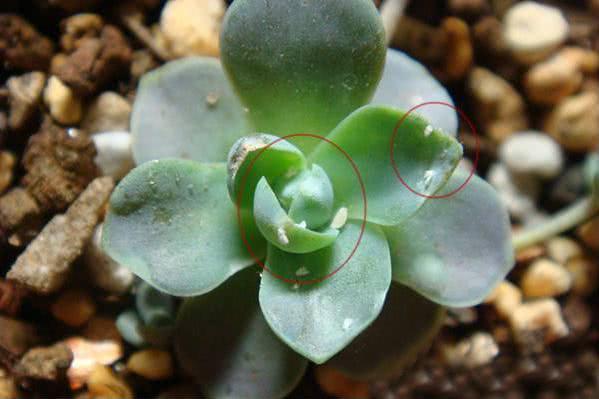
Winter is almost here, and your succulents have "white" bugs? Dense clusters of them, how do you get rid of them? These bugs are none other than scale insects (mealybugs), one of the most common pests on succulents, often clustering on the stems and leaves of the plant, sucking the sap from stems and leaves, causing the stems and leaves to wither, and in some cases even killing the whole plant. Besides that, they can also trigger sooty mold, doing considerable harm to the plant. I believe any friend who has grown succulents has run into them; they multiply quickly and look especially annoying, and flower lovers with trypophobia may not be able to stand them. Next, a brief introduction to scale insects and how to control them.
Where on succulents do scale insects usually appear?
The branches and leaves of succulents and the soil around the roots are the high-incidence areas for scale insects. The eggs are especially tiny, very hard for us to spot with the naked eye. From egg hatching to adult, it takes as little as two or three [months], or as long as three or four months at the slowest, and such a long time span may give you the illusion that your succulent had no scale insects back then, so how did they suddenly appear now? Scale insects basically get around by crawling, whereas aphids can fly.
Why do succulents get scale insects?
In most cases, the succulents you bought already had scale insects or eggs on their branches, leaves, roots, or in the soil; you just didn't notice at the time, and only saw them once they exploded into a full-scale infestation. Greenhouses themselves are high-outbreak areas for scale insects; they are just suppressed by various means, and it is entirely possible for a few insects or eggs to remain on the roots, the soil, or even occasionally on the succulents themselves.
It is related to the humidity of the care environment
Excessively high humidity tends to favor the occurrence of scale insects and rarely causes nymphs to die, whereas under low-humidity conditions the survival rate of scale insects decreases. When the average relative humidity is below 38%, the egg hatching rate drops by 89.3%. When humidity is below 15%, nymphs die in large numbers, so dry years are unfavorable for the occurrence of scale insects. Therefore, succulent pest problems are mostly caused by a growing environment that is not ventilated, stuffy, and humid, so ventilation of the environment is very important in normal times.
Your succulents have "white" bugs? Dense clusters of them, how do you get rid of them?
A relatively eco-friendly and quick method is to repeatedly wipe the affected leaves with alcohol, which can thoroughly remove scale insects; even the larvae invisible to the naked eye can be killed, and the method is safe, simple, and effective. Rice vinegar also works: dip a cotton ball in rice vinegar and gently wipe the leaves with pests and disease; it not only achieves a thorough insecticidal effect but also makes the plant's leaves turn green again and become glossy. For example, when wiping diseased orchid leaves with alcohol, not only can the scale insects be removed, but even the larvae that cannot be seen clearly with the naked eye are thoroughly killed, and in the second year few scale insect infestations are found. This method is simple, safe, and highly effective.
Baijiu from home diluted with water can also be used to treat scale insects on succulents. Mix it at a ratio of 1:2 and water the surface layer of the potting soil thoroughly. You can water once in mid-April, then about once every half a month, and the best results come from 4 consecutive times. Once scale insects are found, it is hard to clean them out all at once; scale insects themselves multiply in large numbers, and there are few specific-effective drugs for controlling them, and eggs may also remain in the soil. But there is no need to be too discouraged; generally speaking, a small number of remaining scale insects will not have too serious an impact on succulents.
This is a gathering place for succulent plant lovers, sharing tips on caring for potted succulents; you are welcome to follow and exchange ideas.