There are so many Agave varieties, and they look especially beautiful on a windowsill
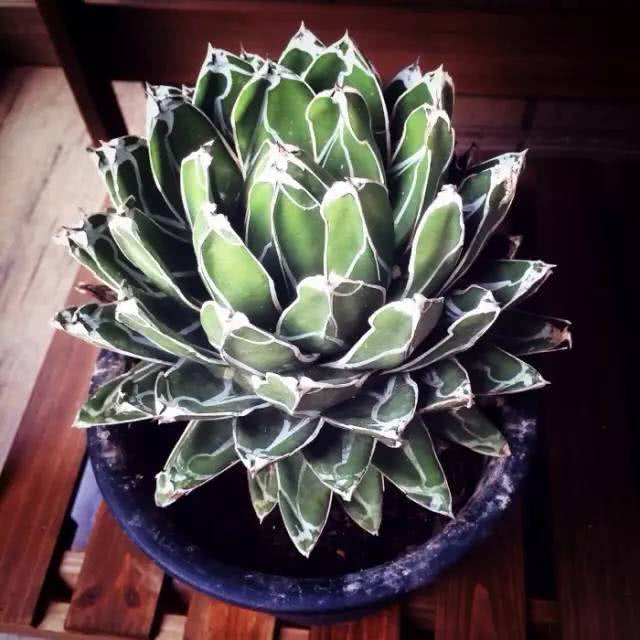
If every plant you try to grow dies, then you might as well try growing an Agave. Don't assume they all belong in the garden; there are also many varieties suitable for container growing, and there is no shortage of compact ones, like the common Queen Victoria Agave (Agave victoriae-reginae), which is very popular. It grows slowly, but it makes up for it by being adorable.
(Agave victoriae-reginae)
1. Growing environment
Agave is also called the century plant, meaning it can live for a century. They all like dry, cool environments. In the stuffy, humid heat of summer, they need more ventilation and light, and the soil should not stay constantly moist.
Agave has a certain degree of cold tolerance, but it is not very shade-tolerant. It needs plenty of light, and even indoors it should be placed on a windowsill to get light.
In winter, it can survive as long as the temperature stays above 5°C. It is true that Agave has some cold tolerance, but that applies to robust mature plants, which will not freeze to death even at around minus 10°C, and can overwinter safely above minus 5°C.
However, in winter it should not be watered much. When the weather is cold, keep the soil dry. Its drought tolerance is very strong, and it is perfectly fine without water for several months. But if the soil stays constantly moist, it is instead prone to root rot and death.
2. Growing Agave in containers
1
Appropriate light
For container-grown Agave, of course, choose compact varieties, such as the common Agave victoriae-reginae and Agave filifera subsp. filifera, both of which are particularly attractive Agaves.
The environment for growing Agave should be sunny. They are not afraid of full sun; when summer temperatures are too high, just provide a little shade in the afternoon.
In winter, when temperatures are low, even after moving them indoors, give them plenty of bright, indirect light through a window and control watering, so the plant stays compact.
2
Appropriate water and fertilizer
When growing Agave, control watering. It is a plant suited to lazy gardeners. In summer, with plenty of light, you can water thoroughly once every 2-3 days, also waiting until the soil is completely dry before watering. In other seasons, extend the watering interval appropriately. In winter, when the temperature drops below 15°C, reduce watering, and when it drops below 5°C, stop watering altogether.
Because it has extremely strong drought tolerance, too much water is instead bad for its growth. Control watering in winter; Agaves grown outdoors basically need no watering at all to survive.
Because of its drought tolerance and its susceptibility to waterlogging, the soil should preferably be sandy. Agave also does not need frequent fertilizing; just give it about one light dose of fertilizer water once per quarter during the growing season. If the soil is slightly fertile, it can even be fertilized just once a year.
3
Repotting and soil choice
Because Agave likes a warm, dry environment, the soil must have good drainage and aeration. It is best to choose a loose, fertile sandy soil. When using ordinary garden soil, mix in 3 equal parts of river sand to ensure good drainage. The container should also be a pot with good drainage and aeration.
Agave grows very slowly and does not need frequent repotting. Generally, repot once every 3-5 years; avoid frequent repotting. When potting, you can put granular soil and an appropriate amount of decomposed organic fertilizer at the bottom of the pot.
3. How to propagate Agave
Agave is generally propagated by division, but if you can buy its seeds, you can also try growing it from seed.
(Climbing a ladder to pollinate the Agave)
It is very hard to see an Agave bloom, because it flowers only once in its lifetime. Most Agave varieties can live for around 80 years, and may only bloom after 50-60 years of growth. To get seeds, you even have to climb a ladder to pollinate its flowers.
If you notice an Agave growing offsets, you can propagate it by division. Cut off the young offsets with some soil attached, then leave them in a shaded, ventilated spot to let the wounds dry, after which they can be replanted in sandy soil.