A climbing plant blooms all over a wall, turning it into a sea of flowers; when the flowers fall, their fragrance trails along the whole path
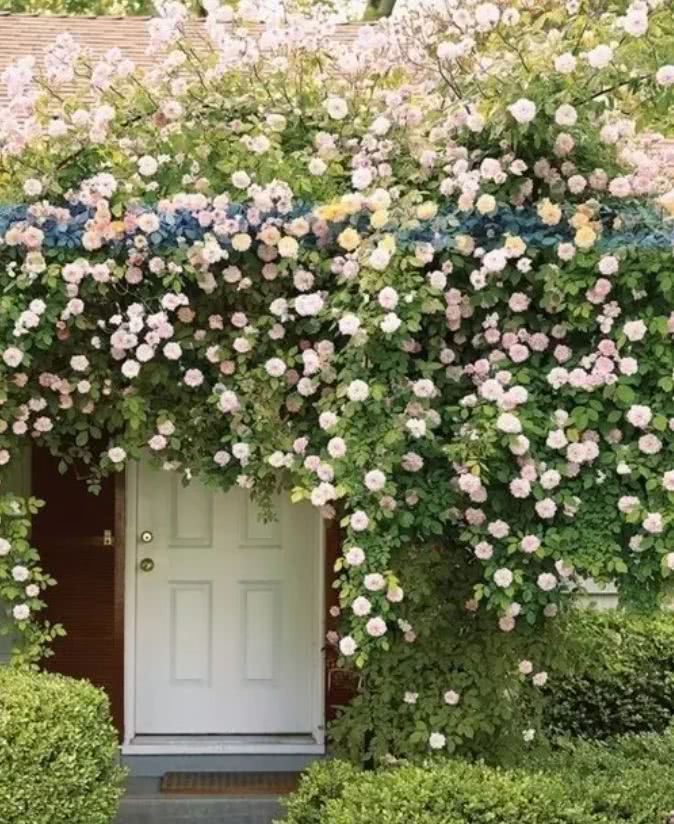
I remember a while ago I came across a great story
An elderly couple were planning to move house
Because they had planted quite a few climbing roses at home
When they bloom, seen from afar
The house looks as beautiful as a sea of flowers
The first floor, which originally was not easy to sell
Because of this sea-of-flowers scenery
Actually sold for several hundred thousand more than the market price
So growing flowers is also a kind of investment
Plant one now
In ten years it might be quite a sum of wealth!
Today let me introduce to you
Several kinds of plants that can climb into a flower wall
Plant any one at random
And it can become as beautiful as a painting!
Climbing roses
Here I first recommend climbing roses
Compared with Rosa multiflora
Climbing roses have a longer flowering period
The flowers are bigger and more beautiful
If they climb into a wall
No need to say how stunning it would be!
Many roses are very beautiful
For example, the fast-growing
and abundantly flowering 'Parade'
The classic pink 'Pierre de Ronsard'
The pink 'Leonardo da Vinci'
The yellow 'Georgia'
'Margaret Thatcher' - any single one of them can intoxicate the heart with beauty
Climbing roses themselves have no climbing organs
They need artificial trellising or tying
Trained upward, they can reach 3~4m tall
When planting, you can plant several varieties together
When they bloom, the flower shapes differ and the colors are varied
Extraordinarily beautiful!
Climbing roses have a relatively long flowering period
They can bloom in three seasons
And when the clustered flowers open they give off a strong fragrance
Climbing roses have strong adaptability
Cold-resistant and drought-resistant, they like sufficient sunlight and air circulation
A well-drained and wind-sheltered environment
They require fertile, loose, slightly acidic soil rich in organic matter
But their range of adaptation to soil is fairly wide
Relative air humidity is best at 75%~80%
But slightly drier or slightly wetter is also fine
They have the characteristic of continuous blooming.
For most varieties the optimum daytime temperature is 15~26°C
And 10~15°C at night
When the winter temperature drops below 5°C they enter dormancy
Generally varieties can withstand a low of -15°C
If summer high temperatures persist above 30°C
Then most varieties bloom less
Quality declines, and they enter a semi-dormant state
Chinese trumpet creeper
Among vine flowers, the most admirable is the Chinese trumpet creeper
The Chinese trumpet creeper has a long flowering period
Every time I see Chinese trumpet creeper I always picture white walls and black tiles
The pairing of the two is just right
Clusters of blooming Chinese trumpet creeper flowers
Up close they look like strings of small orange-red trumpets
Gathered together in groups of three or five
From afar they look like wind chimes on a flower stand
The Chinese trumpet creeper's dry branches are twisted and varied in form
Its emerald leaves are round like canopies
The flowers are large and brilliantly colored, and the flowering period is very long
It is a good greening material for pergolas and flower gates in gardens
For climbing walls, dead trees and stone faces, it is extremely suitable
Dotted in the gaps of rockeries, its profuse bright blooms feel even more moving
Chinese trumpet creeper likes plenty of sunlight
It also tolerates half shade and has fairly strong adaptability
Cold-resistant, drought-resistant, barren-resistant, salt-alkali-resistant, with relatively few pests and diseases
But it is not suited to blazing sun or no sunlight
Well-drained, loose neutral soil is preferable
Acidic soil should be avoided
Chinese trumpet creeper likes warmth and is not cold-resistant
In winter it must be placed indoors in a place that does not freeze to overwinter
Chinese trumpet creeper likes fertilizer and moisture; after sprouting in spring, water and fertilizer management should be strengthened
Generally apply liquid fertilizer 1-2 times a month
But it does not like heavy fertilizer, so do not fertilize too much
Otherwise it will affect flowering
Bougainvillea
In provinces such as Fujian, Guangdong, Guangxi and Yunnan
Bougainvillea can be seen everywhere
Many flower lovers also grow it at home
Pruned into a bonsai, or left to grow freely
Covering half a house
Full of tropical charm
If you have seen it, you will never forget it
It likes warm, humid
and sunny environments
It is not cold-resistant
In China, except in the southern regions where it can be cultivated outdoors and overwinter
In other regions it needs pot cultivation and greenhouse cultivation
Well-drained sandy loam soil is most suitable
Bougainvillea is commonly propagated by cuttings, and raising seedlings is easy
In May and June
Cut mature woody branches
20 cm long, and insert them into a sand pot
Cover with glass and keep moist
They can take root in about a month
After two years of cultivation they can bloom
The whole plant's flowering period is very long
It can reach three or four months
During the flowering period there are many fallen flowers and fallen leaves
They need to be cleared away promptly to keep it fresh and beautiful
Clematis
Clematis enjoys the fine title of "Queen of Vine Flowers"
The flowers are generally white, and the flowers have a fragrant scent
Clematis can be used as exhibition cut flowers
It can be used to climb evergreen or deciduous trees and shrubs
It can be used as ground cover
Its roots and whole plant are used as medicine
Clematis has sparse, graceful branches and leaves
Some have large, brilliantly colored flowers
Some have many small flowers gathered into large inflorescences
Unique and charming, it can be planted by walls and windows
Climbing on flower columns, flower gates and fences
And care is relatively easy, so it is very suitable for planting in a small yard
Prefers fertile, well-drained alkaline loam
Avoid soil that waterlogs or dries out in summer and cannot retain water
Clematis needs more than 6h of direct sunlight every day
This is extremely beneficial to its growth
Generally, during the growing season, water thoroughly once every 3-4 days
Water when the growing medium has dried out but the plant has not yet wilted
During the dormant period, simply keep the growing medium moist
The optimum temperature for growth is 15~17°C at night and 21~25°C during the day
Provide appropriate shade in summer
Clematis is highly cold-hardy
It can tolerate low temperatures of -20°C
Japanese honeysuckle
Plant Japanese honeysuckle at home
Not only can you enjoy the flowers
You can also use it as a Chinese herbal medicine
Since ancient times, Japanese honeysuckle has been praised as a fine remedy for clearing heat and detoxifying
Pick a little yourself and brew it as tea
You will be as happy as can be!
It is sweet in nature, cold in property, and aromatic
Sweet and cold, it clears heat without harming the stomach
Aromatic and penetrating, it can also dispel pathogenic factors
Japanese honeysuckle can both disperse wind-heat
And is also good at clearing and resolving blood toxins
It is used for various heat-related diseases
Such as body heat, rashes, macules, heat-toxin sores and carbuncles, and sore, swollen throat
All with remarkable effects
Brewing Japanese honeysuckle as tea can inhibit and kill pathogenic bacteria in the throat
It has anti-cold and anti-infection effects for the elderly and children
Japanese honeysuckle is highly adaptable, likes sunlight, and also tolerates shade
It is cold-tolerant, and also tolerates drought and waterlogging
It is not demanding about soil and can adapt to both acidic and alkaline soils
But moist, fertile, deep sandy loam is best
Its root system is well developed, its sprouting ability is strong, and its stems and vines root at every node
Where they touch the ground, so providing a trellis favors its climbing growth
Flame vine
Flame vine is not cold-tolerant
It grows better when planted in the south
It is a trellis plant widely grown in tropical courtyards
It is often planted around courtyard buildings
Climbing over arbors
It blooms in early summer, with red-orange flowers in dense hanging clusters
As lively as firecrackers, hence the name flame vine
It truly blooms passionately and explosively!
Water by the principle of dry-wet alternation, and never let water accumulate in the pot
During bud formation and blooming, water a little more generously
In summer, when temperatures are high, water sufficiently
At the same time, sprinkle water on the ground near the flowerpot
To raise air humidity
In autumn, it begins to enter the flower bud differentiation stage
At this time, watering should be appropriately reduced
In order to control vegetative growth and promote flower bud differentiation
During the growing season, apply a dilute liquid fertilizer combining nitrogen and phosphorus about once every 2 weeks
During the bud formation stage, apply 1-2 additional quick-acting liquid fertilizers mainly based on phosphorus
After the flowers fade, apply 1 additional liquid fertilizer mainly based on nitrogen
To benefit flowering and plant growth
Flame vine is not cold-tolerant
In northern regions, after winter begins it must be moved indoors to overwinter
During overwintering, place it indoors in a spot with ample sunlight, control watering, and stop fertilizing
Keep the room temperature above 10°C
Generally, from mid to late December, the room temperature needs to be gradually raised a little
At the same time, water and fertilize in moderation
By February to March, it can form buds and bloom
Morning glory
Morning glory has a fairly strong self-seeding ability
Basically, it can come up on its own every year
It is easy to grow
And the flower shape is also very attractive
Morning glory is generally sown in spring
And blooms in summer and autumn
It has many varieties
Flower colors include blue, crimson, peach red, purple, and so on
There are also mixed colors, and the petal edges vary greatly
The seed capsules split into several valves
Collect them well and sow again the next year
Then they can quickly grow again and produce beautiful flowers
Morning glory is extremely adaptable
It likes ample sunlight and can also tolerate partial shade
Morning glory is not frost-tolerant
The optimum temperature for growth is 13~18°C
In winter, the temperature should be 4~10°C
If it drops below 4°C, the plant stops growing
In summer, it can tolerate high temperatures above 35°C
Morning glory is a long-day plant
It requires fairly strong light conditions
Whether potted or planted in the ground, it must be given ample light
With ample sunlight, it grows vigorously with lush leaves and abundant flowers
If light is insufficient, branches and leaves tend to grow leggy, and it blooms little or the flower quality is poor
If it can be given more than 12 hours of light per day
And the night temperature is above 10°C, then it can bloom in all four seasons
Morning glory has a long flowering period and needs continuous nutrient replenishment
Only then can it keep blooming
Hoya
Hoya is a plant in the genus Hoya of the family Apocynaceae
Hoya is a very cute plant
The flowers are spherical and umbel-shaped, with a peculiar yet elegant form
And they give off a captivating fragrance
Keep one pot at home
It can create a fresh and elegant home environment
Very charming
There are also many varieties of hoya
In all kinds of colors and forms
The only thing that never changes is that they all bloom into cute little balls
Hoya likes a warm, semi-shaded environment
In summer and autumn, it needs relatively high air temperature
Avoid scorching sun exposure; if sunlight is too strong
The leaf color will turn yellow, and the texture will become rough and dull
The suitable growth temperature for hoya is 20~25°C
In winter, the temperature should not be lower than 1°C
It can bloom only with 3~4h of ample sunlight each day
In areas with insufficient light, it is often grown in pots for foliage
It grows vigorously in soil rich in humus and well drained
It is more suited to more light and slightly dry soil
I like Chinese roses the most, super obsessed!
However, the pest problem with Chinese roses is rather troubling
But when they are beautiful, they truly have no equal!
Which one do you like?
--THE END--
Floral Field & Nature
The most readable WeChat public account in the floral art field
Flower lover exchange:zouzaidalulogo design:zouzaidalu
Floral aesthetics | Plant aesthetics | Life aesthetics | Plants & floral art exploration