What yokai appear in "The Tale of Kamakura"?
By: DaDa
This is Kamakura, where time flows differently than in Tokyo.
- The Tale of Kamakura
"The Tale of Kamakura" tells the story of writer Isshiki Masakazu and his newlywed wife Akiko, who after their marriage live in Isshiki's hometown of Kamakura, where the husband desperately ventures into the underworld to save his wife. The plot is fairly simple, but the film presents viewers with a bizarre and fantastical world. Today let's talk about the yokai in it.
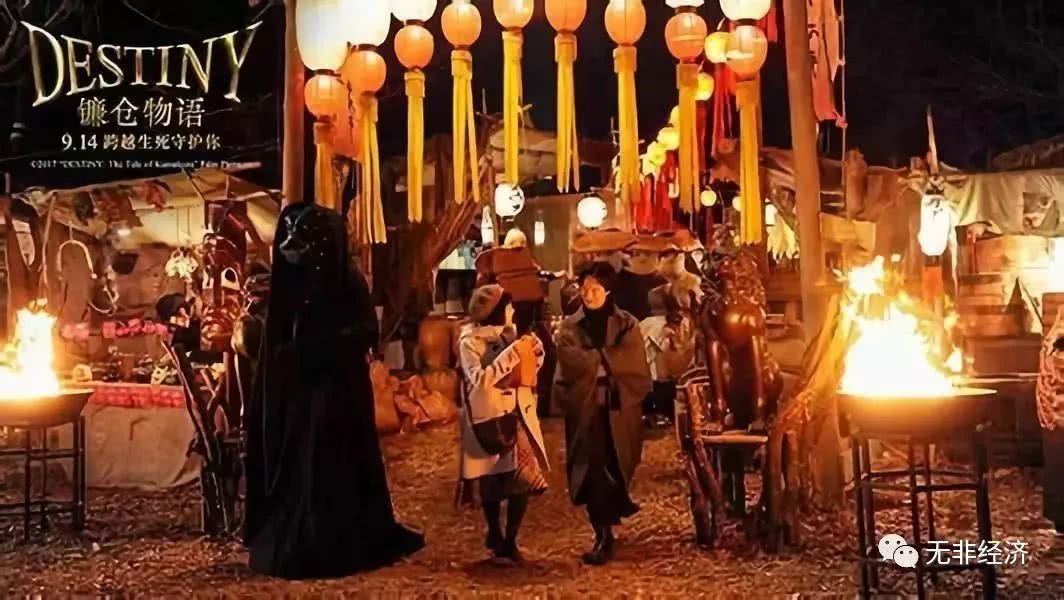
In "The Tale of Kamakura," the ancient capital of Kamakura where the male and female protagonists live has become a city connected to the other world and full of spiritual energy, and all kinds of ghosts, monsters and deities make their appearance:
There is a God of Poverty quietly hiding in the home, a kappa that quickly runs past people's front doors, yokai selling magical creatures in the night market, a mixed-blood fox who works as a police officer, and a Grim Reaper who smiles as he apologizes to people...
The abundance of yokai is a major characteristic of Japanese ghost story culture.
Eastern ghost and monster culture has always differed from that of the West. The appearance of Western ghosts and monsters always gives people a feeling of perversion, madness and bloodshed, while Eastern ghosts and monsters are mostly melancholy and classical; they suffered injustice in life, and after death are tragically beautiful and desolate. Japanese ghost and monster works are different again.
In the film "The Tale of Kamakura," there are all kinds of cute yokai, a Grim Reaper who can show human compassion, a big boss who is not scary at all, and an otherworld full of warmth.
In "The Tale of Kamakura," Isshiki, who grew up in Kamakura since childhood, has long been accustomed to coexisting with ghosts and spirits. After Isshiki's friend dies of illness, he transforms into a frog and continues to silently watch over his family in secret. And Isshiki's family's hired granny, who has already guarded the family for several generations, still exists as a ghost within the family and continues to devote her strength. In addition, Isshiki's colleague who helps handle cases at the police station also has fox blood and is a half-human who can reveal animal nature at critical moments. Toward all these things that seem abnormal but are the most normal of phenomena in Kamakura, the newlywed Akiko is somewhat uncomfortable, but fortunately Isshiki is quite devoted to caring for her.
Director Takashi Yamazaki's "The Tale of Kamakura" focuses not only on a romantic love that crosses the boundary between yin and yang and the river of life and death, but more on portraying death, ghosts and the underworld in a very relaxed, natural and quite interesting way. The underworld is actually just a resting place before another life begins; death is not as frightening as imagined, especially for "good people." Of course, the film does not truly define what makes "a good person," but instead makes assumptions based on dorky cuteness, optimism and positivity in real life. Faced with this self-evident answer, the writer couple's daily life of course involves plenty of showing off affection. The writer is full of acceptance toward his current life, choosing to live a naturally ordinary and motivated life, while the wife is a typical Japanese good wife. In the intervals between repeated fights in the underworld, a monster casually tells them and the audience the truth: it turns out they have already been destined for one another through many lifetimes. The fundamental story of "The Tale of Kamakura" returns to the reincarnation paradigm of the East Asian Confucian cultural sphere, namely the promise that lovers can remain faithful through past and present lives and even death, and be husband and wife (or parents, or brothers) again in the next life.
01
Kappa
When Sakai Masato and Takahata Mitsuki first arrive at their home in Kamakura, a small kappa runs through the yard. In fact, tracing it back to its origins, the kappa was first recorded in China's "Compendium of Materia Medica," where it was called the water tiger and appeared in the waters around Hebei. In Japanese culture, the kappa is a spiritual creature that lives in water, similar in nature to what we call a river god.
The kappa is one of Japan's most famous yokai. Its appearance combines those of a frog, a turtle and a human. Its height is generally between 60 cm and 1 m, its weight is "under 100," its whole body is green, and it secretes mucus. The hair on its body is red, and the shell on its back is impervious to swords and spears.
02
God of Poverty
Another typical traditional yokai figure in "The Tale of Kamakura" plays a decisive role in the story, and this key figure is the "God of Poverty." The God of Poverty is also mentioned in Chinese folk culture, and in Japanese culture, as in the film, the God of Poverty is a thin, slovenly old man. The treasures he holds differ from version to version; in the film it is a cracked bowl, while in legends there are also depictions of him holding a wooden staff or a round fan.
This kind of deity really does like to hide in a family's closet. In some novels, he is said to like miso, so some people avoid making miso soup at home in order to avoid attracting the God of Poverty. Speaking of which, the first meal that Sakai Masato's family serves the God of Poverty in "The Tale of Kamakura" is miso soup with rice.
03
Sky Lantern Oni
The villain's screen time in "The Tale of Kamakura" is not especially prominent, and the image of the villain boss was very likely inspired by the Sky Lantern Oni. In the film, the infatuated "Sky Head Oni," who is deeply devoted to Akiko but is always rejected, has a prototype that looks like a large toad with six legs and horns.
04
One-Eyed Monk
In the film, a One-Eyed Monk also appears in Sakai Masato's courtyard, and this is also a Japanese yokai image with a very high appearance rate in films and anime. Although the One-Eyed Monk exists only as a cute presence in "The Tale of Kamakura," in the "Night Parade of One Hundred Demons Picture Scroll," the one-eyed monk image is very terrifying, often appearing on mountain roads near cliffs, with eyes that emit light as bright as day. The little yokai in the film that hop around the protagonist's yard, play with tops and play games look a bit like "Minions," except they are light purple.
05
The Land of Yomi
The Land of Yomi in the film is the same; its appearance also differs depending on who sees it. People with kind and pure hearts see the Land of Yomi as a place of countless beautiful sights, as if it were a fairyland; people who have done much evil may see a gloomy and terrifying "netherworld."
That's all for today's article. Good night, everyone!