These succulents can bring wealth; if you like them, try growing a pot
01
Qianchuan
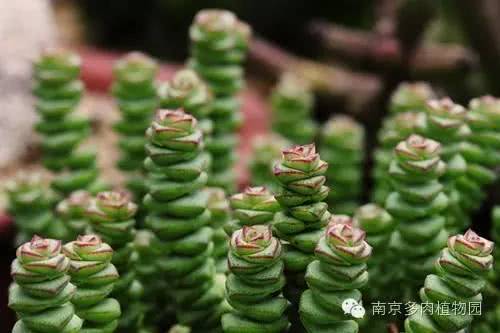
Qianchuan, also called Xingyinv or Qianchuan Sedum, with the Chinese alias Guantongye Shendao, is a perennial succulent herbaceous plant of the genus Crassula in the Crassulaceae family. The plant grows in clusters, with fine small branches, fleshy stems that later become slightly woody, and fleshy leaves that are gray-green to light green, with slightly red leaf margins, which become more pronounced in the cool season from late autumn to early spring under conditions of abundant sunlight. Chuqian Sedum is native to South Africa, and prefers a sunny, cool, and dry environment. It tolerates partial shade, fears waterlogging, and avoids muggy and humid conditions. It has the habit of growing in the cool season and going dormant at high summer temperatures, making it a "winter-type" among succulents.
Meaning
Qianchuan looks like strings of copper coins threaded together, plump and fleshy, making you feel that life can also become more and more abundant like this, our wealth strung together one by one, with happiness overflowing.
02
Tongye Huayue
Also called the money-sucking tree, it is a succulent plant of the genus Crassula in the Crassulaceae family. The original species Huayue is produced in Natal Province, South Africa. Tongye Huayue is a multi-branched shrub form, with obvious round stems and yellow-brown or gray-brown epidermis. The leaves grow in a ring around the stem, densely clustered at the top of the stem or branches. The fleshy leaves are tubular, 4 cm to 5 cm long and 0.6 cm to 0.8 cm thick, with an oblique truncated top. The cross-section is usually elliptical, and the leaf color is bright green and glossy. In winter, the top is rose red, while the other parts, although still green, flash with a waxy luster, extremely beautiful. It prefers a warm, dry, and sunny environment, tolerates drought and partial shade, and is not cold-tolerant. Apart from avoiding scorching sun exposure during the high heat of midsummer, it should be given sufficient light in other seasons.
Meaning
A rarely seen leaf shape, like little suction cups, sucking all good luck and wealth into the tube.
03
Hongsi Yulu
Hongsi Yulu is one type of Yulu, named because red threads are distributed between its leaves; Yulu is a succulent plant of the family Asphodelaceae in the order Asparagales, and is a "soft-leaf" variety among succulents. Yulu plants are exquisite and small, rich in varieties, with crystal-clear leaf colors full of variations, like living artworks. Native to South Africa, it prefers a cool, semi-shaded environment, and its main growing period is in spring and autumn. It tolerates drought, is not cold-tolerant, avoids high temperature, humidity, and scorching sun exposure, fears shade, and also fears water accumulation in the soil.
Meaning
Red in China symbolizes prospering wealth, just as in the stock market red means rising while green means falling. Yulu's fleshy leaves are arranged in a compact rosette, thick and plump, crystal clear, connected by red threads. One of the must-have succulents for business households.
04
Taozhiluan
A succulent plant of the genus Graptopetalum in the Crassulaceae family. Taozhiluan prefers a warm, dry, and sunny environment, has strong drought tolerance, likes loose soil with good drainage and aeration, and has no obvious dormant period. It can accept relatively strong sunlight. It grows well under climatic conditions of warm winters and cool summers, and is not tolerant of hot and humid summer weather. Apart from a brief dormancy during high summer temperatures, it basically grows consistently the rest of the time. When sunlight is sufficient, it presents an intoxicating pink color, with egg-shaped leaves like ripe peaches.
Meaning
Taozhiluan is a succulent plant with bright, dreamy colors and a cute, highly attractive shape. Especially after it has drunk its fill of water, its round, chubby appearance really makes you unable to put it down. Pink symbolizes hope, while the rounded appearance implies reunion, happiness, and completeness. Growing a pot of Taozhiluan might bring good things your way.
05
Hongbaoshi
A succulent plant hybridized from the genus Sedum and the genus Echeveria. The leaves are slender and spoon-shaped, with the front end relatively thick and obliquely pointed, arranged tightly in a lotus shape, and the whole plant is relatively compact. Hongbaoshi's leaves are very smooth, so whether they turn red in autumn and winter or turn green in summer. Overall, Hongbaoshi is not difficult to care for; water thoroughly when the soil is dry, and give as much full light as possible in autumn and winter, and it can turn seductively red.
Meaning
Hongbaoshi is just like a red gem, symbolizing a flourishing life and everything going smoothly. It also implies a change of fortune and good health.
06
Jinqianmu
Jinqianmu belongs to the Portulacaceae family and is named because its thick fleshy leaves are neatly arranged and closely resemble copper coins. Jinqianmu plants are 50 to 80 cm tall, with a large fleshy tuberous stem underground, 5 to 8 cm in diameter; the aboveground part has no main stem, and pinnate compound leaves emerge from the top of the tuber, with each leaf axis having 6 to 10 pairs of opposite or nearly opposite leaflets. The leaves are ovate, thickly leathery, green, with a metallic luster. The spathe is green, boat-shaped, and the spadix is relatively short. Jinqianmu prefers a sunny, warm, and dry environment, tolerates drought, and avoids damp shade, cold, and water accumulation in the potting soil. It is sensitive to high temperatures; when summer temperatures are high, watering should be reduced, or it may cause leaf shrinkage and leaf drop.
Meaning
Jinqianmu's leaves are even more similar to copper coins, with strings of coins strung on rough wooden poles. The green leaves paired with golden-yellow stems give it an air of attracting wealth and treasure. Jinqianmu's leaves are emerald green and glossy, filling the home with vitality when displayed.
07
Huaji
Huaji, also called Qiuhuolian, is a perennial herbaceous plant of the genus Crassula in the Crassulaceae family. The stems are prostrate or upright. The plant grows in clusters, with fleshy leaves arranged alternately opposite each other, closely arranged under normal growth conditions, and the whole plant appears four-angled. It likes a sunny and relatively dry growing environment. The leaves appear light green to bright red under sufficient sunlight. Huaji likes a cool, dry, and sunny environment, tolerates drought, fears waterlogging, and has a certain cold tolerance. In partial shade or shaded places, although the plant can grow, the leaves remain green, making it hard to highlight the variety's characteristics. It likes a cool, dry, and sunny environment and well-drained sandy soil.
Meaning
If Huaji is placed in a sunny spot, it will become very red and dazzling. Looking at it makes you feel that life will surely be flourishing. At the same time, Huaji is very easy to grow and symbolizes tenacious vitality.
08
Golden Boxue Wanniancao
Boxue Wanniancao is a perennial herbaceous plant of the genus Sedum in the Crassulaceae family, widely distributed from southern Europe to Central Asia. Native to Spain, it is also called Jixiaosong. It fears heat and tolerates cold. Its roots are fibrous, the stems grow prostrate, and the leaves are rod-shaped and dense, and it blooms. Golden Wanniancao is a natural variety of Boxue Wanniancao. Golden Wanniancao has low soil requirements; sandy loam or general potting soil is fine, and it is relatively tolerant of poor soil. Of course, peat can also be used. Normally, water as thoroughly as possible when dry, and do not let water accumulate. If the soil is slightly moist, growth will be faster, but be careful of leggy growth.
Meaning
A golden expanse gives a feeling of soaring success, and it also symbolizes wealth rolling in.
09
Fozhu Diaolan
Fozhu Diaolan, also called Zhenzhu Diaolan, is named because its plump, full, emerald-green oval small leaves resemble pearls. It is a succulent plant of the genus Senecio in the Asteraceae family. Zhenzhu Diaolan likes soil rich in organic matter, loose and fertile. It grows best in a warm environment with relatively high air humidity and strong diffused light. In summer, high temperature and high humidity should be avoided, otherwise the stems easily rot and the plant dies. The potted plant can be placed in a rainproof shaded area for cultivation. After autumn, the plant resumes growth, light should be increased, and liquid fertilizer applied. There are also blue pearl diaolan and brown pearl diaolan.
Meaning
Fozhu is a portable ritual implement used by Buddhists for reciting and counting, originally called "prayer beads," originating from the name of upholding the Three Jewels of Buddha, Dharma, and Sangha, and used to eliminate affliction obstacles and retribution obstacles. Fozhu Diaolan is like stringing prayer beads together one by one, calming the heart, with worries and unhappiness leaving along the way, neither arrogant nor impatient, neither sorrowful nor joyful, praying for peace and long-lasting joy.
10
Busi Niao
Busi Niao is another name for the Crassulaceae plant Kalanchoe delagoensis among succulents. It grows bulbs beside bulbs, bulbs on top of bulbs, small plantlets on leaves, seeds inside leaves, and roots from a single inserted leaf; its vitality is extremely vigorous. According to appearance characteristics, it is divided into three major categories: narrow-leaf Busi Niao, rod-leaf Busi Niao, and broad-leaf Busi Niao. A Crassulaceae succulent plant often seen at eaves and wall corners, with super strong vitality, it can reproduce with just a little bit of soil dust. Adventitious buds grow on the leaves, and when they fall into the soil they can become new plants.
Meaning
Not dying means rebirth. In life, there really is no hurdle that cannot be passed; as long as we have a strong heart, new hope can appear in everything. No matter how the world changes, as long as we have love in our hearts, we can withstand all storms, and after the storm comes clear skies.
Source: Nanjing Succulent Garden