Gives birth once every one year and ten months, once extremely numerous, now relies entirely on farming to meet demand
The ocean area on Earth is much larger than the land area, so marine life is also quite abundant. Today, ocean fishing is highly developed, and basically every edible animal in the sea has been eaten by humans, even the once-fearsome sharks cannot escape human hunting. The consequence of this is that many species have been eaten to the brink of extinction. Now many countries have fishing bans, and there are also quite a few marine farms. This has slowed the extinction rate of marine animals to some extent, but it cannot fundamentally solve the problem. Some wild marine animals are now very hard to see.
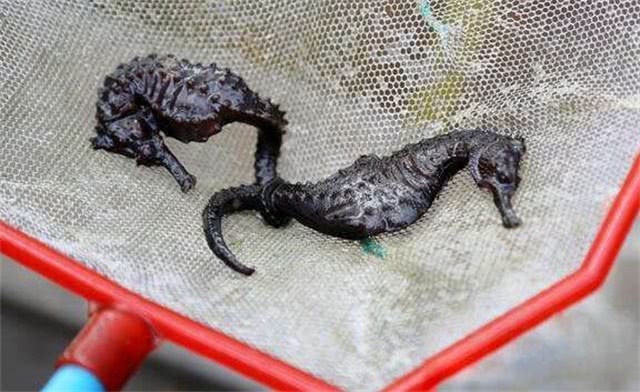
In the coastal waters of our country there is an animal that is small and cute, and even more amazingly, it is a "hermaphrodite" animal. This animal is the seahorse, standing upright in the sea, feeding on plankton. Because its head looks like a horse's head, it is called a seahorse. Even though it is associated with horses, its swimming speed in the water can be described as "turtle-slow." Fishermen can easily catch it in coastal waters. Near seagrass and reefs, it once appeared in huge groups, in enormous numbers.
Except for the coldest January and February each year, the seahorse keeps giving birth during the remaining ten months. In the male seahorse's belly, after 20 days of gestation, it can produce 400-2000 baby seahorses, a very strong reproductive capacity. But it still cannot escape the fate of being endangered. Why?
First of all, environmental problems. Everyone knows that urban development has caused coastal pollution to become more serious than before. The seahorse, an animal that cannot migrate, bears the brunt. The consequence of pollution is that large numbers of seahorses in that area die. This is the main cause of the global endangerment of seahorses, not a special case of our country. In addition, in our country there is another reason, namely that because of the seahorse's unique appearance and name, it is believed to have the effect of tonifying the kidney and strengthening yang, and has become a tonic medicinal ingredient. It is widely used by people to make soup and steep in liquor, so in our country wild seahorses are not only insufficient to eat, but many farms have also been developed.
In traditional Chinese medicine in our country, the seahorse is also called "Long Luizi," meaning the son the dragon left behind in the sea. In our country, the dragon itself is a highly revered mythical animal, so the seahorse is naturally considered to have powerful medicinal effects. It is not only very popular in our country's market; in Southeast Asia, including Singapore and Indonesia, the seahorse is a precious tonic. So seahorse farming has considerable prospects, but the seahorse is a very difficult marine animal to raise, and artificial feeding can even cause it to refuse food, so if one wants to develop this kind of farming, it will probably take a great deal of effort.