Sweet potatoes grown hanging in the air, harvested 4 times a year, yielding 600 jin annually, more than you can eat
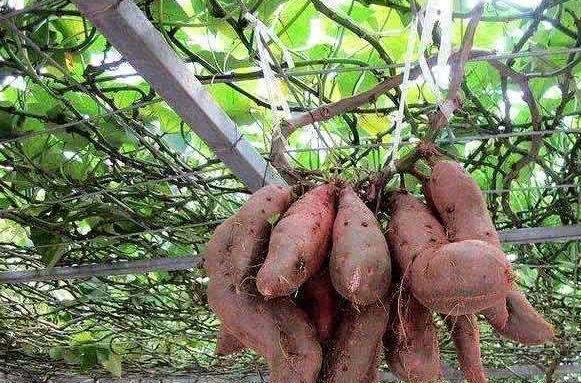
Generally speaking, sweet potatoes are planted in the ground, which means they need soil. The sweet potatoes I've seen are only a few jin at most. Today we're going to introduce a rather impressive cultivation technique. Some people don't need pots or soil - they hang sweet potatoes in the air to grow, and they can survive and even serve as ornamentals. Two benefits in one.
Hang "sweet potatoes" in the air to grow, harvest "4 times" a year, yielding 600 jin annually - more than you can eat!
This cultivation method is mist irrigation. The misted water contains a large amount of nutrient solution, which can be sprayed directly on the sweet potato roots, allowing the sweet potatoes to absorb it faster. With sufficient nutrients, they grow faster and yields increase. We generally apply this to sweet potato trees, also called woody sweet potatoes or woody sweet potato vines. They are perennial shrubs belonging to the tuber crops.
The sweet potato tree has strong adaptability and relatively few pests and diseases. The full growth period is 110-160 days. It can be planted in any region with a frost-free period of more than 180 days. Starch content is 47%, and the drying rate is 60%. In the same year, a single plant yields 90-100 jin, with the highest single plant reaching 120 jin. Each sweet potato tree can grow dozens of sweet potatoes - large ones 7-8 jin, small ones 2-3 jin, and many about the size of a potato.
Nutrient solution cultivation
The advantage of this method is that nutrient solution cultivation can also be used to speed up growth. When the sweet potato roots absorb the nutrient solution, they grow faster. Sweet potatoes grown hanging above are generally larger, with certain differences from those grown in the ground. If you have a balcony at home with enough space, you might want to give it a try.
Harvest is generally in autumn from October to November. Harvest the large ones and leave the small ones, and next year they will grow to over 20 jin. After digging out the tubers, straighten the tree and mound soil around it. The tree itself is unaffected and continues to send out new roots, growing stronger and stronger. If mist irrigation is used, it can supplement leaf surface moisture and carry out intense photosynthesis.
The propagation capacity of sweet potatoes
A flower-loving friend said that a sweet potato he bought had a small spherical shape and was bumpy and uneven. He felt it would be hard to peel and didn't have much flesh. It seemed a pity to throw it away, so he casually buried it in a flower pot and watered it. A few days later, tender green and lovely sweet potato sprouts actually grew - four or five sprouts.
I thought these sweet potato sprouts were very cute, so I transplanted them. Unexpectedly, a few days later more new sweet potato sprouts grew. As I transplanted them out, it kept producing new sprouts. A small, spherical sweet potato has so far sent out 16 sprouts, and who knows how many more it will produce. There's no space left at home to plant them. I remember sweet potatoes used as seed potatoes before were all slender. I never expected a small round sweet potato could send out so many sprouts. Sweet potatoes have very strong propagation capacity.
This is a gathering place for flower enthusiasts, sharing flower care tips. Welcome to follow and exchange ideas.