Why are traditional Chinese landscape bonsai so captivating? You only find out after exploring the reasons
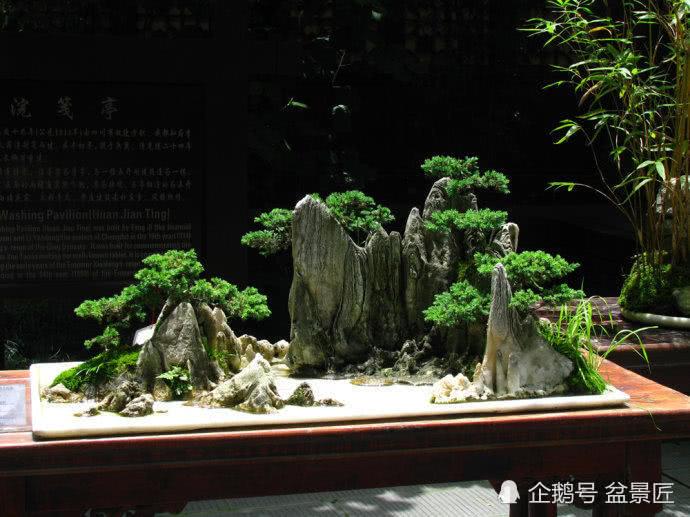
One very important category of bonsai is landscape bonsai. In my personal view, landscape bonsai not only reflects natural scenery, but also reflects the soul of nature even more. That is because its materials are drawn from a wider range, and it also reflects the breath of life more vividly. For example: in a well-made landscape bonsai, some decorations will be added on top, such as: a small bridge, a pavilion, an old man fishing, and so on. So, just as the question in the title asks, which part of a landscape bonsai is actually better able to attract your attention and make you feel that the soul of the work is expressed?
Today, while organizing and downloading landscape bonsai, I noticed the various small ornaments that the creators add later, such as: small bridges, pagodas, pavilions, towers, figures, animals and other decorative pieces. They can make the work look more lifelike, for example, it may closely resemble a scene from a period costume film, or the scene when we go out for a spring outing and suddenly see an old man fishing. All of these make our imaginations run wild. As a foundation, green plants are laid out; for green plants, moss, asparagus fern, orange jasmine and other plants are often chosen. There are also herbaceous plants such as saxifrage. Generally, the choices are plants that easily grow together with the stones. That is because many people have this feeling: the bonsai plants they grow themselves always fail to coexist peacefully with the moss. In fact, moss is a very easy plant to look after; for moss care, keeping up the moisture is enough to care for it very well. In mature works, the moss we see is mostly very realistic. Why do I say that? It is because when these works were made, moss was placed where it should appear; for example, there is more moss on the shady side of the stone and relatively less on the sunny side; there is less on the upper part of the stone, but more on the lower part; in the natural environment there is less at the mountain ridge, but relatively more in the mountain hollow. If you look carefully at these works, the positions where the moss appears are just like natural growth.
What I want to say here is that there are many methods for planting moss, and when planting it you need to distinguish clearly. That is because mosses and liverworts are different plants, and generally there are more moss species. You can spray rice-washing water onto the stones, then place them in a ventilated and shady place so that moss will grow. It is best to let rainwater water them several more times, and the moss that comes out will also be more realistic. There are also many plants whose root systems are placed into the crevices of the stones, and then cultivation soil is used to plug these stone crevices. This mainly serves to fix the plant root systems. For transplanted plants, you need to consider whether the proportions of the plants are in harmony with the overall landscape bonsai. Even more ingenious is that for different parts of these transplanted plants, the plants grown are different. For example, on the top of a landscape bonsai, you certainly need to plant in a bionic way some relatively ancient, withered and sturdy plants, while in the slightly shaded places of the landscape bonsai, that is certainly the place most suitable for plant growth.
It can be said that the overall placement of the stones, the planting of the plants, and the decoration of the small ornaments are integrated into one whole. They are completely traces of nature, with not the slightest bit of artificiality visible. Usually, the landscape bonsai we see, whether the plants on top or the ornaments, all emphasize refinement rather than quantity. They are arranged in a well-proportioned, scattered manner, with some hidden and some exposed, some concealed and some revealed. The choice of colors is coordinated with the surrounding rocks and trees. They display Chinese classical landscape painting to the fullest. Let us return to our earlier question. Is it the stones, the green plants, or the ornaments in a landscape bonsai? Which expresses the soul of this work? Actually, my answer is experience. I do not know whether everyone agrees or not, because only by observing the life around you very carefully and experiencing the charm of nature can you have enough details to present the work. Would you say so?
A complete guide to dealing with common pests and diseases in flower growing; once you have mastered it, you will no longer worry about plants getting sick
Do you know whether lucky bamboo is better grown in soil or in water?
Never fertilize plants casually again; 80% of flowers are burned to death by fertilizer
Hydroponically grown carnations, Chinese roses and cyclamen grow twice as fast as those grown in soil; all the clever tricks are here