Osmanthus Fragrance Fills the October Air: Autumn Is the Perfect Time to Admire Osmanthus
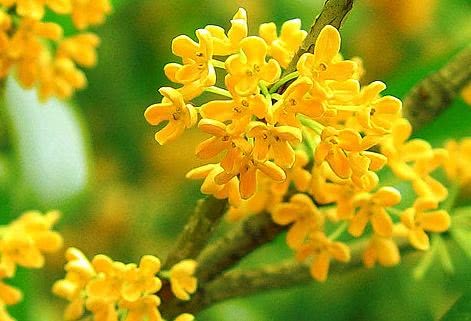
In autumn, osmanthus should be in full bloom, its fragrance filling the air, with golden blossoms and jade-like buds covering the trees. It happens to be mid-autumn, when the feeling of autumn is at its strongest, blooming in all its glory. On a quiet night with a full moon, enjoying osmanthus with wine in hand, the lingering fragrance greets the nose and refreshes the spirit.
Osmanthus is one of China's ten traditional famous flowers. It is an excellent landscape tree that combines greening, beautification and fragrance, offering both ornamental and practical value. Its fresh scent can rid the air of dust, and its rich fragrance carries far and wide, making it truly unique. In ancient Chinese poetry praising flowers, the number of works celebrating osmanthus is also quite considerable. It has been deeply loved by the Chinese people since ancient times and is regarded as a traditional famous flower.
Osmanthus trees have a cultivation history in China of more than 2,500 years.The "Classic of Mountains and Seas: Classic of the Southern Mountains" from the Spring and Autumn and Warring States periods mentions that Zhaoyao Mountain was rich in osmanthus. The "Classic of Mountains and Seas: Classic of the Western Mountains" mentions that Gaotu Mountain was rich in osmanthus trees. Qu Yuan's "Nine Songs" contains the lines "I raise the Big Dipper to pour osmanthus wine, and deck the magnolia cart with osmanthus banners." The "Lüshi Chunqiu" praises it highly: "Among the finest things, none surpasses the osmanthus of Zhaoyao." The "Yuejue Shu," compiled by Yuan Kang and others of the Eastern Han dynasty, records Ji Ni's words in reply to the King of Yue: "The osmanthus seed bears osmanthus, the paulownia seed bears paulownia." This shows that since ancient times, osmanthus has been beloved. By the Tang dynasty, it had even appeared in myths and legends, with Wu Gang chopping the osmanthus tree, the moon rabbit beside him, the fragrance rich and intense, all associated with mid-autumn~
Osmanthus is suited to subtropical climate regions and prefers warmth and moisture.In cultivation areas, the average temperature is 14-28°C, the average July temperature is 24-28°C, the average January temperature is above ℃, it can withstand a minimum temperature of -13°C, and the optimal growing temperature is 15-28°C. Humidity is extremely important for the growth and development of osmanthus, requiring an annual average humidity of 75%-85% and annual rainfall of around 1,000 mm. In particular, young plants and mature trees need more water when flowering. If drought occurs, it will affect flowering. Strong sunlight and shade are both unfavorable to its growth, and it generally requires 6-8 hours of light per day.
Osmanthus prefers warmth and has strong stress resistance, tolerating both high temperatures and relatively cold conditions. Therefore, in China, it can overwinter outdoors in areas south of the Qinling Mountains and the Huai River. Osmanthus prefers sunlight but also tolerates shade. Under full sunlight, its branches and leaves grow luxuriantly and it blooms profusely; in shady places, its branches and leaves are sparse and flowers are few. If grown indoors in pots in the north, special attention must be paid to providing sufficient light to promote growth and flower bud formation. Osmanthus likes moisture but must never be waterlogged, though it also has a certain tolerance for drought. Osmanthus is not very demanding about soil. Apart from alkaline soil, low-lying land, or soil that is too heavy and poorly drained, it can generally grow. However, deep, loose, fertile, well-drained slightly acidic sandy loam is most suitable. Osmanthus has a certain resistance to harmful gases such as chlorine, sulfur dioxide and hydrogen fluoride, and also has a strong ability to absorb and trap dust, so it is often used in cities and industrial and mining areas.
Osmanthus is suitable for planting in well-ventilated, well-lit places, and prefers a clean, airy environment;It is not tolerant of smoke and dust damage, and after being affected it often fails to bloom; it fears waterlogging, and if subjected to waterlogging damage, the root system turns black and rots, the leaves first scorch at the tips, then the whole leaf turns yellow and falls off, ultimately leading to the death of the entire plant; it is not very cold-tolerant, but compared with other evergreen broadleaf tree species, it is still a relatively cold-tolerant species.
Finally, it should be said that in addition to enjoying its fragrance and color, osmanthus also has remarkable benefits.Osmanthus is pale yellowish-white and fragrant, and aromatic oil is extracted from it,to make osmanthus concrete; it can be used in food and cosmetics, can be made into pastries and candies, and can also be brewed into wine. Osmanthus is pungent in taste and can be used as medicine.The flowers, fruit and roots are used as medicine. Flowers are collected in autumn; fruit in spring; roots in all four seasons, and each is dried in the sun. The flowers can dispel cold and break up stagnation, and resolve phlegm and relieve cough. They are used for toothache, cough and asthma with excessive phlegm, and amenorrhea with abdominal pain. The fruit warms the stomach, calms the liver and dispels cold. It is used for deficiency-cold stomach pain. The root dispels wind-dampness and cold. It is used for wind-dampness pain in the muscles and bones, low back pain, and toothache due to kidney deficiency.
——END——
All the excitement is at Huayipai Youzan Mall
Flowers and love | Huayipai