When a succulent grows a flower stalk or blooms, should you pinch it off?
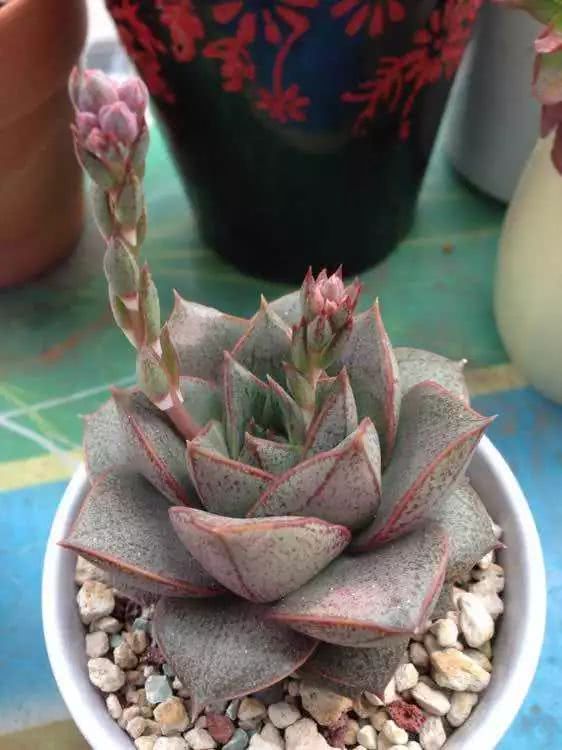
It is said that succulents in their native habitat generally bloom within a year, mostly concentrated in spring. However, having left their native habitat, and with changes in climate, water and other environmental factors, succulents blooming is relatively rare. But as long as the temperature and environment are fairly suitable, succulents can also grow flower stalks or bloom. At this point, many flower lovers struggle over whether to pull off the flower stalk and pinch off the flowers, fearing that the succulent will die right after blooming.
According to horticulturists,succulents blooming is a normal physiological phenomenon, the purpose of which is to reproduce.There are not many succulent species that die right after blooming. Among them, the most typical is the genus Orostachys in the Crassulaceae family, which dies entirely after blooming. For some, such as the genera Sinocrassula and Aeonium, casualties occur when the flower stalk grows out, while in others only the blooming branch dies (for example, Aeonium arboreum 'Zwartkop'), and in still others it merely consumes some nutrients...
Classification of succulents by blooming behavior
Orostachys: dies entirely after blooming
According to horticulturists, succulents of the genus Orostachys in the Crassulaceae family are rather special, basically dying entirely after blooming. For example, Orostachys boehmeri, Orostachys 'Phoenix' and Orostachys 'Fuji' all require attention.
Take Orostachys boehmeri as an example. It is a succulent of the genus Orostachys in the Crassulaceae family, with leaves arranged in small rosettes. The leaf surface has a faint white powder, and the leaf tips turn a beautiful pink in sunlight; in winter, with large temperature differences, the leaves also turn slightly reddish. To prevent Orostachys boehmeri from dying after blooming, you can "behead" it - cut off the flower buds.
It is worth mentioning that although Orostachys boehmeri dies right after blooming, it has a strong ability to reproduce itself in nature. Before blooming, you can move them outdoors; after the flowers die in winter, they will reproduce a new batch on their own the following spring.
According to horticulturists, besides Orostachys succulents, there are also Crassula alba and others, as well as Sinocrassula indica and Sinocrassula deqinensis in the genus Sinocrassula, which also die entirely after blooming.
Aeonium: blooming does not mean dying completely
According to horticulturists, Aeonium succulents themselves look like a flower and are very beautiful, but on the contrary their flowers are not attractive - except for Aeonium 'Velour', whose flowers are stunning. Therefore, for Aeonium succulents, you can cut off the flower buds to stop them from blooming.
It is understood that for Aeonium succulents such as Aeonium arboreum 'Zwartkop', during the blooming process they consume a large amount of their own nutrients. After blooming, the whole succulent becomes very thin and weak, and the blooming branches gradually wither after the flowers fade. However, only the blooming branches die; the others do not die, and new branches will even grow out, so the whole plant will not die entirely.
If you want to admire the stunning flowers of Aeonium 'Velour', you need to pay special attention to its nutrient supply. If you find that the grown flower buds wither before opening, it means the succulent lacks nutrients, and you need to promptly check whether the soil is suitable, whether it has been infected by disease, affected by pests, etc.
Echeveria, Mesembryanthemum and Pachyphytum have stunning flowers
The flowers of succulents in the genera Echeveria, Mesembryanthemum and Pachyphytum are basically all very beautiful, and it is recommended to let them bloom.
It is understood that the flowers of Echeveria are mostly yellow, with some red and orange, and the flowers are very beautiful. Take Echeveria 'Black Prince' as an example: when it blooms, the flower stem extends very long and produces extra-large red flowers.
Succulents of the Mesembryanthemum type look like a pot of wild grass when not blooming, but once they bloom they are stunning, especially when several colors are mixed together, which is very beautiful. The flowers of Pachyphytum succulents are similar to those of Echeveria, but the flower shapes are a bit cuter.
According to horticulturists, these three types of succulents can be cultivated to bloom, and they will not die after the flowers fade; with careful care they can continue to grow well. If you are interested, you can also hybridize them to cultivate new varieties.
Flower stalks need supplementary nutrients
When a succulent grows a flower stalk, it shows the succulent is still growing, and the flower stalk will consume a lot of nutrients to grow and bloom. The leaves at the bottom of the succulent will dry up very quickly. At this time we need to supplement the succulent with some nutrients, so as to avoid consuming too many of its own nutrients and affecting its own growth.
Note that Greenovia dodrentalis belongs to the genus Aeonium and very easily forms clusters, but if only a single plant grows a flower stalk, it should be cut off promptly, otherwise there will be casualties. However, if it has already grown many heads, only the head that blooms will die; the other heads will not die. But the flower stalk consumes nutrients when it grows, so nutrients need to be supplemented promptly.
Flower stalks can also be used for propagation
If you do not want the flower stalk to consume nutrients, you can also cut it off. The cut flower stalk can actually still be used for cuttings. Of course, if the flower stalk has leaves on it, the success rate of cutting will be higher. You can also water-culture the flower stalk to let it bloom; if you just want to admire the flowers, cutting it off and water-culturing it is also a method.
In addition, the leaves on the flower stalk can be removed for leaf propagation. As long as the growth point is still there, leaf propagation can basically succeed. The soil used for leaf propagation should have a certain water-holding capacity and also contain certain nutrients so that the sprouted buds grow better. The higher the air humidity, the faster the succulent will take root.
Tips for handling blooming succulents
1. For succulents that die entirely after blooming or whose flowers are not stunning, you can cut off the flower buds to stop them from blooming.
2. When Echeveria blooms, small leaves grow at the flower stem; these leaves can be used for leaf propagation, and the success rate is quite high.
3. For succulents that grow flower stems, you can cut off the flower stems after blooming and use them for flower arranging (cultivated like fresh cut flowers), generally keeping for about 2 weeks.
4. After succulents bloom, you can put flowers of the same genus together for natural pollination or artificial pollination, and perhaps new varieties can be produced.