Winter rose dormancy outdoors vs. indoor care without dormancy: which is better?
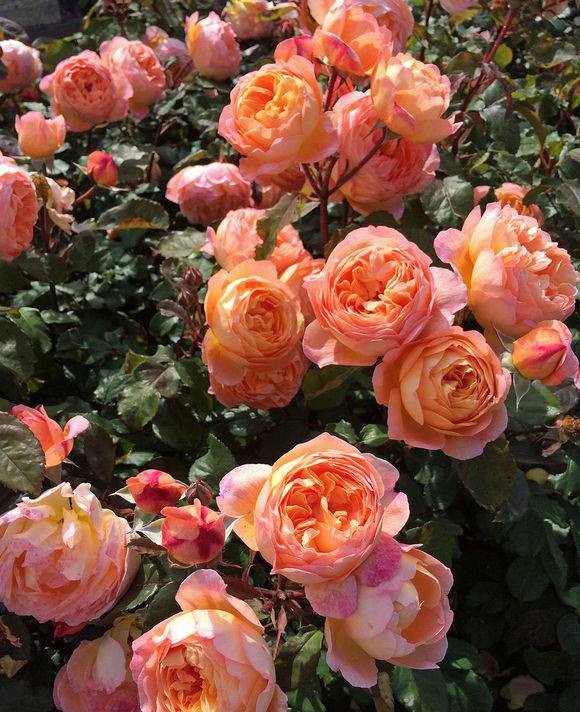
For those who love landscaping and growing flowers, a reader asked: for potted roses in winter, is it better to let them go dormant or keep them indoors without dormancy? I think what the reader is really asking is whether, in winter, it is better to put roses directly outdoors to go dormant or to keep them indoors at normal temperatures so they do not go dormant?
Key point: Clearly, potted roses are naturally in their dormant period in winter, and it is best for them to go dormant. If they are still kept indoors at a suitable temperature through the winter, it easily wastes nutrients, and the following year the new growth will be weak and the number of flower buds will be greatly reduced.
Roses are very cold-hardy plants and can tolerate temperatures down to minus 8 degrees Celsius. Below minus 8 degrees Celsius, they will suffer cold damage. The best temperature for pruning is between 0 degrees Celsius and minus 3 degrees Celsius. So in the south, they can generally overwinter outdoors directly with no measures needed at all, while in the north, where temperatures are very low, the temperature must be controlled, because too low a temperature easily causes frostbite.
Why do roses need to go dormant in winter?
Actually, this is easy to understand. Since plants have a dormant period, there must be a reason for it. The role of the pruning period for roses is to restore energy. After three months of continuous growth and flowering, even though nutrients are constantly supplied, the nutrients in the plant body cannot be fully restored. It is just like how women need postpartum confinement to recover their bodies after giving birth. If they do not recover fully, then the branches that grow in early spring will be thinner and weaker, and it is easy for alternate bearing to occur, or even for the plant not to bloom at all.
What is the difference between outdoor dormancy and indoor dormancy for roses?
I am quite willing to recommend outdoor dormancy, because the temperature can be guaranteed. Indoors, however, since the indoor temperature in most homes is around 5 degrees Celsius (of course, except for air-conditioned and heated homes), temperatures above 5 degrees Celsius will cause roses to break their pruning, which simply means they cannot rest properly and are often disturbed, just like when our sleep is frequently interrupted. After waking up, we definitely do not feel energetic, and roses are the same. So if conditions allow, I suggest outdoor care.
Is it good to keep roses indoors at normal temperature in winter?
If you do not want roses to undergo pruning and instead keep them at normal temperature in winter, you should know that roses are very fond of light and a humid, well-ventilated environment. Obviously, light indoors is insufficient, and if the temperature is high, ventilation is certainly insufficient too, since windows and doors are generally kept closed in winter. Also, indoor air is dry in winter, which is another major reason. Roses grown in such an environment with insufficient light, poor ventilation, and lack of humidity will certainly produce leggy, weak branches, and the flowers they produce will naturally be unsatisfactory. Moreover, without dormancy, they are severely depleted and prone to premature aging.
How should roses be handled for outdoor dormancy in winter?
In winter, what roses fear most is wind dehydrating the branches, the roots easily becoming dehydrated, and the root system being frozen. So after winter begins, when we see the rose leaves turn yellow and curl and the branches also turn red, we prune the rose branches to a height of about 40 cm. Small seedlings do not need pruning. Then, at around 4 degrees Celsius, water thoroughly with antifreeze water, and then cover the roots with soil. Simply put, mound up the soil, which can prevent the roots from being frostbitten after snow.