Bonsai Design Sketch Sharing and Appreciation of New Works by Bonsai Friends
A Brief Discussion on the Role of Bonsai Design Renderings
Recommended Article | Zhijiang Bonsai
A bonsai design rendering is a predictive drawing of how a tree blank will take shape in the future.
Overseas bonsai enthusiasts often conduct rational analysis of their raw material, then hand-draw or computer-composite it, making corresponding adjustments based on the characteristics of the tree form and the tree's movement tendency, producing several or even a dozen renderings, and finally carrying out directional cultivation and processing based on the best rendering.
Personally, I believe that those who practice the art of bonsai need to master the drawing of renderings. I myself often draw my own tree stumps, and over the years I have gained something from it, which I share with everyone.
First, analyze the tree material. For the tree blank to be processed and shaped in the future, you must observe from all sides and choose the best side, the one that maximizes the tree material's strengths and minimizes the exposure of its weaknesses. Most mountain-collected tree blanks have certain unsatisfactory aspects, which requires making certain cuts before the initial blank is planted in soil. Deciduous trees are easier, but once pines and cypresses are cut wrongly it is very regrettable, especially for some rare materials. So at this point, draw a simple sketch of the concept in your mind. When friends are around to exchange ideas, facing the drawing and discussing the result with the raw material at hand, you can make the cutting of the raw blank as ideal as possible.
Second, care for the tree according to the drawing. After the raw blank has been cultivated for a year and survived, and when the buds and branch points are in position, purposefully and directionally cultivate the needed branch pads. While corresponding to the drawing, the grower should understand in their mind the front-to-back and spatial relationships of the branches shown in the design rendering. Images are two-dimensional, while bonsai art is three-dimensional. As much as possible, when drawing, add light and shade treatment to open up the spatial relationships of the tree, the primary and secondary elements, the interweaving, the front and back, and other factors. You can draw arrows at corresponding positions and mark explanatory text, so that whether it is yourself or others, picking up the drawing makes everything clear at a glance.
Third, avoid detours. The first type is that many bonsai enthusiasts, because at the time it was difficult to choose and judge the raw material and they had no clear direction in mind, often end up redoing the work years later. The second type is beginners, who collect or spend money to buy any material they see, and years later, aside from spending money, end up with a pile of wasted stumps and time consumed for nothing. Although learning takes time and money to buy experience, I personally believe the intermediate steps can be reduced. There are several ways for me to improve my understanding, and one of them is drawing renderings. Through drawing in large quantities, you come to know the strengths and weaknesses of the raw material itself, where the beauty and lack of beauty in bonsai lies, and the difference between the mediocre and the elegant.
Finally, combined with the sketch, design the final exhibition rendering. Since exhibition requires the coordination of pots and display stands, this gives bonsai enthusiasts a certain understanding and room for thought in improving and using appropriate pots and stands. The various temperaments of the tree itself, such as towering, open and spacious, majestic and extraordinary, refined and elegant, and plain, will greatly weaken the beauty and artistic appeal of the work if the pot and stand pairing is inappropriate. In addition, besides pots and stands, there should also be some accessories, such as hanging scrolls and viewing stones, etc. In the combination of items, this reflects the natural beauty and the beauty of artistic conception of bonsai.
The images above are all hand-drawn pine and cypress bonsai works by the teacher, for everyone to reference and use in future bonsai making.
Wenzhou, Zhejiang @Houtianlaige Self-recommended bonsai design drawings are as follows:
Chongqing bonsai friend@Wen GuolinRecommended bonsai as follows:
The essence of bonsai is "nature": fruit trees under the clear mountain breeze; sturdy pines standing on cliff edges; deciduous trees growing in pursuit of sunlight. Bonsai is about condensing these scenes into a small flower pot, making full use of the characteristics of each tree species to shape a free and easy tree form.
There is no bend in the trunk; from the root base to the treetop it is all straight. The roots are also very important; in this case it is generally considered best to have roots spreading in eight directions.
A tree posture and spirit that is majestic and upright, towering and steadfast, with ancient trees reaching the sky. Its form is concise and brisk, dignified and elegant, and it also gives people an artistic feeling of unyielding perseverance and striving upward.
Although it is still largely straight, there are still some bends, and overall it looks as if it is being blown to one side by the wind.
An excellent tree form should have a perfect root spread, a rugged upright raised base, and a trunk of moderate thickness, thick at the bottom and thin at the top.
The trunk has extreme bends near the roots, with a unique posture, and the branches twist upward like a coiled dragon.
"Bent into a coiled posture, winding in dragon form" is a vivid portrayal of the curved-trunk style bonsai. It conforms to the commonly recognized appreciation habit of "beauty in curvature" for shaping.
It is roughly in a natural state between the straight trunk and the curved trunk. The curved trunk form is ever-changing; as long as you work according to the material, you can create a perfect work.
The main trunk is slightly curved, and the overall form appears both precarious and stable, vivid and expressive, embodying the unified artistic effect of the balanced changes of movement and stillness in the tree's momentum.
Bamboo secluded in the mountains and wilds; a few stones and a few clumps of bamboo are enough to make one linger.
The tree roots fall into the pot soil, so it does not count as a true root-on-rock bonsai.
The beauty of clustered bamboo lies in proper density and well-arranged irregularity; the composition is clear and natural, only then can it be captivating.
There are two types, water and dry; because plants need to be grown, dry pots are mostly used, that is, pots with holes.
Root-on-rock bonsai reflects the natural appearance of trees growing on rocks. It is an exaggeration and close-up of the image of trees tenaciously growing in cliff crevices or on mountain peaks and rock summits, rich in content and profound in artistic conception.
Fully expressing the lushness and depth of natural forests.
Let the long roots go deep into the crevices of the rock, so that rock and tree become one.
The forest-style bonsai is a miniature of mountain and wild forests. It is a unified yet richly varied whole composed of multiple trees.
Generally, single-trunk forms are the majority, with a thin and vigorous main trunk, either upright or inclined, and occasionally in a cascade or waterside form, but the branches are all concentrated at the top of the main trunk.
One root with two trunks, with the main and secondary trunks both extending beyond the pot: the main trunk hangs heavily; the secondary trunk follows the momentum of the main trunk, and can also twist above to form a crown.
The shaping of a double-trunk large tree combines the essence of the natural large tree form and the conventional double-trunk form.
A slender trunk paired with interesting curves, with not many branches and leaves but one branch growing very tall, emphasizing the slenderness of the trunk. In order to show a slight flavor of dryness, it is better to tilt the trunk slightly.
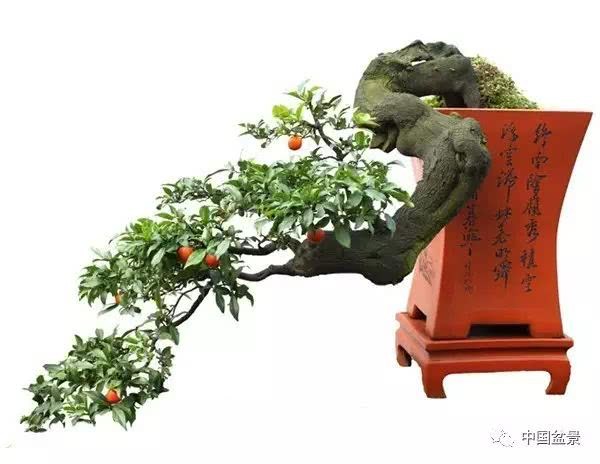
When the trunk hangs downward starting from the root base, it is called "cascade"; if it is the branches that hang down, it is called "semi-cascade."
Hanging roots and exposed claws, firmly gripping the rim of the pot, fearless in the face of danger.
Cascade-style tree stumps are a general term. In detail, there are large cascade, semi-cascade, inverted-hanging head-raised cascade, probing-branch cascade, hook cascade, double-trunk cascade, three-trunk floating-branch semi-cascade, downwind-style floating-branch cascade, wall-hanging cascade, and moon-scooping cascade. They share the same characteristics but also have their own features.
Weeping-branch bonsai has a unique aesthetic feeling in appreciation.
Five trunks, seven trunks, nine trunks... composed of several branches and trunks, it is called one-root multi-trunk.
Clump-growing plants are plants without obvious distinction between main trunk and branches.
When planting two specimens together, first distinguish the host and guest. The main tree occupies a prominent position, and the companion tree is arranged around the main tree; they must not each go their own way.
The feeling of branches flowing to one side with the wind is very similar to the slanting trunk; the difference between the two is that in the wind-swept flowing style, all branches are fixed to one side.
An artistic reproduction in a tiny pot of mountain and wild forests battling fierce winds; it is a static dynamic-momentum form in stump bonsai art that seeks movement within stillness.
Connected-root style, commonly known as "crossing the bridge." When making it, lay the tree horizontally in the pot, cover the trunk with soil, and wait for new shoots and new roots to grow. Gradually raise the roots, and through shaping, pruning, and other techniques, a connected-root style bonsai can be made.
Double trunk again. Relatively speaking, the single-trunk style's "scene" is more abstract and monotonous, while the double-trunk style, because the two trees reference and contrast with each other, turns monotony into liveliness, and its "scene" is richer in interest and more intuitive than a single-trunk tree.
Rebirth? I think it should be one-root clump-growing. Under normal circumstances it is a gift from nature; artificial cultivation takes a long time and is difficult, so choosing natural collected mountain stumps to cultivate one-root multi-trunk forests becomes a shortcut.
Wonderful replay:
Chinese bonsai welcomes you!
Enjoy at any timeAppreciateBonsai Exhibition Hall
Promote bonsai culture, exchange bonsai techniques!
Appreciate bonsai art, share a happy life!