Master the measure of life, and savor the award-winning bonsai Mountain Mandarin
[Bonsai enthusiast's reflections]
Text by | @Zhou Yingzhi, Xiamen, Fujian
Image recommended by | Ouyang Yucheng
Life has its measure, society has its limits; when the mind is calm, the measure lies level, and when the mind is clear, the measure is accurate. When measure and limit combine perfectly, life gains direction, society gains rules, and the world becomes beautiful because of it.
Master the measure of life, and the inner world gains depth. As the sea admits a hundred rivers and a cliff stands a thousand fathoms high, with a breadth of mind like mountains and seas, wherever one lives, one can rise above the mundane and move freely with ease.
Measure governs life, and the inner life gains breadth. Loosen the measure within your heart, and the whole world will make way for you. Measure yourself, illuminate the world, face honor and disgrace, rise and fall with composure, and once the mind is at peace, the road naturally grows wider with every step.
The finest way to live is none other than running along the road of ideals together with a group of like-minded people!
-- Looking back, there is a road full of stories;
-- Looking down, there are firm footsteps;
-- Looking up, there is a clear distant horizon.
Life has no rehearsals; every day is a live broadcast. Grasping well the time of each day is the best way to cherish life.
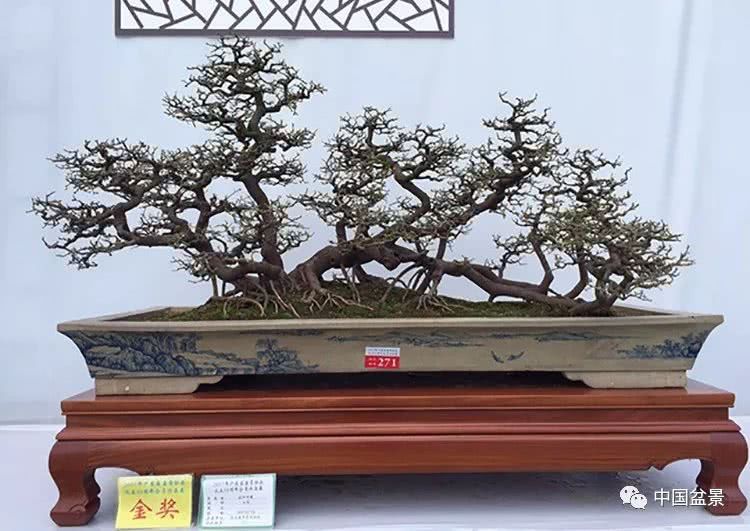
Mountain Mandarin bonsai, collection of Wang Jinglin
Mountain Mandarin bonsai, collection of Li Bingtian
Reading award-winning works closely: the Mountain Mandarin chapter
Images and text by | A Bonsai Amo
This article was first published on "A Bonsai Network"; copyright belongs to A Bonsai Amo
Preface: Dongfeng Ju, commonly known as Mountain Mandarin, belongs to the genus Atalantia in the family Rutaceae, an evergreen species with verdant leaves that never fade all year round. It tolerates shade, drought and barren soil, and has exceptionally strong vitality. As a medicinal plant it is named Jiubing Jin, also known as Shanjujin; it is in the same family as but a different genus from the wild mandarin we usually speak of, and is certainly not the mandarin tree depicted in Qu Yuan's "Ode to the Orange" with its "layered branches and sharp thorns, round fruits hanging". Because it mostly grows on gentle slopes near the coastline in the south, Mountain Mandarin has risen sharply in status in Lingnan bonsai in recent years. Like the Buddhist pine, it is loved by more and more bonsai friends. Mountain Mandarin has gradually developed into one of the commonly used characteristic tree species in the Lingnan bonsai art world.
First, let us look at the gold award work
Huang Jitao (Leisure and Elegant Charm, Mountain Mandarin 120×120, Gold Award, 86.71 points)
This work is not unfamiliar to us; it first won a gold award at a bonsai exhibition while in the hands of Mr. Zhu Bennan.
This is a bonsai with a double slanting trunk style, and the work above all requires abundant years of skill. Even in Lingnan, Mountain Mandarin has the trait of being difficult to build branches on, as branches form slowly, so the time needed for a bonsai to take shape is relatively long. This work has full, abundant branches and trunks and an aged tree appearance, which could not be achieved without many years and months. The root base of the work curls like a dragon's claw, solidifying the foundation of the whole tree; the two trunks, one large and one small, lean on each other in thickness and support each other in height, lively and full of charm. The branches and trunks of the work are evenly distributed, regulated with measure, and each branch extends naturally, deeply capturing the painting principle that no branch is straight for even an inch. The dense large and small branches filling the tree are lush and abundant yet give no feeling of clutter, as if everything were born this way and formed naturally, with every branch and node fully accounted for, perfectly embodying the wonderful Lingnan technique of building branches.
Tree top:
Side view: the bonsai pot uses a traditional Lingnan Shiwan pot
Root base
Details
Daily maintenance state.
Lu Zhiwen (Mountain Mandarin, specifications: 130×118, Silver Award, 85 points)
Ouyang Guoyao (Mountain Mandarin 150×70, Silver Award, 83.29 points)
This is also a familiar work, which once won a gold award.
Huang Zengquan (Leaning on Each Other, Mountain Mandarin 48×120, Silver Award, 80.29 points)
Ouyang Mantian (Mountain Mandarin, specifications 60×65, Bronze Award, 73.86 points)
Li Shiling (Dongfeng Ju Charm, Dongfeng Ju, specifications 110×120, Bronze Award, 72.71 points)
Little facts about Mountain Mandarin:
The best time to collect Mountain Mandarin is after the Start of Spring and before Qingming. Mountain Mandarin fears cold; if planted before the Start of Spring, plastic film bags must be used to keep it warm. After Qingming, temperatures gradually rise, which is unfavorable for survival. Mountain Mandarin and Orange Jessamine both belong to the Rutaceae family. Orange Jessamine roots must not be soaked in water for long periods, but Mountain Mandarin can be soaked in rooting agent for 24 hours without harm, and instead sends out roots rapidly and sprouts uniformly.
Next, let me introduce the maintenance methods for Mountain Mandarin bonsai
Transplanting time for collected wild stumps:It is recommended to dig them around Qingming in March and April. After May, they are not suitable for collection, as problems such as high temperatures and exposure to the sun can easily scorch young buds, cause branch dieback, or even death. After digging them back, do not rush to plant; soaking them in rooting agent before planting is beneficial for growth. As long as the roots of Mountain Mandarin do not rot, it can basically survive, so the early stage is very important.
Selecting stumps:Since Mountain Mandarin does not grow quickly and thick branch pads are relatively difficult to cultivate, when selecting stumps it is best to choose stumps with companion transition branches and small cut surfaces.
Trimming stumps:Before planting, trim the stump and cut the roots in one go. It is best for the roots to be balanced and not take up the pot. Use a sharp knife to make a 45° circular cut at the root ends, enlarging the cut area of the root bark and trying to make the root bark at the root ends smooth. Seal the cut ends of the trunk with self-adhesive tin foil.
Soil:Use coarse river sand soil; some also say sea sand is acceptable (this should relate to the original plant and its growing location), but I have not tried it so I do not recommend it. Cover the roots with soil to about 2-3 cm. For repotting and changing soil, a mix of mud and sand can be used, with a ratio of pond soil + sand soil at 8:2, for planting. After planting well, place it in a spot with good light but able to provide shade, avoiding direct strong light that affects growth. But it must not be fully shaded; full shade easily causes root rot.
Watering:Mountain Mandarin itself is drought tolerant. Many beginners cause the plant to die from root rot due to overwatering, so after planting well, just spray water to keep the soil surface moist. Keep the moisture level at about 2 cm of the soil surface, and that is enough. After budding, increase the watering frequency. Once the work has taken shape, watering once about every 20 days is enough, and each watering should soak through at once.
Light:Provide shade in the early stage. When the leaves become thicker and take on a dark green glossy color, it indicates that the stump has grown new roots well. At this point, light can be increased and thin fertilizer can be applied. Once growth is stable, routine management can begin.
Fertilizing:Apply thin fertilizer when buds appear in spring. After temperatures rise, gradually increase fertilizer and water. Apply decomposed farmyard manure + solid cake fertilizer on the pot surface, and apply water-soluble fertilizer once a week, which can make new branches grow more healthily and thicken more noticeably.
Other notes
If water sprouts lose water and stop growing, prune them promptly, and do not be reluctant to do so. Just retain the growth position of three or four leaves. This can reduce dehydration and nutrient loss so as not to consume nutrients. If Mountain Mandarin flowers and fruits, promptly remove the green fruits.
Repotting:Mountain Mandarin recovers slowly from growth. Generally, after growth has recovered, repotting into an ornamental pot takes about 3 years, carried out at the Start of Spring, which is beneficial for rapid growth recovery later. While repotting, prune and heavily cut the root system, and replant into a shallow pot. After about 30 days, begin selecting and keeping strong buds and shape them appropriately.
Pruning:Mountain Mandarin is heavily pruned once every year at the Start of Spring. After new buds appear, pinch the tips once as needed. In about 15-20 days, secondary buds will appear at the pinched points, achieving a speed of 2 nodes per year. Generally by the 6th year, when the stump reaches 8 nodes, the work is basically formed. After formation, only short pruning is needed. Young branches will gradually increase over time, and the work will become more vigorous and full, reaching its best ornamental period. In addition, after Mountain Mandarin has formed, leaves can remain on the stump for as long as 3 years, so protect them well and do not pick them randomly unless necessary.
Mountain Mandarin bonsai "Like Shadow Following Form", collection of Huang Jitao
Links:
Scoring standards (for judges' reference only when making comprehensive scores; not used for individual item scoring):
1. Title, 3 points
The title is apt, concise and elegant, with profound meaning; it is a high-level summary of form and connotation, the finishing touch.
2. Scene, 85 points
Skillfully apply the creative principles of bonsai art, and be able to use various good techniques and branch methods proficiently and ingeniously for creation, with bold innovation and rich creativity. Exhibited works are highly mature, reasonably laid out, clearly layered, beautifully composed, and rich in poetic and painterly quality. The works are rich in connotation, with both form and spirit, achieving an artistic effect that originates from nature yet is higher than nature.
3. Matching pot, 7 points
The shape, size, texture and color of the matching pot suit the work appropriately, so that pot and scene bring out the best in each other; the terrain and landscape treatment on the pot surface is natural and beautiful, elegant and generous.
4. Stand, 5 points
The shape, size, height and color of the stand are coordinated with the bonsai arrangement, fully expressing the beauty of the bonsai to achieve the best ornamental effect.
Scoring method
Scoring adopts a 100-point comprehensive scoring method. Judges, according to the scoring standards and scoring method and the number of awards decided by the organizing committee, separately give a comprehensive score to each exhibited work. In order for each judge to grasp the scoring measure well and smoothly complete the scoring work within the stipulated time, when judges review exhibited works, the score for each bonsai work shall not be lower than 65 points; for gold awards, scores are controlled at 91-98 points; for silver awards, controlled at 81-88 points; for bronze awards, controlled at 71-78 points, with a 2-point interval between each grade, to prevent excessive overlapping scores that make final determination difficult. If, in the calculated award results, overlapping scores appear at the end of an award tier and it is difficult to determine the award, judges shall vote by a show of hands on the tied works, and the decision shall be based on the majority vote.
Scoring calculation method
The scoring calculation method is: after judges finish scoring, under the supervision of the supervisory committee, professional personnel use computer software to calculate the scores. For each work's score, according to a preset program, one highest score and one lowest score are removed, and the average of the remaining total score is the work's final assessed score. Then, according to each bonsai work's score, the awards for winning works are ranked in order from high to low. The calculated scoring results are handed to the judges and supervisory committee for review and signature confirmation, then handed to the exhibition organizing committee to publicly announce the scoring results.
Bonsai friends@Ouyang YuchengRecommended bonsai as follows:
Highlights replay:
Chinese bonsai welcomes you!
Enjoy at any timethebonsai exhibition hall
Promote bonsai culture, exchange bonsai skills!
Appreciate bonsai art, share a happy life!