Goji berry king and Taiwan chrysanthemum exceed pesticide residue limits, yet packaging states inspection by the Agricultural Chemicals and Toxic Substances Research Institute as passed
Be careful with Chinese medicinal herbs commonly used in autumn and winter! The Taipei City Government Department of Health conducted spot checks on 19 products sold on the market, three of which did not comply, including the "Organic Goji Berry King" product, which was found to contain the pesticide residue fenpyroximate at 0.07ppm, and the packaging also bore the words "guaranteed to pass inspection," constituting false labeling; another product, "Taiwan chrysanthemum," was found to contain the insecticide chlorantraniliprole residue at 0.06ppm, failing to meet the "Standards for Pesticide Residue Limits," and the packaging also bore the words "passed inspection by the Agricultural Chemicals and Toxic Substances Research Institute, Council of Agriculture, Executive Yuan," constituting false labeling.
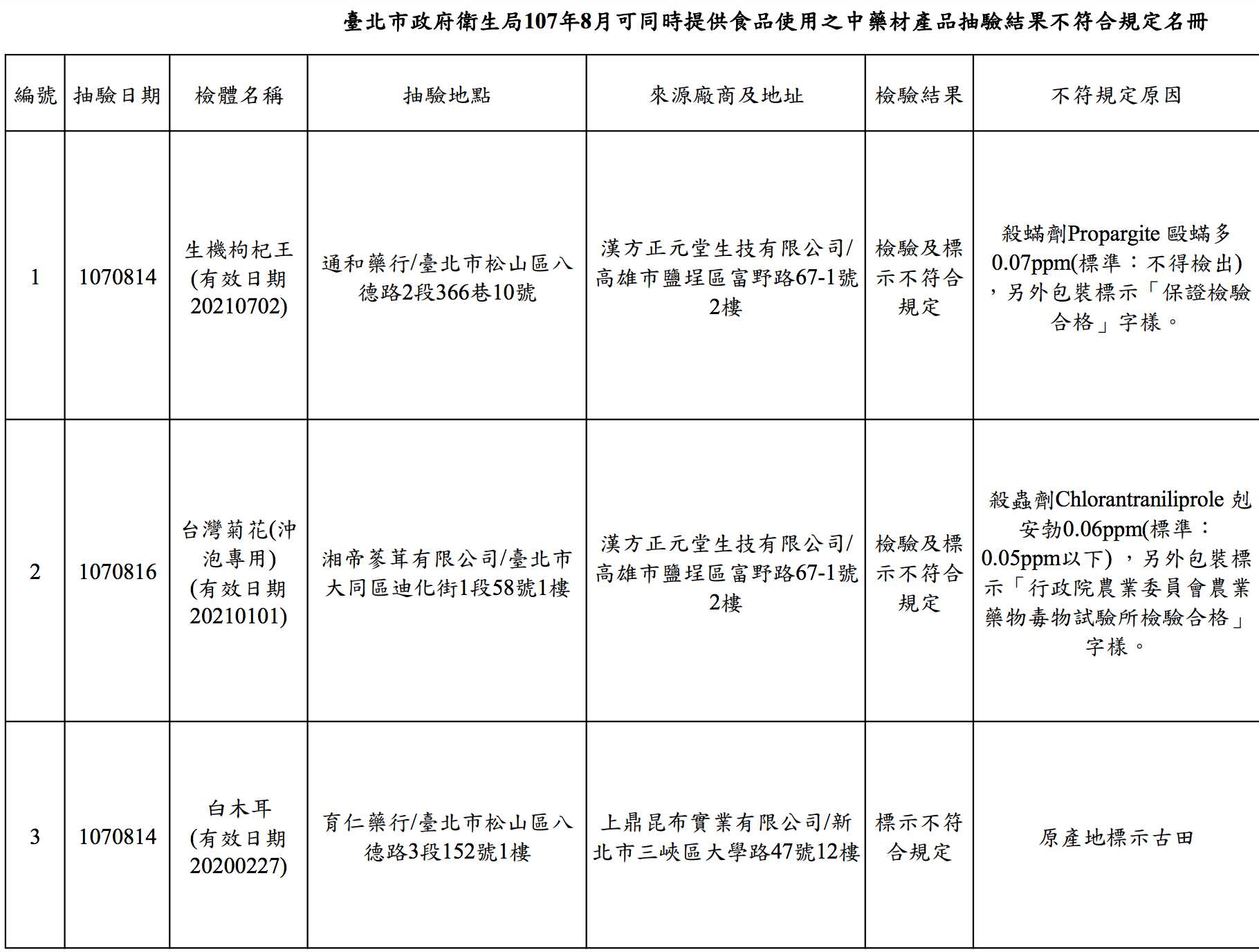
Department of Health: Pesticide residues exceeding limits require fines
The Department of Health stated that products found to contain pesticide residues exceeding the "Standards for Pesticide Residue Limits" violate Article 15, Paragraph 1, Subparagraph 5 of the Act Governing Food Safety and Sanitation, which states "pesticide or veterinary drug residues exceeding the safe tolerance level," and under Article 44, Paragraph 1, Subparagraph 2 of the same Act, the responsible business operator may be fined a minimum of NT$60,000 and a maximum of NT$200 million. Packaging product labeling that fails to comply violates Article 28, Paragraph 1 and Article 22, Paragraph 1 of the Act Governing Food Safety and Sanitation, and under Article 45, Paragraph 1 and Article 47, Subparagraph 7 of the same Act, the responsible manufacturer may be fined a minimum of NT$40,000 and a maximum of NT$4 million, and a minimum of NT$30,000 and a maximum of NT$3 million.