The stick-leaf orchid has an odd and extraordinary form; most people have never seen it.
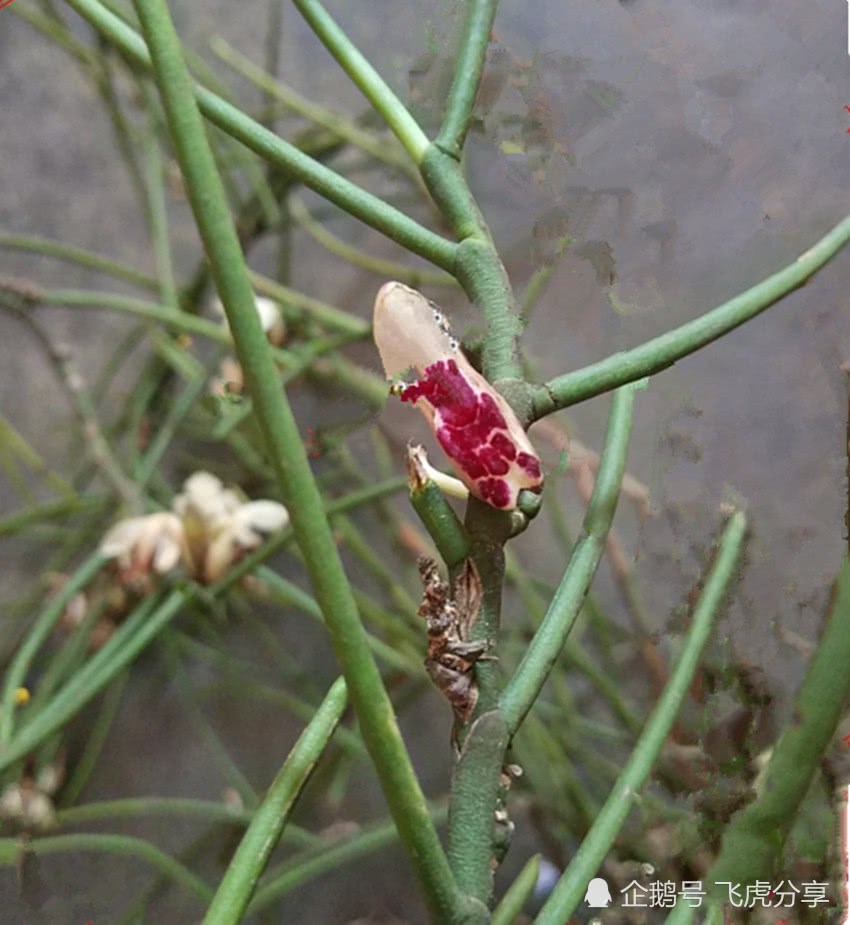
The stick-leaf orchid, also called chaizigu, is a native orchid species. Its stem is erect or leaning, hard, cylindrical, with many nodes and many alternate leaves. The leaves are fleshy, leaning or slightly arched upward, cylindrical. The raceme is opposite the leaves and usually bears 4-6 flowers; the flowers are pink and bloom from April to May.
The stick-leaf orchid is a native orchid species, growing alone and rarely, with only round leaves on the whole plant. It blooms twice a year, once in spring and once in autumn. The flower looks like a crawling red spider and is very peculiar and odd in appearance. It is very beautiful and has extremely high ornamental value.
The stick-leaf orchid is characterized by preferring shade, fearing long periods of direct sun, and not tolerating cold; it is an epiphytic plant and is not suitable for soil cultivation. It is best to use epiphytic substrate materials such as bark, stones, tree stumps, and wooden boards. For pot cultivation, bark, leaves, crushed stone, and wood shavings can be used as substrate. Routine care is simple, and watering should not be too frequent.
The stick-leaf orchid is an epiphytic orchid; its pseudobulbs are relatively small, and its leaves are fleshy and cylindrical. The raceme is borne at the base of the pseudobulb; the sepals are slightly larger than the petals; the inflorescence is 10 cm long and bears 1-6 flowers, with narrow and long petals and sepals, white, and purple spots at the base of the lip; the flower diameter is 5 cm, and it is fragrant. During care, give it sufficient water and relatively high air humidity. In summer, provide 50%-70% shade; in winter, provide no shade or little shade. Other care methods are basically the same as for ordinary orchids, but when watering, wait until it is dry before watering, to prevent root rot from too much water and waterlogging.