Why does chest impediment occur? This article will help you understand chest impediment
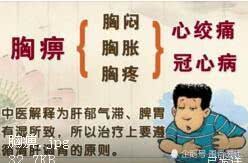
Chest impediment, in terms of sensation, is most obviously chest pain, but for ordinary people, chest pain generally does not bring chest impediment to mind, because ordinary people do not understand chest impediment. Chest impediment is a disease name in traditional Chinese medicine, encompassing respiratory system diseases, cardiovascular system diseases (the main focus), and other systems or tissues and organs in Western medicine that cause chest pain. Some chest pain is actually stomach pain from digestive system diseases, which is easily confused. Therefore, one should first understand the manifestations of chest pain caused by chest impediment.
Symptoms of chest pain from chest impediment and their corresponding Western medicine disease names
That is to say, what does chest pain caused by chest impediment feel like to the patient? Traditional Chinese medicine says that when chest impediment causes chest pain, in the chest it is often a kind of dull, oppressive pain, and in some cases the pain even extends through to the back, with panting and an inability to lie flat; this is a manifestation of chest pain in which the condition is already relatively serious. However, the chest pain caused by the earliest stage of chest impediment in traditional Chinese medicine generally struggles to draw people's attention, because the earliest chest pain of chest impediment is only a sensation of chest tightness, unsmooth breathing, and the like.
Therefore, in most people's mindset, they think this is not chest pain, and this needs to be corrected. In fact, from the perspective of Western medicine, at this point the patient already has heart disease, only in its mildest form. From the perspective of traditional Chinese medicine, at this point you are already a patient with mild chest impediment, with a uniquely favorable opportunity for treatment. But for most people, this opportunity is missed. As it progresses, the chest pain that people recognize in their mindset will appear.
At this point, the chest pain can basically be said to be heart-rending, with piercing pain in both the front of the chest and the back, and sometimes it is also filled with unbearable feelings of tightness and suffocation. In terms of the condition, whether it is heart disease in Western medicine or chest impediment in traditional Chinese medicine, it has already reached a serious or extremely serious degree. The traditional Chinese medicine term "chest impediment" first appeared in the *Jingui Yaolue* (Synopsis of the Golden Chamber) written by Zhang Zhongjing in the Han Dynasty, which pointed out the pathogenesis as "yang slightly weak and yin string-taut." Yang slightly weak means yang qi is faint and weak, and how should "yin string-taut" be understood? There is an ancient saying, "swords drawn and bows bent," and here yang slightly weak and yin string-taut is a metaphor indicating that the yang qi of the upper jiao is weak and deficient, while the yin cold qi of the lower jiao is abundant and exuberant, with deficiency in the root and excess in the branch.
The development of coronary heart disease