Detailed Explanation of the Bending and Tying Methods and Techniques for Suzhou Bonsai
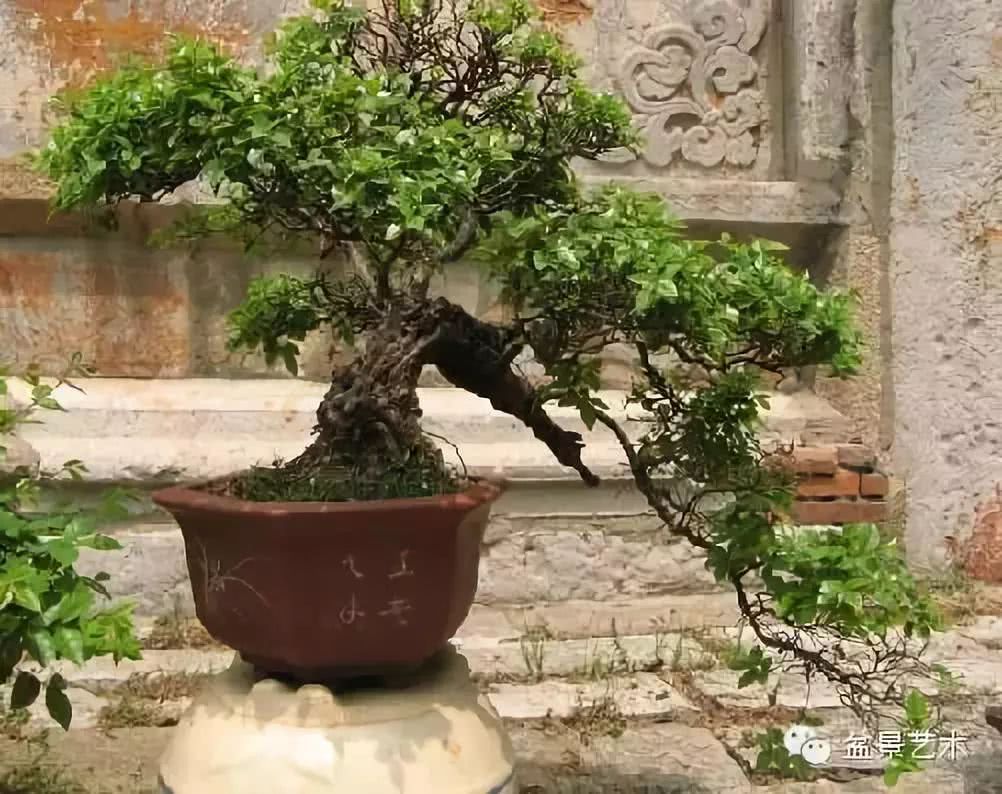
Suzhou stump bonsai is mainly based on pruning, with tying as a supplement; coarse tying and fine pruning, pruning and tying used together. Among these, bending, tying and pruning are the key to shaping the stump. Now the focus is on introducing its branch bending and tying. Suzhou stump bonsai traditionally uses palm fiber for bending and tying. The palm fiber harmonizes with the color of the bark, and after bending and tying, the stump can already be viewed ornamentally. The key is to master the anchor points for the palm fiber when bending and tying, and the thickness of the palm fiber must be chosen appropriately.
1. Full tying method
All the material is nursery stock; from the trunk (main trunk) to the branches (branch pads), everything must be bent and tied. The branch pads are divided into three types: "tai, tuo, ding." "Tai" refers to the branch pads on both sides of the main trunk, "tuo" refers to the branch pads behind the main trunk, and "ding" is the branch pad at the top of the main trunk. First tie the main trunk, then tie the branch pads. The main trunk is tied from the lower part upward; before tying, first determine the viewing side (front) of the stump, then determine the styling pattern according to the natural posture of the stump. Bending and tying patterns include the coiling dragon style, the reclining trunk style, or the cascade style, etc. Taking the coiling dragon style as an example, its characteristic is that the main trunk forms an 'S' shape, spiraling upward. When bending and tying, the front of the stump faces forward; according to the thickness of the main trunk, choose appropriate palm fiber and secure it at a suitable spot on the lowest part of the main trunk, preferably at a node or scar, where the palm fiber is less likely to slip. Then move the palm fiber left and right a few times, choose a suitable spot on the upper part of the main trunk, tie and secure it, and the first curve of the main trunk is complete. The second and third curves are the key to bending and tying. The lower position of the second curve is generally about one-fifth upward from the middle of the first curve; after securing the palm fiber, twist it left and right a few times, then choose a suitable spot on the upper part of the main trunk and tie it. For the third curve, simply bend and tie upward along the "S" shape.
2. Half tying method
For those dug up from the wild, the main trunk is generally already set in form and cannot be bent for tying. For such stumps, the styling pattern should be determined according to the natural form of the trunk, and only the main branches are bent and tied.