Key Points and Detailed Methods for Making Wall-Hanging Bonsai
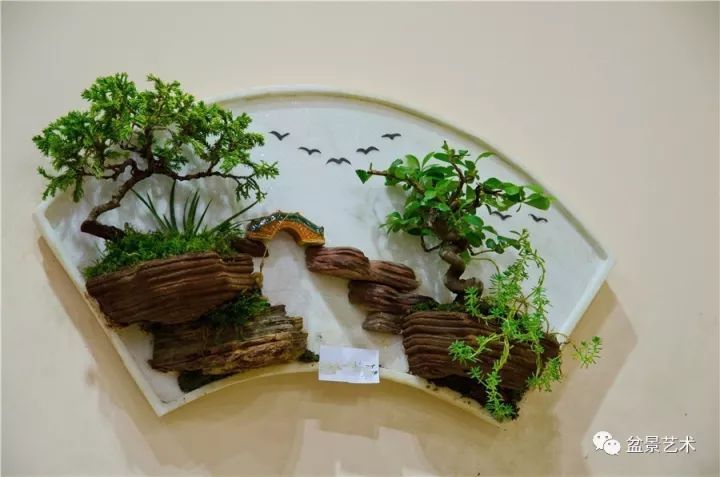
Wall-hanging bonsai is a new type of bonsai artwork created by bonsai practitioners who cleverly combine traditional bonsai art with the crafting techniques and forms of arts and crafts such as shell carving and bark painting, while absorbing the essence of Chinese painting and calligraphy.
Wall-hanging bonsai uses a rectangular marble slab, lightweight metal sheet, three-ply or five-ply board, or a specially made plastic container as the background, hung on a wall, onto which rocks are glued or plants are planted. Because it does not take up tabletop or floor space and its form is very novel, it is extremely effective at decorating and beautifying a room and is deeply welcomed by people.
Wall-hanging bonsai can be divided into wall-hanging landscape bonsai and wall-hanging tree bonsai. The specific key points for making the two types are:
(1) Wall-hanging landscape bonsai: the modeling method is the same as that of general landscape bonsai. The flat-and-distant style expression method is commonly used. For the background, a marble slab with natural abstract landscape veining is even more ideal. If a metal sheet or three-ply board is used, its upper part can be coated with lake-blue paint to imitate the sky and lake water, treated as a distant view. For the materials of the middle ground and foreground, one must consider not only the form, material thickness, and weight, but also the fixing and installation of the structure. Axe-cut stone, sand-accumulated stone, and other stone materials are mostly used. The rocks used should be thinner than the peaks and ridges of general landscape bonsai; smaller pieces are selected and glued or fixed with screws in the middle-ground position; appropriately larger stones are selected, a good viewing side is chosen, and they are fixed to the base board in the same way as the foreground. If larger plants need to be planted, the container can be placed behind the base board, holes drilled in the base board, the plants passed through the holes, the roots planted in the container behind, and the crown in front. If only miniature plants are arranged, small holes can be chiseled in appropriate parts of the rocks, culture soil placed in the holes for planting, and then decorative ornaments arranged according to the artistic conception. Poems can also be inscribed and a signature added, making it a living, three-dimensional Chinese painting.
(2) Wall-hanging tree bonsai: tree species should be chosen that grow slowly, have strong adaptability, have graceful tree forms, and possess a certain degree of shade tolerance. There are two forms of arrangement for wall-hanging tree bonsai. One is to hide the planting pot behind: the method is to chisel a hole in an appropriate part of the pot vessel, and on the back of the pot, slightly below the hole, glue half of an unglazed firing pot or another container, place culture soil inside, pass the tree roots through the hole and plant them into the unglazed pot, so that from the front only the graceful tree-form modeling is seen, with no pot vessel exposed. The other is to fully reveal the pot vessel and the tree's posture on the picture surface. The method is to select a fine miniature tree bonsai that has already been formed in the cliff-hanging style or curved-trunk style, and on a background board of three-ply or five-ply board of suitable size, saw a hole at an appropriate position according to the shape of the bonsai pot so that the pot fits exactly into it, exposing at most about 1/3 on the front of the board, and fix the pot on the back of the board. The background board should be coated with ready-mixed paint in white to serve as a foil.