Production and Care Techniques for Miniature Fruit Tree Bonsai
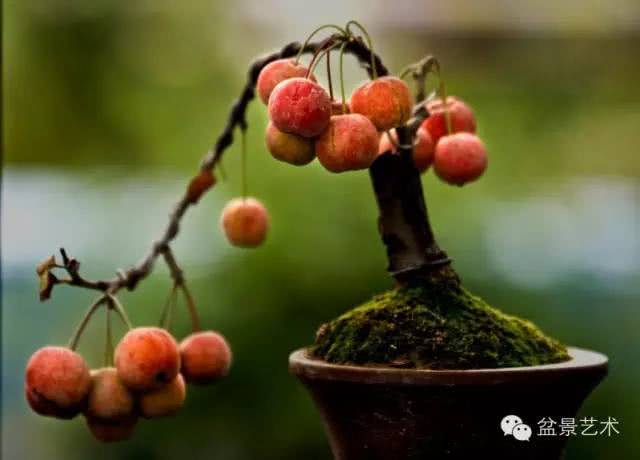
Miniature fruit tree bonsai uses northern deciduous fruit trees such as apple, hawthorn, persimmon, pomegranate, pear, and peach as the main material, integrating modern fruit tree cultivation techniques with traditional bonsai shaping skills. It reduces fruit trees that reach several meters in height to just tens of cm, planting them in shallow pots less than a chi long and only a few cun tall, where they can still bloom and bear fruit and grow normally, thus achieving the artistic effect of "seeing the large in the small" and "shrinking a dragon into a cun," forming a true "miniature fruit tree bonsai" and becoming a unique gem in the great family of Chinese bonsai.
Characteristics of Miniature Fruit Tree Bonsai
Miniature fruit tree bonsai must possess the shaping arts of roots, trunk, form, and spirit, while also having a sufficient number of fruits. The quantity, arrangement, size, and color of the fruit are important components of miniature fruit tree bonsai art. Only by closely combining the two can roots, trunk, branches, leaves, flowers, fruits, and form constitute an ornamental whole, making it delicate and graceful with spring blossoms; laden with colorful fruits in autumn; sparse-branched and sturdy in winter, upright and vigorous; while in summer, when fruits are developing and branches and leaves are lush, the green branches and jade-green fruits take on a new appearance within ten days, full of life's charm and the breath of nature.
In addition to studying shaping, miniature fruit tree bonsai also requires attention to cultivating flowers and fruits, and the cultivation of flowers and fruits requires branches with a certain growth vigor, a certain number of leaves, and sufficient nutrient supply. In addition, the flowers and fruits of some fruit trees such as apple, pear, persimmon, and hawthorn are located at the tips of branches. All of this determines that miniature fruit tree bonsai cannot, like ordinary foliage bonsai, have their branches and leaves precisely wired and finely pruned at will. Its own laws determine that in shaping and pruning it must adopt a bold, natural style. In terms of size, it can be miniaturized, but it is difficult to make it micro-sized; in branch and leaf treatment, it can be layered, but it is difficult to form "pads"; in overall shaping, the basic form can be freely created, but the fine details are difficult to precisely wire and coil; moreover, the number of fruits on miniature fruit tree bonsai changes every year, and the fruiting positions differ each year, so flowers and fruits must be cultivated anew every year, and it cannot be done once and for all. Therefore, producing and caring for miniature fruit tree bonsai requires certain skills, care knowledge, and sufficient nutritional conditions, and this is precisely where its charm lies.
Production and Care Techniques
1. Preparation of nutrient soil. The soil used for potting is nutrient soil. In production, the raw materials for nutrient soil are often divided into the following three categories: loam type, such as garden topsoil, mountain soil, turf soil, etc. Such raw materials can be sourced locally, but neutral sandy loam is best; fertilizer type, such as leaf mold compost, barnyard manure, cake fertilizer, etc. Such materials can be chosen at will according to actual conditions, but attention must be paid to full decomposition and differences in fertility; the third category is minerals such as sand, furnace slag (ash), and vermiculite, whose main role is to increase soil permeability. In production, garden soil, leaf mold compost, and sand are often mixed in a ratio of 4:4:2.
The preparation of nutrient soil should also appropriately adjust the ratio and add other raw materials depending on the tree species, the pot used, and the care environment. The root system of peach has very poor tolerance to waterlogging, and the potting soil needs to be loose and well aerated, while glazed pots and purple clay pots have poor wall aeration, so using ordinary nutrient soil makes it difficult to meet the root system's respiratory needs. In ordinary nutrient soil, 10% to 20% coarse sieved furnace slag can be added to increase its permeability.
When miniature fruit tree bonsai is cared for at home, it is very easy for leaves to scorch, fruits to wilt and drop, and even branches to die and the tree to perish due to reasons such as smaller pots, short water retention time of the potting soil, untimely watering, and relatively dry ambient air. Through years of experimentation, the author has concluded that these problems can be solved by adjusting the nutrient soil ratio and mixing 0.1 kg of water-retaining granular agent into each pot of soil. The water-retaining granular agent is non-toxic and harmless, does not pollute the environment, and its water absorption capacity is about 400 times its own volume. A single application remains effective for as long as three years, extending potted trees in the home indoor environment from the original watering 1 to 2 times a day to watering once every 3 to 4 days, significantly improving water retention and fundamentally solving the long-standing problem that miniature fruit tree bonsai is not easy to care for at home, which has plagued the healthy development of this industry for many years.
2. Watering. Watering is the most commonly performed yet not easily mastered potting technique. Watering in pots should follow the principles of "water when dry, stop when wet" and "when watering, water thoroughly." This is because after watering, the pores of the potting soil are filled with water, and a large amount of air is expelled from the soil, affecting root respiration. If watering is done before the potting soil dries, and the interval between waterings is too short, the potting soil remains in an overly wet and oxygen-deficient state for a long time, and waterlogging damage easily occurs. Therefore, watering should be done only when the potting soil dries and turns white, that is, "water when dry, stop when wet." Beginners and those caring for plants at home, fearing that too much water will waterlog the tree, apply an insufficient amount each time, resulting in "half watering." The lower half of the potting soil does not see water for a long time and becomes dry and hard, and the root system within it will naturally dry up and die. Therefore, after watering, the potted tree should be checked, and it is appropriate when a small amount of water seeps from the bottom hole of the pot, that is, "when watering, water thoroughly," keeping the moisture of the upper and lower potting soil consistent, with relative water content generally between 50% and 90%.
3. Fertilizing. The tree body growth, flowering and fruiting, and fruit development of miniature fruit tree bonsai require a relatively large nutrient supply, but the potting soil volume is small, the soil nutrient reserve is low, and nutrients are easily lost with water, so the limited nutrients in the potting soil alone are far from sufficient. Therefore, in order for potted trees to maintain vigorous growth and normal flowering and fruiting, various nutrient elements must be promptly applied as top dressing during the growing season, but fertilizer damage due to excessive fertilization should be avoided, so the principle of "light fertilizer, frequent application" should be followed.
In the production and care of miniature fruit tree bonsai, in order to achieve the goal of rational fertilization, it is necessary to match the tree, the fertilizer, the timing, and the amount, adapting to local conditions and handling matters flexibly. Tree species with strong fertilizer tolerance and large growth and fruiting amounts, such as apple, pear, and peach, should be fertilized more; tree species with poorer fertilizer tolerance, such as persimmon and pomegranate, should be fertilized less. Potted trees with few fruits and vigorous growth should be fertilized less, especially fertilizers with relatively high nitrogen content; potted trees with many fruits and weaker growth should be fertilized more. In spring during the vigorous growth period and in autumn during the nutrient accumulation period, more fertilizer should be applied; in summer during the high-temperature season, less fertilizer should be applied to prevent excessive vegetative growth; no fertilizer should be applied during the dormant season. Newly potted trees with good soil physical and chemical properties and comprehensive and sufficient nutrient elements should temporarily not be fertilized; but potted trees whose soil has relatively poor fertility or that have not been repotted or had their soil changed for a long time should be fertilized more. Top dressing should preferably be carried out on sunny days when the temperature is relatively low, so as to avoid fertilizer damage or nutrient loss.
Commonly used fertilizers include fermented peanut cake, sesame cake, soybean cake, rapeseed cake, etc. The method is to first add a small amount of water and dry fertilizer in a container for full fermentation, then dilute and pour. The concentration used is 100 times, that is, 1 kg of dry cake fertilizer soaked in 100 kg of water. In alkaline soil regions of North China or when the potted plant is a fruit tree that prefers slightly acidic conditions, ferrous sulfate equal to one-tenth of the amount of dry fertilizer can be added during fermentation, thus making a slightly acidic nutrient solution fertilizer.