Identifying wild orchids is very simple, just remember this marker and you can't go wrong
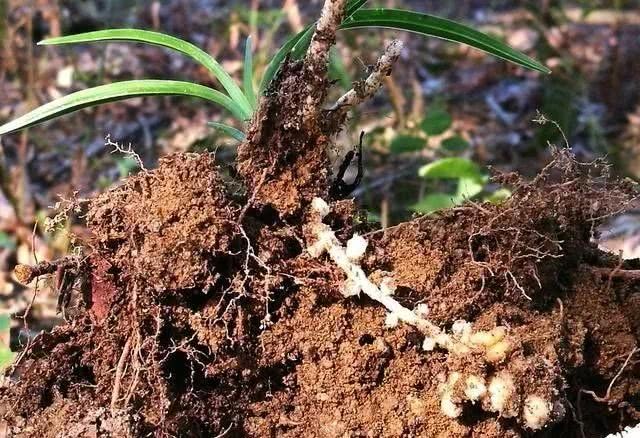
Recently, a fellow orchid grower left a message on the platform asking: What is the difference between orchid dragon roots and dragon eggs? How are they different from ordinary orchid seedlings?
Only wild orchids have dragon roots and dragon eggs. Regarding the formation of dragon eggs, the Baijiahao account Rural Search Society has a video explanation: they are formed when an unopened orchid fruit falls over and develops in the soil. It is said that 10000 seeds must gather together to germinate a dragon egg. Orchid seeds have extremely high environmental requirements, and a place where dragon eggs can germinate is certainly very suitable for orchid growth. So, what is the difference between dragon egg seedlings and ordinary seedlings?
Wild orchid seedling with a dragon egg
Anyone who grows orchids knows that orchid roots and bulbs are the nutrient storage reservoirs of the orchid. Compared with ordinary orchids, dragon egg seedlings store more energy, and dragon egg seedlings with this innate advantage have a greater possibility of variation and producing unusual flowers during later growth.
Of course, what kind of flowers an orchid can produce still depends on its variety; the dragon egg only increases the possibility of some variation.
Single orchid seedling with a dragon egg
For orchids of the same variety, those with dragon eggs and ordinary ones are clearly different. First of all, their seedling bodies are different in sturdiness. When a dragon egg seedling is not yet able to carry out photosynthesis to produce nutrients, the nutrient storage of the dragon egg can provide it with more energy, so its seedling is much sturdier than an ordinary orchid seedling.
Single orchid seedling with a dragon egg
Orchid growers all say: dragon eggs produce sturdy grass, and that is the reasoning. Therefore, many orchid growers want to find a dragon egg. At the very least, a dragon egg seedling can be confirmed as a native seedling, not a tissue-culture greenhouse seedling. Artificially cultivated orchid seedlings cannot possibly have dragon eggs.
Regarding the growth patterns of dragon egg seedlings and how to find wild dragon egg orchid seedlings, Good Photography Farmer has made a statistical summary and will share it with orchid growers in the next issue.
Dragon root seedlings are mostly single seedlings
The above are some superficial views of Good Photography Farmer on dragon egg seedlings. If you have different suggestions, you are welcome to leave your valuable opinions in the comment section.