Crassula rogersii: A succulent with a lovely name and a beautiful form
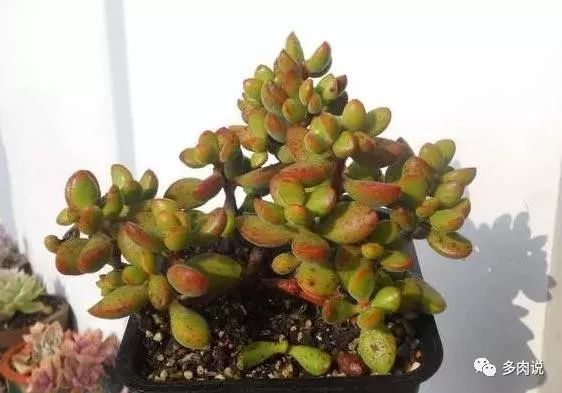
Crassula rogersii is a succulent in the Crassulaceae family, genus Crassula, native to a dry river valley in the Eastern Cape of South Africa. Crassula rogersii has upright stems that can reach 30 cm tall, branches easily, and grows into a large cluster. The leaves are green, oval and plump, growing in opposite pairs along the stems, and covered with a layer of fine white hairs. In the cold season, under sufficient light, the leaf margins and even the entire leaves of Crassula rogersii turn red, which is very beautiful. Crassula rogersii blooms in late spring, though rather rarely, with small yellow flowers gathered into spherical clusters.
Growing and caring for Crassula rogersii is generally not difficult, and after being planted for a while it often turns into a large potful. Come and see Crassula rogersii in its colored-up state, so charmingly red.
Growth habits:
Crassula rogersii likes a warm, dry environment with plenty of sunlight. It fears low temperatures, frost and snow, and tolerates partial shade. It is not demanding about soil, and a mix of peat soil plus coarse sand is best. In winter the temperature should not be lower than 5°C.
Daily care:
1. Water properly.Everyone knows that succulents must be watered sparingly, so when we water Crassula rogersii we must let the potting soil dry out completely first, and when it is time to water, water thoroughly all at once. After watering, do not rush to put it in the sun, as this will raise the water temperature and injure the roots. We should place the freshly watered Crassula rogersii in a ventilated spot and let the water in the pot dry off, reducing water accumulation in the potting soil. This is the correct method.
2. Maintain the temperature.Succulents are rather vulnerable in both summer and winter, because too high a temperature causes dormancy, and too low a temperature in winter also causes dormancy. So during these periods we must be extra careful: in summer, place it in a cool, ventilated spot as much as possible; in winter, place it where sunlight often reaches, raising the temperature of the growing environment.
3. Choosing the soil.When planting, we should choose fertile, loose soil, such as soil from a pond bottom or from community flower and plant beds. After meeting this requirement, it should also have good drainage. If you cannot find soil with good drainage, we can also put some plant ash at the bottom of the pot. For the soil, choose peat soil mixed with ordinary community garden soil; this way the soil is relatively easy to obtain, and the soil quality is also fairly good.
4. Sufficient light.Succulents love sunlight very much. In a warm environment with sufficient light, Crassula rogersii will grow better, more lustrous and plump, and look more translucent. However, in summer it cannot be kept in high temperatures for long periods, because if the light is too strong and the temperature too high, the succulent will go dormant. In this season we can move the succulent to a cool, ventilated spot; this method can lower the growing temperature and make dormancy less likely.
5. Propagation of Crassula rogersiiThere are several methods: stem cuttings, leaf cuttings and division. Crassula rogersii is mainly propagated by stem cuttings. Generally in spring and autumn, select healthy stems and cut them off, let them dry, then insert them into slightly moist soil. Keep them cool and ventilated, and they will root in about 20-25 days, with a very high survival rate. The division method is to separate the clustered Crassula rogersii from the mother plant, let the wounds dry slightly, and then plant them directly into a prepared container. Because Crassula rogersii clusters easily, it can generally be divided once every 2-3 years, and the survival rate is also very high.
Leaf cuttings of Crassula rogersii are also very easy. Select healthy, strong leaves, twist them off, let them dry in a cool, ventilated place for a few days, then place them on the surface of moist soil. After a few days or several weeks they will root or grow small buds and become independent small plants. Once the roots reach 2-3 cm, they can be planted into a pot.