Bonsai Art: Landscapes Hidden in a Tiny Pot, Tabletop Scenery Originating from Nature
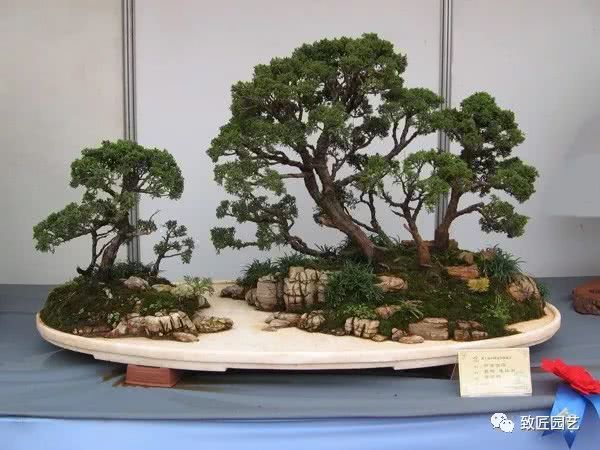
Deep Love Across the Strait (Chinese juniper, tortoise-vein stone)
Bonsai: one of the excellent traditional arts, it is a work of art that uses plants and mountain stones as basic materials to express natural landscapes in a pot. Using plants, mountain stones, soil, water and other materials, through artistic creation and horticultural cultivation, it typically and intensively shapes the beautiful scenery of nature in a pot, achieving the artistic effect of shrinking a dragon to an inch and seeing the great in the small, while also expressing feelings through the scenery and conveying a profound artistic conception, like a three-dimensional, beautiful, miniature version of a scenic landscape area.
Memories of Hometown (Chinese persimmon)
Bonsai originated in China. Bonsai generally falls into two major categories: tree-stump bonsai and landscape bonsai. Bonsai is composed of three elements: the scenery, the pot and the stand (rack), which are interconnected and mutually influencing as a unified whole. People praise bonsai as "three-dimensional paintings" and "silent poems."
Bonsai originated in China. In 1972, in the Tang Dynasty tomb of Crown Prince Zhanghuai (built in 706) excavated at Qianling, Shaanxi, a mural on the east wall of the corridor depicts a maidservant holding a bonsai in her hands, and it is the earliest known record of bonsai in the world to date. By the Song Dynasty, bonsai had developed to a relatively high level. Famous literati of the time, such as Wang Shipeng, Lu You and Su Dongpo, all described and praised bonsai in detail. In the Yuan Dynasty, the eminent monk Yun Shangren made small bonsai, modeled on nature, called "xiezi jing" (small-scale scenery). In the Ming and Qing dynasties, bonsai flourished even more, and many works on bonsai had already appeared. The term "bonsai" first appeared in the Ming Dynasty work Kao Pan Yu Shi by Tu Long. After the 1950s, bonsai making became greatly popularized in public gardens, nurseries and private households, and bonsai associations were established, frequently holding bonsai gardens and bonsai art exhibitions.
Yellow River Sentiment (three-spring willow)
Golden Autumn in the Miao Mountains (firethorn, thousand-layer stone)
Pastoral Song (three-spring willow)
Affection for the Earth (Chinese hackberry)
Rhythm of Stone City
Sparse Grove and Layered Green (small-leaf Buddhist pine)
Rural Charm (thread cypress)
Heart to Heart (white-bark boxwood)
Remembering Jiangnan (creeping juniper, Lingbi stone)
Deep Roots (creeping juniper)
Cloud Cliffs Vying in Beauty (Chinese sweet plum)
Wu Zixu's Fierce Battle (Chinese wingnut)
Ancient Trees in Summer Shade (azalea, tortoise-vein stone)
Green Fragrance and Pure Charm (needle juniper, tortoise-vein stone)
Maple Grove Scenery (trident maple)
Sharing Nature (Chinese elm)
Featured Content