Poinsettia leaves change color in autumn, so why do people only display them at home?
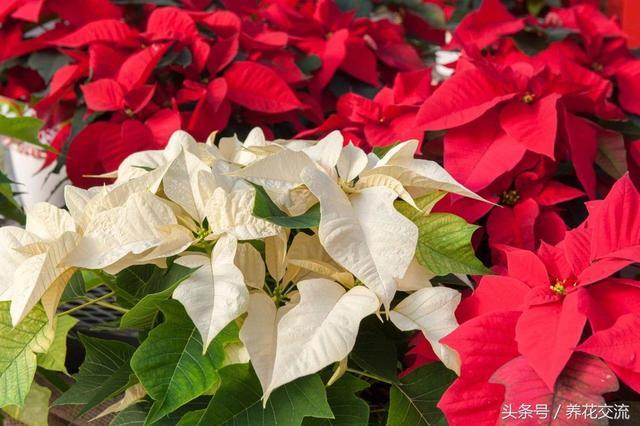
The plant to introduce to you today is the poinsettia. If you observe carefully, you will find that most people do not move poinsettias indoors to care for them, do not place them on the dining table, and certainly do not grow them in the bedroom. So do you know what the reason is?
Few people know that the poinsettia is actually a plant of the genus Euphorbia in the family Euphorbiaceae. Plants belonging to this group are all toxic plants and are very unsuitable for placing indoors. This type of plant also includes the common Euphorbia tirucalli, Euphorbia lactea, Euphorbia trigona and Euphorbia milii.
Actually, its toxicity is not strong, so everyone should not be afraid of the poinsettia. Under normal care, you will not be poisoned. Even touching its leaves and branches will not cause any toxicity infection. Only the sap inside the branches is toxic, and accidental ingestion should be avoided. Its toxicity is relatively mild, and it is still very suitable for cultivation as an ornamental plant.
In autumn and winter, the leaves at the top of the poinsettia turn fiery red. These topmost leaves have the highest ornamental value. However, if you think that the top leaves of all poinsettia varieties are red, some varieties have top leaves that only turn white, pink, orange or yellow, each with different ornamental appeal. These colorful leaves are easily mistaken for flowers, but in fact they are all color-changing leaves.
The true leaves of the poinsettia are hidden among the color-changing leaves at the top. The flowers are very delicate and small, and can only be discovered by parting its colorful leaves. The poinsettia generally blooms from November to around March of the following year, usually flowering around Christmas and around New Year's Day, which is why some people call it the Christmas flower.
Although the poinsettia is a toxic plant, it can also be used as a medicinal plant. It has the effects of promoting blood circulation and resolving phlegm, and of setting bones and reducing swelling.
Caring for a potted poinsettia is also very simple. It likes a warm and humid environment year-round, and the minimum care temperature only needs to be kept above 7 degrees. It is afraid of cold, and in winter it can be moved indoors to avoid frost damage, otherwise its lower leaves will continuously turn yellow and drop, and new branches and leaves can only sprout after spring warms up.
The optimal temperature for caring for a poinsettia should be kept above 15 degrees, so that it can grow well. Another key point in caring for a poinsettia is to pay attention to watering. In spring and summer, the soil should be kept moist, and in autumn and winter, watering should gradually be reduced, watering thoroughly only after the soil has dried out.
Caring for a poinsettia does not require overly abundant light. It is generally cared for as a potted plant, and only needs appropriate scattered light each day to grow well. In autumn and winter, more light needs to be supplemented, with more than eight hours of direct sunlight per day, which is beneficial for flowering and also helps the top leaves of the poinsettia turn colorful.
In the frost-free areas of southern China, the poinsettia is also planted in parks as an ornamental plant, while in the north it can only be kept indoors as a potted plant. Propagating a poinsettia is also very simple. You just need to cut a section of branch and use the soft-wooded young shoots for cutting propagation.