A close look at Zhang Zailiang, an outstanding Chinese bonsai artist
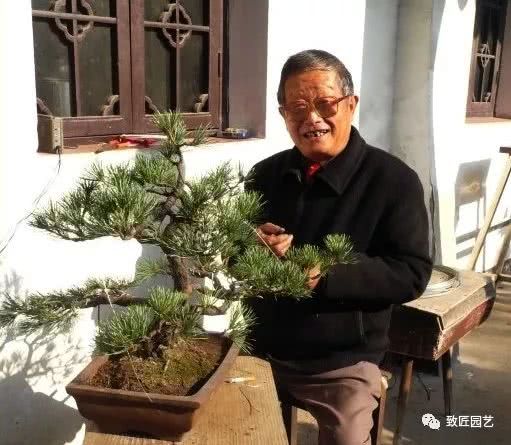
In his seventies, Zhang Zailiang still loves the art of bonsai
When people talk about Zhang Zailiang, the first impression he gives is that of a simple, generous and approachable man. Without seeing the many award certificates granted to him over the years, it is hard to imagine that he is a senior bonsai master of the Suzhou Gardens Bureau, an executive director of the China Bonsai Artists Association, an outstanding Chinese bonsai artist of the turn of the century, and a senior advisor to the World Bonsai and Stone Culture Advisory Committee. He has loved the art of bonsai all his life, treating it as his second life; he often faces his bonsai, meticulously wiring and pruning, utterly absorbed, forgetting food and sleep. His bonsai-making skills are at a leading level in China, and his works have won awards many times, making him an important inheritor of the Suzhou-style bonsai art.
Zhang Zailiang is not only highly renowned in China's bonsai art circles, but also has a certain influence abroad. One year, at a friend's invitation, he visited Japan and was warmly received by several Japanese bonsai artists. When he proposed to visit Japan's most famous world-class bonsai artist, Masahiko Kimura, the hostess politely declined on the grounds that he was busy with work. But when Masahiko Kimura learned that it was Mr. Zhang Zailiang from China who had come to visit, he not only made an exception to receive him, but also accompanied Zhang Zailiang for several days to visit Japan's main bonsai gardens and production bases, making his peers look at Zhang with new eyes.
Loving bonsai, devoted to growing and admiring flowers
Zhang Zailiang was born in 1942 in Haiyan, Zhejiang. In April 1963, he was sent to the Fifth Production Team of the Xinnong Brigade in Pingwang Town, Wujiang County, where he worked on a farm; he also worked in the town's sauce and pickles factory and served as a shop assistant in the supply and marketing cooperative's retail outlet. He loved nature from childhood, liked flowers and plants, and had a strong interest in plant growth and curious stones and unusual scenery. In 1968, Zhang Zailiang planted a pomegranate in an ordinary flower pot; this was his first bonsai.
In 1970, he borrowed a book from a friend titled "Among Flowers and Trees." The book was published in September 1956 by Shanghai Culture Publishing House and written by the famous Suzhou calligrapher, painter and bonsai artist Zhou Shoujuan. At the time, China was in the midst of the "Cultural Revolution," when only "politics in command" was emphasized, bookstores carried only political books, and traditional culture was criticized as "feudal dross." When Zhang Zailiang borrowed "Among Flowers and Trees," he treasured it like a precious jewel and could not put it down. He read it carefully and learned the basic knowledge of bonsai art; this book became Zhang Zailiang's first teacher in his study of bonsai art.
In the early 1970s during the "Cultural Revolution," bonsai art had neither status nor market. There was even the risk of being branded with labels such as "petty-bourgeois sentiment" and "neglecting one's proper work," and of being criticized. Not only could bonsai art books not be bought, but the varieties of flowers one could see were extremely few, and even when one saw them, they could not be bought. Zhang Zailiang often went to the Suzhou gardens, because only there could one still admire a small number of flowers and bonsai. Once, at the Humble Administrator's Garden in Suzhou, he saw azaleas in full bloom and truly could not bear to leave; how he wished he could have an azalea of his own. Zhang Zailiang, so eager in his love of flowers, though he usually treasured every flower and blade of grass, at this moment could not spare his pride and made an exception by quietly snapping off a branch tip. After returning home, it actually took root as a cutting, giving him a pot of azalea flowers of his own, which was very precious at the time.
A few years later, this rare pot of azalea was cultivated by him into a large potted plant, and after a few more years of propagation by cuttings, one pot became dozens of pots. But he was not satisfied with having only a few varieties such as azaleas. To add new flower varieties, he made several special trips to the mountains near Lizhu Town in Shaoxing, Zhejiang, to dig up wild orchids. Once he dug up two big bags, happily carried them home on his back, and planted dozens of pots of orchids. By the mid-1970s, in the small garden at Zhang Zailiang's home, potted flowers and bonsai were already everywhere, with more than a dozen varieties including Chinese sweet plum, elm, five-needle pine, azalea, orchid and camellia.
In 1979, Zhang Zailiang built two single-story houses in the town, with a small 30 sq m garden. In order to grow flowers, the roof was made into a flat platform. In 1981, when policies were implemented, Zhang Zailiang changed from a rural household registration to a town household registration, was arranged to work at the town supply and marketing cooperative, and grew flowers as a hobby after work. Entering his home, the garden was all flowers, and the roof platform was also full of flowers. Zhang Zailiang moved several pots of flowers to the shop to admire them together with customers; he regarded growing and admiring flowers as the greatest pleasure in life.
Learning from nature, studying under a famous master to receive true transmission
As time went on, near and far everyone knew that Zhang Zailiang especially loved flowers, loved growing flowers, and grew them especially well, and more and more people came to Zhang Zailiang's home to admire the flowers. In 1985, Pingwang Town planned to build a park. The town Party secretary discovered that Zhang Zailiang was a talented person and decided to transfer him to Pingwang Yinghu Park to take charge of the park's preparatory construction work. Such a personnel transfer, which seemed very ordinary to others, was an important turning point in Zhang Zailiang's life, transforming him from an amateur bonsai art enthusiast into a garden manager and setting him on the path toward becoming a professional bonsai artist. Zhang Zailiang worked from dawn to dusk, treating the garden as his home; no matter how busy the park construction work was, he always looked cheerful. When others advised him to rest, his answer was simple: "I like it."
Through Zhang Zailiang's diligent efforts, in just over a year, Pingwang Town's Yinghu Park was initially completed; this was the first public park in the history of Pingwang Town. After the park opened, in spring there were red peach blossoms and green willows with azaleas in full bloom, and in autumn there were chrysanthemum exhibitions for admiring chrysanthemums, which the citizens deeply loved; citizens doing morning exercises, taking walks and enjoying the park came in an endless stream. What made Zhang Zailiang happiest was that, in addition to doing the park's daily management work well, he also set aside a "garden within a garden" of about 2,000 sq m (3 mu) in the park, specially for displaying bonsai.
He gave this small garden an elegant name: "Cui Zhuang." From then on, Zhang Zailiang had a place to display his bonsai art. Although it was a "garden within a garden," the layout was very exquisite, and it was filled in perfect order with bonsai of all kinds of postures. "Cui Zhuang" became famous far and near and became the main feature that made Pingwang Park famous. Because Zhang Zailiang had a strong sense of responsibility for his work and loved bonsai and greening causes, he was elected director of the Pingwang Town Landscaping Management Station and deputy director of the town government's Greening Office.
Zhang Zailiang was not satisfied with his achievements. Every year he subscribed to newspapers and periodicals such as "Flowers and Bonsai" and "Chinese Flowers," and specially bought books such as "The Plastic Art of Bonsai" and "Flower Cultivation and Bonsai Making," studying theoretical knowledge earnestly, absorbing the strengths of bonsai works from various places, and broadening his artistic thinking. He treasured and seized every opportunity to study bonsai art, striving to improve his theoretical level and practical making skills in bonsai art. In 1985, he attended the China Rural Youth Wealth-Building Correspondence School to study garden art. In 1986, he took the famous bonsai master at home and abroad and leader of the Suzhou-style bonsai, Zhu Zi'an, as his teacher and became his formal disciple. In 1988, he attended a crash course in bonsai art at Beijing Forestry University, achieved the excellent result of first place in the examination, and was accepted as a member by the China Bonsai Artists Association.
Usually Zhang Zailiang most loved to draw nourishment from nature and increase his inspiration for making bonsai. Using opportunities to participate in bonsai exhibitions across the country, he squeezed out time to tour local gardens and scenic spots. Whenever he saw ancient and famous trees, he would often gaze at them for a long time and be reluctant to leave. Every year he specially set aside time to go to mountainous areas in provinces such as Zhejiang and Anhui, walking into nature, observing the growth patterns of plants, and pondering how to introduce the forms and growing momentum of large trees in nature into bonsai. Therefore, the bonsai Zhang Zailiang made had the majestic, extraordinary bone and elegant, refined temperament of ancient and large trees in nature, and he became an inheritor of Suzhou-style bonsai, repeatedly winning the praise of the elderly Mr. Zhu Zi'an, who many times praised Zhang Zailiang: "He is my true disciple."
Zhang Zailiang (right) taking the famous bonsai master and leader of Suzhou-style bonsai Zhu Zi'an (left) as his teacher
Inheriting tradition, bravely pioneering and innovating
Bonsai art originated in China and is a traditional Chinese art treasure. Bonsai art is a plastic art that integrates garden cultivation, literature, painting and other arts; it is a miniature of natural scenery, with a simple natural beauty and elegant artistic beauty, and is praised as "three-dimensional painting" and "silent poetry." It is not only deeply loved by the broad masses at home, but also enjoys a lofty reputation in the forest of world art.
Bonsai art has been passed down from generation to generation. Due to factors such as historical evolution, geographical environment and natural conditions in different places, major bonsai schools such as the Suzhou, Yangzhou, Sichuan, Lingnan and Shanghai schools have formed. The bonsai Zhang Zailiang makes belongs to the Suzhou style, whose characteristic is emphasizing "learning from nature," with rough wiring and fine pruning, clear and elegant, and it has had the greatest influence on the formation of the other schools. Common varieties mainly include trident maple, pomegranate, five-needle pine and elm. The most classic artistic style is "six platforms, three supports, one crown," 10 pieces in total, also called "perfect in every way." In nature, due to the effect of Earth's gravity, after a tree grows to a certain height it can no longer grow taller; the original pointed top gradually grows year by year into an inverted-pot-shaped, flat-round crown, and the branches extend in all directions, forming "supports" and "platforms" at varying heights.
Selected award-winning works by Zhang Zailiang
Zhang Zailiang's most valuable quality is this: on the basis of understanding and inheriting the traditional style and theoretical essentials of Suzhou-style bonsai, he can creatively break through the structural form of "six platforms, three supports, one crown" and pursue the natural beauty and artistic conception beauty of tree forms. Zhang Zailiang believes that the structural form of "six platforms, three supports, one crown" is an ideal form of bonsai art. However, among trees growing in nature, perfect ideal structures are very, very few. The large trees and ancient trees we see are of a thousand postures, including the majestic type, the dangerously strange type, the tall and elegant type, and so on. Therefore, in "learning from nature," bonsai art must not stick to one pattern and must dare to create its own unique style.
He has a trident maple collected from Jiuhua Mountain in Anhui. The original tree was about 1.6 m tall. When it was dug up, most of the trunk was withered and only a small half survived. Judging from the surviving visible growth rings, the tree was more than a thousand years old. It was just such a remnant trident maple stump that, through Zhang Zailiang's careful pruning, wiring and care, actually took root and survived; new branches sprouted from the bark, and tempting tender green new leaves emerged. A few years later, a large bonsai, verdant and ancient-looking, gnarled and majestic, full of wildness, stood in "Cui Zhuang." The tree body was covered with the traces of years tempered by wind, rain, cold and heat, making guests marvel endlessly. An organization wanted to buy it for a huge sum of 100,000 yuan, but Zhang Zailiang politely refused. For his award-winning bonsai "Dragon Dancing in Colorful Clouds" (Chinese juniper), a client was willing to trade a "Pajero" car, and Zhang Zailiang likewise politely refused.
Striving for perfection, producing fine works and winning awards
To date, Zhang Zailiang has studied flower and bonsai art for more than 40 years, and his bonsai-making skills are at the height of perfection. He has more than 1,000 pots of flowers and bonsai of more than 60 varieties, including black pine, Chinese sweet plum and azalea. He believes that no matter how unattractive a bonsai is, after a few years of correction it can become beautiful, because what bonsai displays is the unyielding spirit of life and vigorous vitality. Because nature is loved by people all over the world, the bonsai art that learns from nature has no national boundaries. He also often tells his disciples: making bonsai requires perseverance; you cannot "fish for two days and dry the nets for three." One should be indifferent to fame and gain and dare to innovate. Because Zhang Zailiang is modest and eager to learn and keeps improving in art, his fame in China's bonsai circles has grown higher and higher. At national-level bonsai exhibitions held over the years, Zhang Zailiang's exhibited bonsai have repeatedly won awards:
Selected award-winning works by Zhang Zailiang
In February 1989, Zhang Zailiang was granted membership in the China Bonsai Artists Association. In October 1989, Zhang Zailiang participated for the first time in the "Second China Flower Expo and First China International Bonsai Works Exhibition Competition" held at the Beijing Agricultural Exhibition Center. On the train to Beijing, in order not to damage a single branch or leaf of his Chinese sweet plum, Zhang Zailiang placed the bonsai on the sleeper berth during the day and beside his pillow at night. But when he carefully carried the bonsai to the Agricultural Exhibition Center, the preliminary judging had already been announced. After leaving the bonsai in the care of the organizing committee, Zhang Zailiang went to his room to rest. Unexpectedly, the next day the judges told Zhang Zailiang that this Chinese sweet plum bonsai of his had a unique shape and had won the praise of the experts present; unfortunately, he had arrived too late, so they could only make an exception and award this Chinese sweet plum the "Excellent Work Award."
In May 1991, Zhang Zailiang was invited to participate in the "First China International Bonsai Conference" and the "'Revitalize China Cup' Bonsai Works Exhibition Competition." Zhang Zailiang's entry, an elm stump bonsai, won first prize. In October 1992, the China Bonsai Association held the "China Cross-Strait Bonsai and Potted Flower Seminar" at the Nanjing Workers' Cultural Palace, and Zhang Zailiang, entrusted by the association, was responsible for arranging the bonsai exhibition. His exhibited true cypress bonsai "Eventful Years" won second prize; his black pine bonsai "Guilt Soul" won third prize. In May 1994, Zhang Zailiang was elected executive director of the Jiangsu Provincial Bonsai and Root Art Aesthetics Research Society and senior bonsai master of the Suzhou Gardens Bureau. In April 1997, the Azalea Branch of the China Flower Association held the "Third National Azalea Exhibition" at the Humble Administrator's Garden in Suzhou. Zhang Zailiang's exhibited azalea bonsai "White Branch" won first prize; "Yingshanhong" won second prize for cultivation.
In January 1999, Zhang Zailiang was elected director of the China Bonsai Artists Association. In March 1999, Zhang Zailiang was awarded the "Honorary Title of Outstanding Chinese Bonsai Artist of the Turn of the Century" in Beijing. In May 2001, the "Fifth China Bonsai Evaluation Exhibition" was held at Tiger Hill in Suzhou, and all 5 bonsai provided by Zhang Zailiang won awards. Among them: "Old Cypress Meets Spring" and "Dragon Dancing in Green Clouds" won silver awards; "Accumulated Green," "Gnarled Exploration" and "Rugged Green Pine" won bronze awards. In April 2002, at the "Shanghai International Flower Festival Bonsai Fine Works Exhibition," Zhang Zailiang's exhibited bonsai won a commemorative award.
In May 2004, the China Bonsai Artists Association held the "China Xinyi Bonsai and Flower Art Festival Bonsai Exhibition" in Xinyi, Jiangsu. Zhang Zailiang's five-needle pine bonsai "Exploring Gnarled Branches" won a silver award; his black pine "Jiangyi Sentiment" won a bronze award. In March 2005, Zhang Zailiang became an honorary villager of the "China Bonsai Art and Culture Village" (Zhujiajiao). In December 2005, Zhang Zailiang was elected executive director of the "China Bonsai Artists Association." In October 2006, the "Fourth China Flower and Bonsai Art Festival" and the "China 'Longevity Cup' Bonsai Fine Works Competition" were held in Rugao, Jiangsu, and Zhang Zailiang's exhibited bonsai won second prize.
In September 2008, in view of Zhang Zailiang's positive influence and outstanding contributions in promoting the development of bonsai stone art, he was elected by the World Bonsai Stone Culture Association as a senior advisor to its advisory committee. At the "Seventh National Bonsai Exhibition," Zhang Zailiang's exhibited five-needle pine bonsai "Gnarled Exploration" won a participation award. In October 2010, the "'Winter Olympics Cup' China Bonsai Fine Works Invitational Exhibition and Bonsai Creation Competition" was held at the Shanghai Botanical Garden, and Zhang Zailiang's exhibited boxwood bonsai "Canopy of Green Shade" won a fine works award.
Selected award-winning works by Zhang Zailiang: title "Canopy of Green Shade," tree species white-barked boxwood, tree height 85CM, canopy spread 125CM, tree age about 100 years. This bonsai was obtained by the author in 1992 at the Nanbei Lake Forest Farm in Haiyan, Zhejiang. After 18 years of careful design, shaping, maintenance and cultivation, it grows luxuriantly with dense shade. The bonsai's trunk is smooth and its posture is neat and natural; it is a rare fine work.
Highlights