Cosmos and Gesang flowers look very similar, so how do you tell them apart?
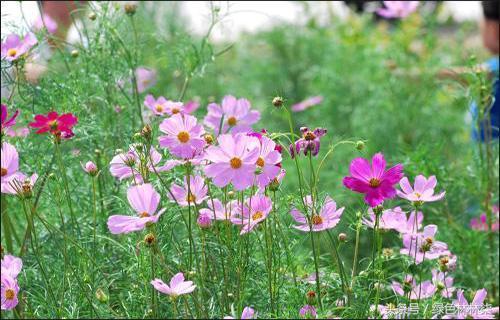
The 2018 Wuhan Golden Autumn Chrysanthemum Exhibition features so many chrysanthemum varieties that it is inevitable some look alike but have different names. Cosmos and Gesang flowers really do look too similar; sometimes they are very hard to distinguish.
What is cosmos?
Cosmos is an annual herbaceous plant with slender, upright stems and many branches; the stems are smooth or slightly hairy. The leaves are simple and opposite, about 10cm long, bipinnately parted, with narrow linear, entire, toothless lobes.
The flower heads grow on slender pedicels, either terminal or axillary, with flower stems 5-8cm. The involucre has 2 layers, with the inner layer membranous at the margin. There is 1 whorl of ligulate flowers, the petal tips are toothed, and there are 8 petals, in white, pink, and deep red.
The tubular flowers occupy the central part of the flower disk and are all yellow. The achenes have ribs, the seeds remain viable for 3-4 years, and the 1000-seed weight is 6g. The flowering period is summer to autumn, and the seeds are crescent-shaped.
Horticultural varieties include white cosmos, large-flowered cosmos, and purple-red cosmos. Horticultural cultivars fall into two major systems, early-flowering and late-flowering, and are also divided into single and double forms.
What is a Gesang flower?
Gesang flower, also called Gesang Meiduo, is widely debated as to exactly which plant it is. In Tibetan, "Gesang" means "good times" or "happiness," and "Meiduo" means flower, so the Gesang flower is also called the happiness flower; for a long time it has carried the Tibetan people's beautiful feelings of longing for happiness and good fortune.
According to related literature research and interviews with key figures, the cosmos that is regarded as the Gesang flower in a large number of Tibetan films, songs, and Tibetan periodicals and magazines is not the true Gesang flower.
In a broad sense, "Gesang Meiduo" is most likely a byname for the wildflowers with the strongest vitality on the plateau, while in terms of botanical characteristics, plants of the Asteraceae genus Aster and the cultivated plant Aster tataricus, commonly seen from Lhasa to Qamdo, both fit the characteristics of the Gesang flower.
The difference between the two
In Tibet, people often use the Gesang flower to express and give voice to beautiful feelings, and many songs and stories praising the Gesang flower have been passed down. The Gesang flower holds a very high place in the hearts of the Tibetan people and is regarded by ordinary Tibetan people as a holy flower symbolizing love and good fortune.
Several plants called Gesang flowers by the people of Tibetan areas: cosmos, Aster tataricus, alpine rhododendron, Potentilla fruticosa, and others.
In other words, cosmos can be a Gesang flower, but Gesang flowers include many kinds of plants. People often place beautiful wishes on flowers, so this one Gesang flower can be a chrysanthemum by the roadside, or it can be Potentilla fruticosa.
Gesang flower is a broad category, and cosmos is only one among this broad category. Now do you understand the relationship between cosmos and Gesang flowers?