Purple vegetables are known as a natural beauty product; the seeds sprout as soon as they touch soil and bear abundant fruit
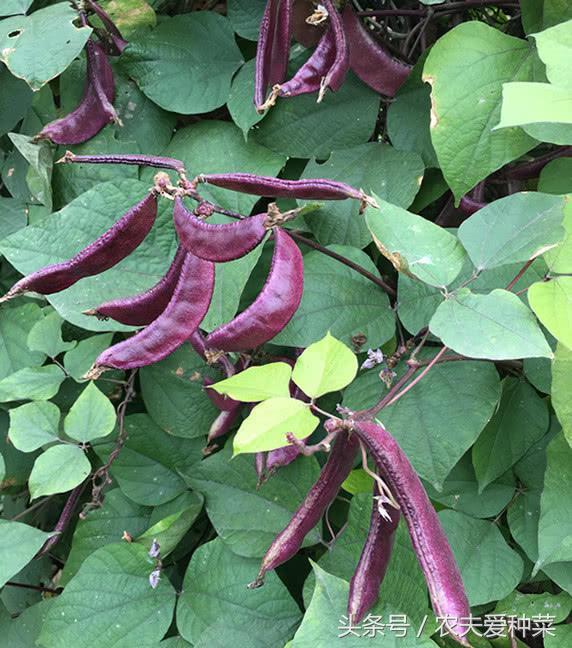
By late September each year, it is once again time to harvest the "moth eyebrow bean" - of course, moth eyebrow bean is just what we call it around here, and I wonder, friends, what do you call it where you are? Its scientific name is hyacinth bean; "moth eyebrow" originally describes a woman's slender and beautiful eyebrows, and the hyacinth bean is also curved and long, so although it is a bit plump, the name is still quite vivid.
What we grow a lot of around here is a kind of purple hyacinth bean. Compared with the white hyacinth bean, it has an extra purple color, and purple foods themselves are rich in natural anthocyanins and the trace element selenium, with strong antioxidant capacity, so they are called a "natural beauty product." Eating them regularly can delay aging, and can also boost immunity and have anti-cancer and anti-tumor effects.
As a vegetable that is relatively easy to grow and high-yielding, purple hyacinth bean is generally planted at the edge of the vegetable garden. After sowing the seeds and watering them, we just leave them alone, and it basically survives as soon as it touches soil. It will keep climbing along a fence, and even without a fence, as long as there is a tree or something else to support it, it will climb up and keep growing, and some can reach 6 or 7 m high.
After that, we never specially buy seeds to sow again each year. It may be that seeds dropped from the previous year will grow into a large patch again in the same old place, so in rural areas we basically never specially plant this vegetable, nor do we water or fertilize it. We simply leave it alone, and it still grows a lot every year. If a family cannot finish eating it all, they give it to neighbors.
We eat purple hyacinth beans mainly by stir-frying them. We wash them clean and cut them into shreds, then stir-fry them with fat meat or with pork belly that has a bit more fat. Hyacinth beans stir-fried this way, after rendering out the lard, are really very fragrant.
Growing purple hyacinth beans is very easy. They have strong adaptability and are also very tolerant of poor soil, so ordinary garden soil can be used for planting. The most suitable growing temperature is between 18-30°C. They grow quickly in summer and bear fruit in September-October, but they are not tolerant of frost. Around November, when it turns cold, they will no longer bear fruit.
Although purple hyacinth beans have extremely strong drought tolerance, they still need moderate watering during the growing period, watering when the soil is dry and stopping when it is wet, mainly keeping the soil slightly moist. Purple hyacinth beans themselves have a very strong fruiting capacity. If sufficient base fertilizer is applied at the beginning of planting, and then some farmyard manure and the like is applied as a top dressing during the growing period, they will be even more high-yielding and of better quality.