A thousand shapes and myriad postures like a divine dragon, churning rivers and overturning seas to display its majestic power
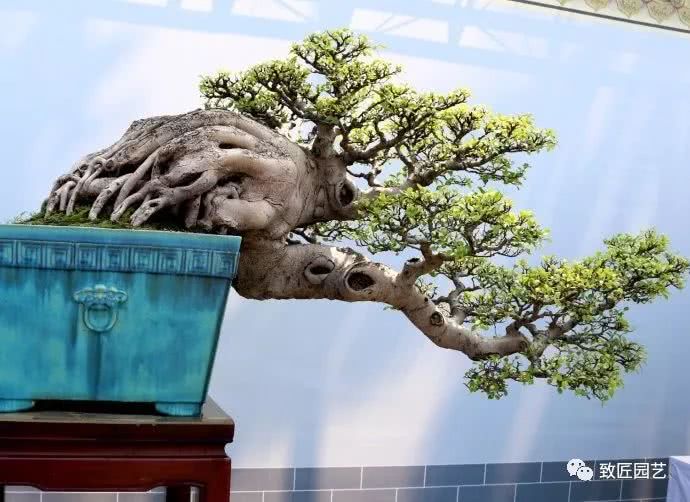
Penjing originated in China and has a history of more than a thousand years. It has long been praised as "three-dimensional painting, silent poetry," with strong cultural connotations and artistic forms, reflecting the Chinese ideal of "the unity of heaven and humanity." The art of penjing is a traditional art of the Han ethnic group and a treasure of garden art. The five major schools of Chinese penjing fall into two main branches, southern and northern. The southern branch is the Lingnan school, represented by Guangzhou, while the northern branch includes the Sichuan, Yangzhou, Suzhou and Shanghai schools along the Yangtze River basin. Influenced by the Lingnan School of painting, Lingnan-style penjing created a unique branch-pruning method of composition based mainly on "trunk chopping and branch cultivation," forming a style characterized by "vigorous naturalness, elegance and boldness." Following the painting principles of "a thousand li within a foot" and "seeing the great in the small," it recreates the natural scenery and landscapes of Lingnan. Using plants, rocks, soil and water as materials, it shapes the beautiful scenery of nature while expressing emotion through scenery and conveying a profound artistic conception, like a three-dimensional scenic area. Penjing is a living artwork, an organic combination of natural beauty and artistic beauty, a healthy ecological culture that can cultivate one's temperament.
(A king of penjing worth tens of millions)
Wonderful content