Spider plant wilting and not growing well? Don't overlook these 3 points, and it will thrive all autumn once you get them right
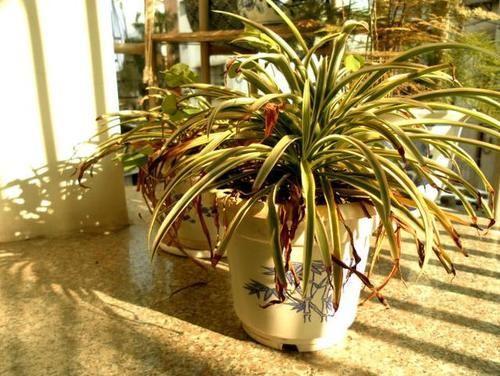
When growing spider plants, if the placement is improper, the light too strong or too weak, or watering too much or too little, the leaves easily turn yellow and lose their vitality, and in severe cases the plant withers and dies; insufficient or excessive fertilizing can also cause the leaves to turn yellow, the tips to scorch and the plant to age, or even die. Dry leaf tips on spider plants are mainly caused by direct strong light, dry air and other such factors. Therefore, when cultivating spider plants in northern regions, in summer they need to be kept under a shade frame or in a cool shaded spot, while in the other seasons they can be hung in front of a window that gets light or on the top shelf of a bookcase, so that their runners hang down naturally.
Point one: waterlogged potting soil and rotting of the fine feeding roots of the spider plant. Because the potting soil is compacted or too heavy and sticky, or because of overly frequent and excessive watering and other such reasons, the fine feeding roots of the spider plant rot, and this greatly reduces the root system's ability to absorb water, causing the tips of the spider plant's leaves to turn black at the ends and the edges to curl inward. If this is the case, you can take the plant out of the pot, shake off part of the old soil, cut away the rotted part of the root system, and replant it in clean, moist sand, keeping the sand moist but not spraying too much water; after it has been induced to grow tender white fine fibrous roots, replant it again in fresh, fertile potting soil.
Point two: dry air, overly intense sunlight and too high a temperature. This situation mainly occurs in summer and autumn, because spider plants like to grow in humid air and semi-shaded environments; once the air is too dry and the sunlight is completely unobstructed, and if the temperature is as high as above 30°C on top of that, it very easily causes the leaf tips of the spider plant to wither. If this is the case, you can move the plant to a semi-shaded environment, cut off the withered leaves, and frequently spray water on the leaf surfaces and the surroundings; the newly emerging leaves can return to a normal state.
The last reason is applying too much nitrogen fertilizer: the spider plant lacks phosphorus and potassium fertilizer, and too much nitrogen fertilizer easily makes the plant's leaves larger and thinner and grow rampantly. But it will lack green color, bloom little and have pale flowers. Phosphorus fertilizer can promote flowering and fruiting in plants, making the leaves emerald green and the flowers brightly colored. If watered too much, the roots rot. Reduce the amount of water and it will recover after a period of time. Another possibility is too little light; simply increase the light.
If the spider plant has not been repotted for a long time, so that the roots grow right up against the pot wall, then in a high-temperature, high-drought or cold-weather environment it is very easy for the root tips to shrink and die, making them lose their proper absorbing function and thereby causing the leaf tips to dry up and shrivel. If this is the case, you can first tip the plant out of the pot, cut off the already dead leaves or the dead parts of the leaves, then pick out part of the old soil, remove some of the aged or dead roots, replant it properly in fresh potting soil, and place it in a cool, moist, semi-shaded environment; be careful to spray more and water less, and the plant's newly emerging tender leaves will return to normal.
If the spider plant has wilted rather severely, prepare a sharp knife or scissors. Starting from about 3-4 cm above the surface of the potting soil, cut off all the leaves above the spider plant, put it in a ventilated place, and wait until the top 2-3 cm of the potting soil has dried out completely before sprinkling water; you can pull aside the surface soil to see whether it is dry. Only after the spider plant's small leaves have grown out can you water a little more; after a month it will grow very well.
This is a gathering place for flower lovers, sharing flower care tips; you are welcome to follow and exchange ideas.