How to Make an Indoor Green Plant Wall? A Detailed Guide to Vertical Greening Methods
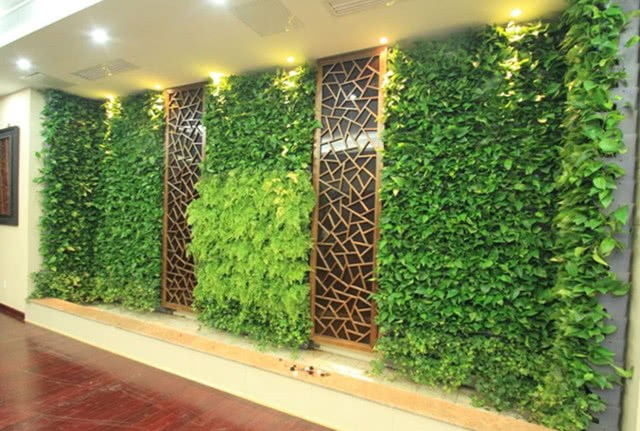
Against the backdrop of increasingly strained ecological conditions, indoor greening has become a trend, and sites are mainly divided by function into office and home. Due to the limitations of indoor spaces, green plant walls have become the best choice for many people. Green plant wall vertical greening uses the self-adaptive ability of plant roots to the growing space, with water and soil as the plant growth medium to achieve plant growth on vertical interfaces. Compared with the traditional greening form of plants growing on flat surfaces, this method is a breakthrough, truly achieving three-dimensional planting of plants on vertical surfaces.
The green plant wall vertical greening system mainly consists of four parts:
1. Unit planting bags for growing plants;
2. A planting frame support system connected to facade walls, partitions, columns, etc.;
3. A drip irrigation system that provides nutrients and water for plant growth;
4. Plant materials.
Depending on the different ways of achieving vertical plant growth, vertical greening includes the natural adsorption type and the auxiliary material type.
I. Natural Adsorption Type Green Plant Wall
This refers to setting planting troughs below the greening wall and planting climbing plants, using their own growth to complete the greening and coverage of the wall. This method is similar to traditional greening methods and is a relatively economical and simple vertical greening method.
II. Auxiliary Material Type Green Plant Wall
Auxiliary material type vertical greening uses structural units to achieve plant growth on vertical surfaces. In indoor environments, the commonly used main technologies can be summarized into three types, namely modular type, hydroponic type and V-shaped trough type.
1. Modular Type
This is the planting method with the strongest landscape composition capability. It consists of modular planting panels and a planting frame. The unit modular panels contain soil and other culture media for growing plants, combined with a drip irrigation system containing nutrient solution to provide all or part of the nutrients and water needed for plant growth on the wall.
Plants are pre-planted in the modular panels and then fixed to the planting frame through hooks, screws, etc. Multiple varieties can be planted to form large-area wall vertical greening, and the planting design can be realized in advance, providing an indoor plant landscape effect with patterned design, a sense of layering and rich species. In terms of plant selection, perennial evergreen ornamental plants with strong coverage and good ornamental value are mainly used.
Advantages: This three-dimensional greening method is quick to construct. Due to the supply of nutrients and water from the drip irrigation system, the sustainable growth effect of plants is good, and later maintenance is extremely easy.
2. V-Shaped Trough Type
It consists of hard V-shaped planting troughs and a planting frame. The V-shaped planting troughs are fixed at intervals on the planting frame and contain a lightweight growing substrate. For plants, perennial evergreen plants with large leaves and slightly taller stems should be selected. Plants are planted directly in the V-shaped troughs and grow diagonally upward. A drip irrigation system can be configured; if planting is carried out on a small scale in an indoor environment, the drip irrigation system may not be configured.
Advantages: This method is simple to construct and low in cost. In terms of indoor maintenance and cleaning, this method has advantages over the other two methods.
3. Hydroponic Type
It can achieve soilless cultivation of plants. It consists of a planting frame, PVC boards, soft plant growth carriers (felt cloth and non-woven fabric bags, etc.) and a drip irrigation system. The planting frame plays the role of the modeling structure and support of the plant wall; the PVC board is used to fix the shape and waterproof the wall; the felt cloth covers the PVC board and contains the substrate for plant growth, providing water and nutrients for plants. The bags are sewn and fixed on the felt and serve as plant planting baskets so that plant roots and stems can be fixed and grow within them; the drip irrigation system adopts a top-down water seepage method. Plant roots absorb the nutrient solution through the felt cloth and bags, achieving soilless growth on the vertical surface.
Advantages: Compared with the modular type, it has the characteristics of light weight, simple construction and being more economical, and is widely used in various small and medium-sized indoor spaces.