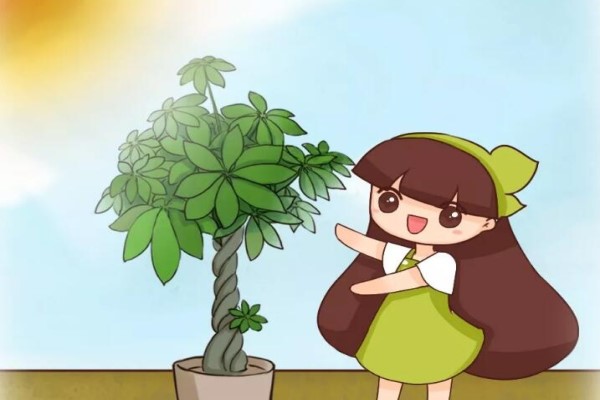
Money Tree and Umbrella Tree leaves dropping like crazy, can they still guard the home and protect your career?
Fiddle-Leaf Fig lacks light, leaves drop like crazy
1. Light
When caring for a Fiddle-Leaf Fig, we need to give it at least 4 hours of natural light every day. If it lacks light, the leaves will be very small, and in serious cases they will turn black and drop.
If it is kept indoors all the time, it is best to use artificial light to supplement it, so that the Fiddle-Leaf Fig can grow healthily.
2. Watering
Starting from late autumn, be careful not to water too much. Only water when you observe the potting soil is dry or feels like it has cracks. If it feels moist, do not water even a drop. Only watering after it dries makes it less likely to cause root rot and death.
3. Ventilation
Be sure to pay attention to ventilation. If ventilation is poor, although the soil surface is dry, water easily accumulates at the bottom of the pot. It is best to place a layer of ceramic balls at the bottom of the pot.
Money Tree watered too much, root rot with no cure
1. Watering
The large Money Trees we buy home are mostly regrown after the seller cuts off the original root system. This kind of root system is not as thick and strong as the original roots and has poor water absorption capacity. If watered too much during care, it will easily rot.
So we must not water too frequently normally. Keep the principle of watering when dry and stopping when wet. If it is hard to control, you can insert a bamboo skewer into the soil. If the skewer comes out fairly wet, don't rush to water. Wait until it is a bit drier before watering.
2. Ventilation
For this kind of large plant, ventilation must be ensured. If the potting soil has accumulated water and the potted plant is in a well-ventilated environment, the water can quickly dissipate with the air circulation, avoiding root rot.
Umbrella Tree without light, leaves keep dropping
1. Light
We should usually place the potted plant in a place with plenty of scattered light. If the plant stays in a dark environment for a long time, not only will it grow poorly, it will also easily drop leaves.
2. Watering
Pay attention to watering. The soil cannot be too moist or too dry. Water as soon as the surface of the potting soil turns white. Keep relatively high moisture during the growing season, and reduce the amount of watering in winter.
3. Ventilation
A good ventilated environment can prevent the occurrence of pests and diseases. For example, the Umbrella Tree at my home had black and sticky leaves some time ago. After a major pruning and giving it a good ventilated environment, it sprouted many new branches in a week!
Monstera watered too much, leaves turn yellow and leaf edges scorch
1. Light
Monstera does not have high light requirements; just avoid strong sunlight. In winter, you can completely place the plant in full sunlight, which is more beneficial to its growth!
2. Watering
For watering, we need to pay attention: water after the soil surface dries, and when watering, water thoroughly. If water accumulates in the potting soil, Monstera leaves easily turn yellow.
If the plant's leaves turn yellow due to overwatering, we should stop watering immediately, cut off the yellow leaves, and place the potted plant in a place with good light and ventilation. Normally, do not water if the soil is not dry.
Elephant's Ear lacks light, grows lanky with small leaves
1. Light
When growing Elephant's Ear, if the light is too strong, the leaves easily wilt and the edges scorch. If the light is weak, the plant grows tall, the stems are thin and weak, and the leaves become thinner and yellow.
We can usually place the potted plant in a place with plenty of scattered light. In winter, when light is weak, full sunlight on a south-facing balcony is best.
2. Watering
Elephant's Ear likes a moist growing environment. During daily care, it cannot lack water. As soon as you see the soil surface dry, water thoroughly immediately. As the weather gradually turns cooler, if the indoor temperature is below 15°C, be careful to reduce the frequency of watering.