Master orchid flowering-period management tips to help you achieve the ideal bloom
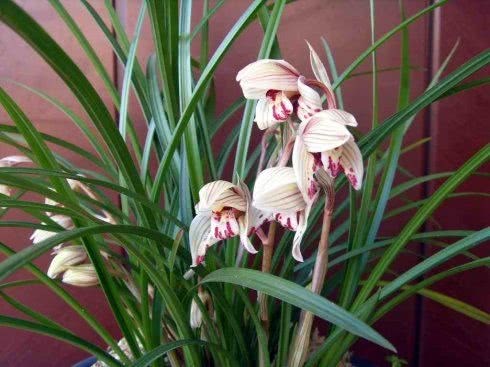
A hundred days of growing orchids, a fleeting moment of enjoying the flowers. The captivating, peerless elegance seen at orchid shows is invariably the product of the grower's daily effort, sweat and devotion. Not to mention the difficulty of obtaining famous varieties and the hardships of care, just consider that from bud initiation to flowering, orchids can take as long as half a year - how could one not treasure them all the more? Therefore, from the emergence of the flower spike to full bloom, management must be carefully controlled and necessary manual adjustments made, otherwise it is hard to achieve upright, graceful, beautiful flowers. Moreover, the same variety, due to improper management of light, temperature and humidity, can produce coarse, inferior flowers at peak bloom, with abnormal spirit, charm and color, or because the flowers remain open too long and consume too many nutrients, affecting the normal development of future leaf buds and flower buds. This involves not only routine cultivation and management techniques, but also a kind of artistic skill.
1. After "Start of Autumn," most orchids begin to form buds. During Start of Autumn, most regions of our country are still in a high-temperature period, with daytime temperatures generally around 32-35 degrees, high temperature and high humidity, unusually muggy, and the orchids suffer greatly. Therefore, orchid growers must also treat shading, ventilation, cooling and heat protection as top priorities. For those with buds emerging from the soil, spray insecticide once or twice to prevent thrips invasion and secure the first checkpoint for normal management later. After orchids form flower spikes, if the plants are weak, diseased, or produce autumn spikes in late autumn, none should be kept. For spikes produced between the old back pseudobulbs, it is best to select and keep only one strong, plump one; if the front pseudobulbs (new pseudobulbs from the previous year) have flowers, it is better to keep the front pseudobulbs' spikes and remove the back pseudobulbs' spikes.
If spikes grow crowded and crooked, or emerge on one side along the pot rim, they are also unsuitable to keep. For precious orchid varieties, after the flower buds emerge from the soil, if there are too many buds, keep the strong ones and remove the rest of the thin, small ones; 2-3 flower buds per pot is appropriate. If there are too many flower buds, it will affect the bloom quality. It will not only make that year's flowers bloom poorly, but also excessively consume the mother plant's nutrients and affect next year's flowering. For ordinary orchids, the flower buds generally do not need to be cut off.
2. After "White Dew," the weather turns cooler, and most new plants have grown. At this time the orchids can receive more sunlight, and a little phosphorus-potassium fertilizer and multi-element organic fertilizer can be added, so that the plants store more nutrients, the buds become plump, and the flowers are full of spirit and fragrance when they bloom. The fragrance of the flowers comes from the plant's carbohydrate substances, and these substances in turn come from elements such as phosphorus and potassium. Therefore, be careful not to apply too much nitrogen in this season's fertilizing; spray and water more phosphorus-potassium fertilizer, which is more conducive to the plants growing sturdy rather than leggy, and also lays a solid foundation for next spring's growth period. For orchids brought indoors to overwinter, the room temperature should be controlled at 5-15°C. If the room temperature is too low, it cannot provide cold protection and warmth. If too high, it will also affect the orchids' dormancy. But for winter-flowering Cymbidium kanran and Cymbidium sinense, the room temperature should be kept slightly higher, but must not exceed 15°C. If the room temperature is too high, the flower stems grow slowly, bud development is poor, and formed buds are prone to shrivel and even die. For the more cold-tolerant Cymbidium goeringii, 3-4 weeks at around 0°C is needed to complete spring dormancy and vernalization, and only then can Cymbidium goeringii bloom well.
Therefore, for Cymbidium goeringii overwintering, controlling the room temperature at 3-8°C is most suitable. Any potted orchid with flower buds should be placed on a stand near a glass window to receive more sunlight; plain-colored flowers can be grown in slightly shadier conditions. For early-blooming varieties of Cymbidium goeringii, once the flower spike shows the "chicken beak," it should not receive much direct sunlight. Cymbidium kanran and Cymbidium sinense are not affected. In late winter and early spring, if indoor temperature and humidity rise sharply and the outside of the pot is covered with droplets of water vapor, ventilation should be strengthened in time. During routine watering, especially avoid letting water droplets intrude into the bracts, otherwise rot is very easily caused. Because winter is dry, spray the whole plant. Especially when in flower, if the air humidity is too low the buds easily drop, so please be careful.
3. Before Cymbidium goeringii and Cymbidium faberi open, keep 1-2 more flower stems; for other types, slightly more is also fine. Before the buds are about to open, according to the height of the flower stem, the "joint" of the three sepals at the spike tip, and the number of leaf clusters and growth vigor in the pot, remove the weak and keep the strong. 4. When moving out of the room, any with flowers should still remain indoors temporarily, and may be moved out only after the "Awakening of Insects" solar term; cover with reed blinds every night to prevent late frost damage. When Cymbidium goeringii opens its spikes and spreads its petals, move it back indoors for display; the room should maintain ventilation and light. If the temperature is not too low, open the vent window at night or leave the door half-closed. For any flowers that show small tight buds, place them under a shade shed during the day and move them to a dew-sheltered place before night, otherwise the petals are prone to wrinkling when they bloom. Flowering Cymbidium faberi is best left under the shade shed overnight only around "Pure Brightness." About one week before "Grain Rain," the flower spike emerges through four or five layers of bracts and rapidly shoots up and lengthens; at this time, if there is rain or prolonged rain, move them to a rain-sheltered place, and cover with blinds promptly after the rain. If exposed to prolonged rain or sunlight, the three sepals are prone to reflexing backward, dropping shoulders, scorched petal edges, spread-apart petals, and faded flower color; plain-colored lips are even more susceptible. To avoid these defects, a herringbone cloth awning must be set up to shield them.
Therefore, friends growing orchids in an orchid room should note that before flowering, temperature and humidity can be increased, but when the flowers are about to open, the humidity should be lowered and controlled at 50-60%. If the substrate is too wet and the air humidity too high, it will promote elongation and floppy curling of the outer three sepals; if water droplets accumulate at the petal tips, the flower stem will bear weight and droop, affecting the flower's spirit and charm. For Cymbidium faberi or other orchids with one stem bearing many flowers, at the small-budding stage, friends without a humidifier can often spray water on the walls and floor or use clean water to moisten cloth curtains, doing everything possible to provide a certain humidity, so as to help the flower stem lengthen and allow the petal bases to tighten, the corners to spread, and the petal width to increase and open fully, with pretty flower color. But when they open, they should also be managed the same as Cymbidium goeringii, so as to obtain the ideal bloom.