Potted pomegranate keeps blooming and fruiting, turning the balcony into a charming landscape
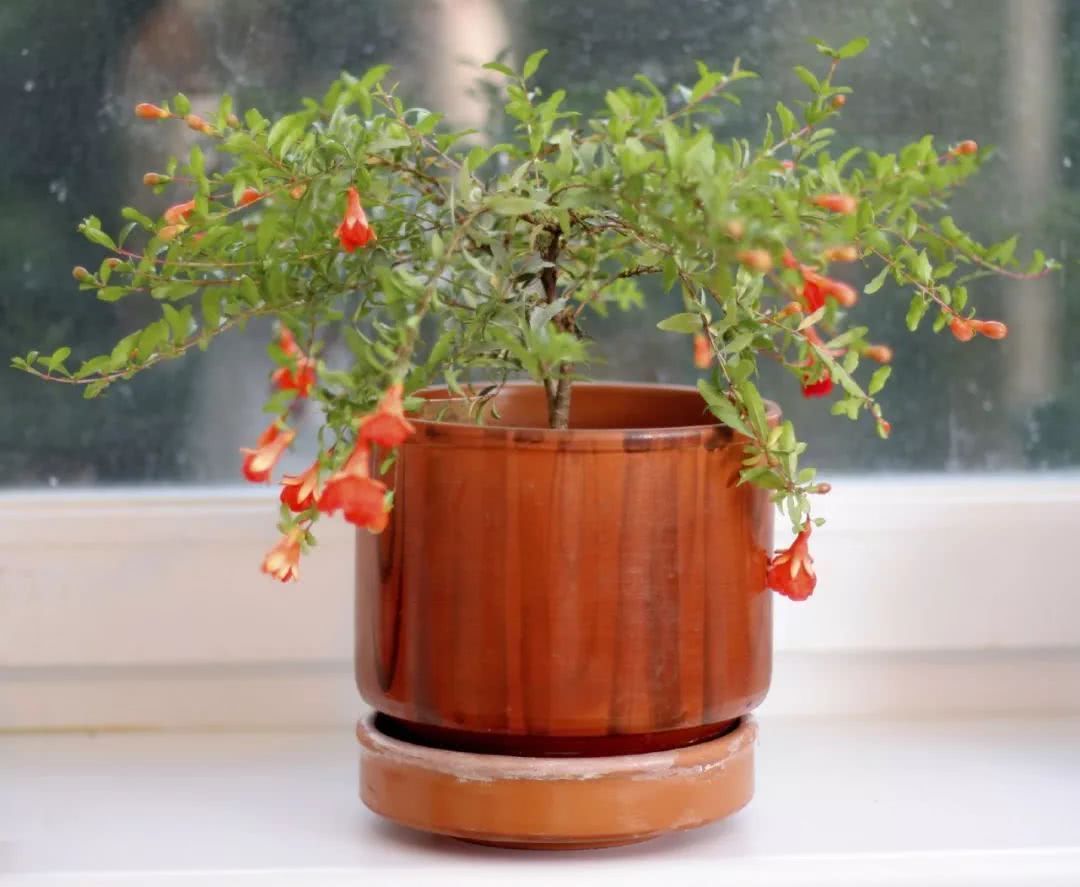
The pomegranate is a very delicious fruit, and it can usually be seen in first- and second-generation gardens. It can serve as a very charming landscape tree, because its flowers are highly ornamental and it also bears fruit, and it comes in abundant varieties. Its flowers are bright red blooms, and there are even varieties grown specifically for their flowers.
The pomegranate differs from other fruit trees in that its root system is very shallow, so a pomegranate planted in a pot can still maintain good growth.
If you want your pomegranate to grow healthily, you need to provide it with a suitable environment. It can grow into a shrub or a tree, reaching up to six meters tall, while in a pot its size can be kept under two meters.
To grow a pomegranate, you should choose a loose, airy, well-draining humus soil or sandy soil. It likes neutral soil, and the growing medium must drain well. Waterlogged soil easily causes root rot.
When growing a pomegranate, it is best to choose a relatively heavy ceramic or clay pot, otherwise it tends to become top-heavy. Drainage must also be good to avoid waterlogged soil.
The pomegranate tree has a very charming appearance, with spear-shaped leaves that carry a bronze-like sheen; once the leaves mature, they turn a fresh green color.
The pomegranate's flowers are bell-shaped, usually bright red, and look very charming. Nowadays we can also see pink, cream and white pomegranate flowers. In fact, what is most charming about the pomegranate is still its fruit. The fruit is usually yellow-brown, red-brown or bright red, with excellent ornamental value, and just looking at it makes your mouth water.
There are many varieties of pomegranate, the most common being Sapphire pomegranate, Giant pomegranate, Dabai Pi pomegranate, Taishan Dahong pomegranate and so on.
Besides pomegranate varieties that bear fruit, there are also some grown specifically for their flowers. They produce brilliant, charming orange or red flowers in summer and autumn, but cannot bear fruit.
A potted pomegranate needs a consistently warm and humid environment. The ideal growing temperature is above 18 degrees, and the minimum growing temperature must be higher than 7 degrees.
You can propagate pomegranate by stem cuttings. This method makes it easier to obtain fruit. Propagating pomegranate by seed can also produce flowers and fruit, but it takes an extremely long time.
Propagating pomegranate from seed is very simple. You can take the seeds directly from a ripe pomegranate fruit, wash them clean, wipe them dry with a paper towel, and dry the seeds in a spot with indirect light.
Once dried, the seeds can be sown directly. The best sowing time is after the warmth of spring arrives. You can bury them shallowly about one centimeter below the soil surface, and you can slip a plastic bag over the seedling pot to keep the soil moist. They will quickly take root and sprout, generally in about 1 to 6 weeks.
I would rather recommend propagating pomegranate by cuttings, as this makes it easy to get flowers and fruit. You can choose a stem section about 12 to 15 centimeters long, remove the lower leaves, make a slanted cut at the base, dip it in a little rooting powder, and insert it into a loose, well-draining sandy soil, keeping the soil moist. It will quickly take root and sprout.
Once the pomegranate's branches have grown to a considerable height, you can prune appropriately to control its shape, and you can also repot it once every 2 to 3 years.
If you want the pomegranate tree to flower and fruit normally, the growing spot must have as much light as possible, with more than eight hours of direct sunlight per day; only then can it flower and fruit. In a spot with insufficient sunlight, it will flower very little, or even not flower at all.
A potted pomegranate tree should be watered regularly to avoid prolonged drought. In spring and summer you can keep the soil moist, while in autumn and winter you should begin to restrict water to avoid the soil becoming too wet.
If you want a potted pomegranate tree to bear fruit, you should also pay attention to regular fertilizing. In spring and summer, generally give it once every two weeks, occasionally giving some organic liquid fertilizer, and you can also add some well-rotted organic fertilizer at the bottom of the pot. This helps promote flowering, but the fertilizer concentration must never be too strong.